
Publications
29 Jun 2026
Europe 2040: Today, Tomorrow, and the Day After
Europe in 2026 stands at an inflection point. The convergence of six structural crises — economic divergence, technological dependence, strategic vulnerability, institutional paralysis, demographic decline, and energy insecurity — means that the trajectory of the continent over the next fifteen years is genuinely uncertain. There is no default path. The future will be made by a series of choices, shocks, and compounding interactions that no single actor fully controls.
Yet uncertainty should not be understood as decline. Rather, it reflects the fact that Europe is entering a period in which multiple futures remain possible. The decisions taken today by governments, institutions, businesses, and societies will determine whether Europe emerges stronger, more fragmented, more autonomous, or increasingly dependent on external powers. In many ways, Europe is being asked to redefine itself at a time when the rules that shaped the post-Cold War era are rapidly being rewritten. This study adopts a scenario-led approach to explore how Europe may evolve by 2040. Instead of attempting to decide on a single future, it examines several plausible pathways that could emerge from the interaction of political, economic, technological, demographic, and geopolitical forces. The scenarios presented in the first chapter are not forecasts; they are tools designed to challenge assumptions, identify risks, and illuminate opportunities.
Building upon these scenarios, the subsequent chapters examine the key drivers that are expected to shape Europe's future, including economic competitiveness, technological sovereignty, energy security, demographic transformations, geopolitical shifts, defence and strategic autonomy, and the evolution of Europe's role in an increasingly multipolar international system. Together, these chapters seek to answer a broader question: not simply what Europe's future will look like, but what kind of Europe will emerge from the choices being made today.
Ultimately, this study is built around a simple premise: Europe's future is not predetermined. It will be negotiated, contested, and continuously reshaped by events both within and beyond its borders. The continent's greatest challenge over the coming years may therefore be learning how to navigate uncertainty itself.

Programmes
22 May 2026
The New Economics of Security: Priced for Permanence in a Fragmented World
Beyond short-term wartime dynamics, the global defence sector is undergoing a significant and far-reaching transformation. The recent increase in military spending, initially framed as a cyclical response to regional conflicts, is increasingly recognized as part of a broader structural repricing of security across global markets. This has also prompted a reassessment of defence firms’ role, shifting their perception from cyclical industrial contractors primarily tied to procurement cycles toward strategic assets embedded within the dynamics of geopolitical fragmentation and sovereign competition.
Consequently, this shift has contributed to the erosion of the post-Cold War peace dividend model, which underpinned global economic integration for more than three decades. In the aftermath of the Soviet Union’s collapse, advanced economies largely embraced the assumption that economic interdependence would mitigate conflict risk, thereby justifying sustained declines in defence expenditure. This assumption underpinned an efficiency-oriented model of globalization, optimized around lean inventories, cost minimization, and geographically dispersed supply chains, while assigning comparatively limited importance to redundancy and strategic industrial depth.
However, by 2026, this model had demonstrated its material vulnerabilities. Security considerations were no longer treated as external to economic policy, but rather embedded within it, as states sought to integrate defence production, industrial capacity, and supply-chain control into a broader framework of national resilience.
Programmes
27 Apr 2026
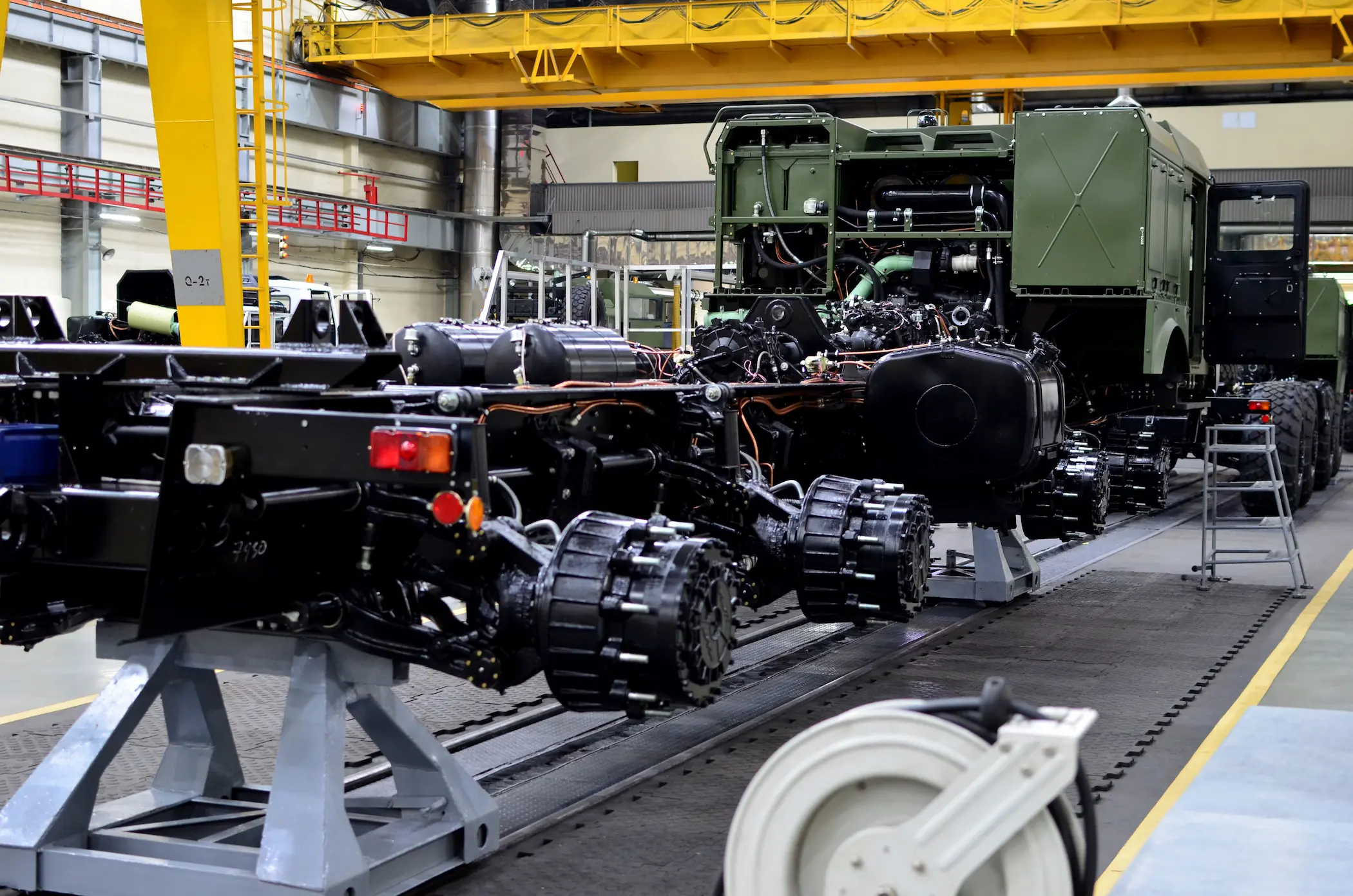
Engines of War: Why the Automotive Sector Is the Fastest to Pivot to Military Production
Modern patterns of armed conflict are shifting from time-limited operations reliant on advanced, low-volume technologies to protracted confrontations driven by industrial attrition and the large-scale deployment of autonomous systems. This transition exposes critical deficiencies in the traditional defence industrial base's production capacity. As munitions stockpiles decline amid ongoing conflicts in Eastern Europe and the Middle East, military assessments increasingly identify manufacturing capability, supply chain resilience, and the speed of industrial mobilisation as decisive factors in strategic competition, alongside technological innovation.
In response to these dynamics, national security institutions are moving to reactivate historically grounded models that integrate the commercial manufacturing sector into military production. This approach was notably deployed during the Second World War, when Ford Motor Company redirected its civilian production lines to manufacture bombers, Chrysler Corporation established dedicated facilities for tank production, and General Motors allocated its industrial capacity to the production of aircraft engines and munitions.
The current operational environment demands a sustained supply of conventional mechanical platforms and expendable systems, including unmanned aerial vehicles and sensor-equipped tactical vehicles. As battlefield requirements increasingly outpace the production capacity of defence manufacturers, the automotive sector emerges as a uniquely positioned industrial base, combining large-scale output with advanced mechanical engineering capabilities. This reality necessitates a focused assessment of the structural and technical attributes that make it the most viable sector for rapid conversion to support military production.

Programmes
5 Jun 2024
Rescheduling: Prioritising Arms over Development on the European Parliament’s Agenda
European Parliament (EP) elections have historically garnered less interest from European voters,* as domestic issues have typically dominated their concerns. Consequently, topics such as defence and security have seldom been central to European election campaigns. However, this situation has changed dramatically in recent sessions. The influx of refugees arriving on European shores and the ominous threat of war looming over the continent have shifted the focus. As a result, Europe now finds itself precariously close to a crisis that threatens to undermine the development and reconstruction efforts of the past seventy years.
Therefore, regional issues began to be politicised and exploited in European Parliament elections as security and defence issues became more urgent. Parties shifted away from discussing the Union's broader policies, focusing instead on these pressing issues, which started to play a significant role in shaping voter preferences. Consequently, these topics became more influential in determining electoral outcomes at various local government levels, ultimately impacting decisions at the level of the European Union (EU).
This analysis examines the positions and attitudes of the main groups within the European Parliament on crucial defence issues facing the EU and how these positions are reflected in the political formulation of their policies.