

Publications
15 May 2026
Hantavirus: Contained Threat or Emerging Pandemic?
On May 2, 2026, a cruise ship in the Atlantic Ocean reported the outbreak of Andes virus, a type of Hantavirus that already existed in the Americas and Europe. Casualties, symptoms, and the spread of the virus renewed global attention surrounding it while bringing back the memories of the initial outbreak of COVID-19.
Since then, it has been linked to how COVID-19 is transmitted between humans, leading to the spread of the pandemic. However, evidence suggests human-to-human transmission is different in both cases; the SARS-CoV-2 virus was transmitted to an average of two or more people within populations that had not previously been exposed. As for the Andes virus, the transmission on the ship happened under very specific conditions of human-to human interaction: the presence of symptomatic individuals in crowded, poorly ventilated spaces with direct and continuous contact. Some experts from the World Health Organisation (WHO) note that the current Hantavirus outbreak on the cruise ship doesn’t qualify as the next “COVID-19” pandemic. Although it signals risks for affected people, it replicates slowly, spreads mainly through close contact, and appears to be most effective when symptoms appear. Nevertheless, other experts warn about the implications of the outbreak of the virus, citing its fatal symptoms and its shift in its traditional method of transmission. This raises a crucial question about whether Hantavirus can realistically become a pandemic.
This paper examines the potential for Hantavirus to evolve into a global pandemic threat by assessing its biological characteristics, transmission patterns, mortality rates, as well as its current global situation, including geographic distribution. It also assesses whether Hantavirus meets the established criteria for a pandemic, including sustained human-to human transmission, international spread potential, asymptomatic transmission, urban transmission, and containment challenges. In addition, the paper explores potential future trajectories for Hantavirus outbreaks by analysing scenarios ranging from continued local outbreaks to expanded regional transmission, as well as the low-probability but potentially high-impact pandemic driven by mutations. The report also addresses policy implications, early warning indicators, and lessons learned from the COVID-19 pandemic to assess gaps in preparedness and response capacity.
Methodologically, this paper adopts both qualitative and quantitative approaches that rely primarily on primary data/numbers and secondary sources. It draws on reports and data from international health organizations, such as the WHO, statistical facts, along with peer-reviewed academic literature, epidemiological studies, and expert analyses. The study also employs a comparative analysis of Hantavirus and COVID-19 to identify similarities and differences in defined indicators, such as transmissibility, mortality rates, and pandemic capability. Furthermore, the paper utilises scenario-building and risk assessment methods to evaluate potential future outbreak trajectories and preparedness indicators as well as challenges.
Publications
10 Jul 2025
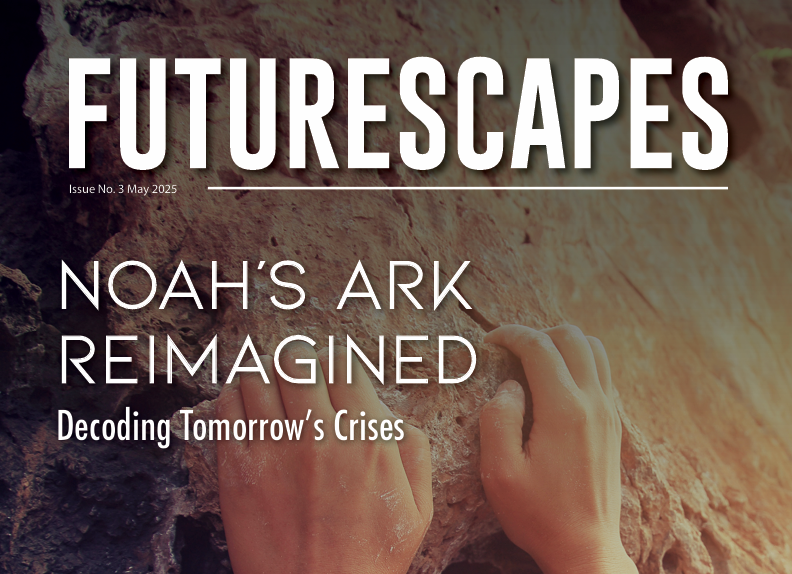
Futurescapes Issue 3 – Noah’s Ark Reimagined: Decoding Tomorrow’s Crises
In an era marked by rapid transformations and mounting threats, it is no longer sufficient to merely bear witness to disasters after they unfold. The imperative now is to cultivate anticipatory vision and to act decisively before the alarm is sounded. It is against this backdrop that the Al Habtoor Research Centre presents this edition of Futurescapes, titled Noah’s Ark, as both an early warning signal and a call for preparedness before time runs out.
The choice of the title Noah’s Ark is far from arbitrary. Just as the ark once symbolised salvation amid an all-encompassing flood, this publication aspires to serve as a vessel of knowledge—an intellectual ark—that carries within it an early awareness of looming risks and a strategic foresight capable of confronting them and adapting accordingly. This edition is a deliberate effort to transcend reactive responses and instead foster a proactive culture rooted in anticipatory planning and resilience-building.
This work forms part of a broader series of periodic reports issued by the Al Habtoor Research Centre, an independent Arab think tank committed to a forward-looking approach. The Centre places strategic emphasis on early warning mechanisms and the anticipation of major threats that may affect the Arab world—whether stemming from natural phenomena, political and technological developments, or the evolving dynamics of regional and global conflict.
In this issue, we undertake an unconventional intellectual journey, wherein we shed light on categories of threats that have not received sufficient attention from think tanks across the Arab world, despite the fact that they carry genuine existential risks. Our analysis does not confine itself to the commonly addressed domains of security and political threats; rather, it ventures further to explore issues that rarely find their way onto the Arab research agenda.
Among these are volcanic eruptions, asteroids, solar storms, and threats emerging from outer space—phenomena that could pose serious dangers to life on Earth in general, and to the Arab region in particular. We also examine nuclear risks, whether arising from warfare, radioactive leakage incidents, or potential scenarios involving cyberattacks on nuclear facilities.
Moreover, this issue addresses pandemics and global outbreaks—not solely from the perspective of disease transmission, but in terms of their structural impacts on economies and societies, as well as their linkages to transformations in the global order.
This publication does not claim to possess definitive answers; rather, it aspires to serve as a first step toward cultivating a collective awareness that is more attuned to risk and more capable of strategic preparedness. Knowledge, when acquired early, becomes a form of power. And foresight, when exercised with precision, becomes a tool for salvation.
We present this work at a critical juncture, with the hope that it will contribute to opening new windows for dialogue and planning and that it may serve as an entry point for broader Arab cooperation in the realms of risk monitoring and the development of effective early warning systems.
The information presented in this publication reflects the situation as of May 2025. Please note that developments may occur rapidly, which could render some of the details outdated or no longer current since that date.