

Programmes
22 Sep 2026
The New Space Economy: How Space Is Becoming the Next Strategic Frontier
The next great economic frontier may not be on Earth. Space is increasingly becoming more crowded, more commercial, and more strategically important, as governments and companies compete to control the infrastructure that supports communications, navigation, finance, climate monitoring, defence, and the next generation of digital services. The shift is not simply about returning to the Moon or reaching Mars. It is about the gradual transformation of orbit into an extension of the global economy, with consequences for national power, technological dependence, and international governance.
The scale of this transformation is already visible. Public investment remains the foundation of the sector, while private firms increasingly provide launch services, satellite communications, Earth observation, and data analytics. At the same time, the boundary between civilian and military space activity is becoming harder to define. Satellites that support agriculture, logistics, or emergency response may also support intelligence, targeting, secure communications, or military navigation. As space infrastructure becomes essential to life on Earth, access to orbit is becoming a question of economic resilience and strategic autonomy.

Programmes
10 Sep 2026
Orbital Data Centres and the Limits of National Jurisdiction over Technology Firms
The largest technology firms are moving their data centres into low Earth orbit, having pushed terrestrial infrastructure to the physical and environmental limits of what it can supply in power, cooling and land to an artificial intelligence sector whose demands keep compounding. SpaceX has set the fourth quarter of 2027 for the launch of its first generation of computing satellites, targeting one gigawatt of orbital data centre power capacity in that same year and one hundred gigawatts by 2030. The scale of the pressure behind that schedule is visible in the wider market, where global data centre demand is estimated to require investment approaching €5.7 trillion before the decade closes.
What presents itself as an engineering migration is in substance a redistribution of sovereign authority. Moving processing beyond national territory removes technology firms from the reach of the data localisation rules, compliance regimes and tax frameworks that states have spent a decade constructing. For Arab states the challenge is immediate. Having invested heavily in domestic digital infrastructure and imposed strict data residency requirements, they now face the prospect that the server handling their citizens’ data sits five hundred kilometres overhead, beyond the enforcement reach of their courts.
This analysis therefore examines the economics of moving computation into orbit and the limits of its viability; traces the legal gap that allows technology firms to shelter behind the jurisdiction of the state of registry in order to avoid the laws of every other state; assesses the risks of monopolistic concentration and the environmental costs borne collectively; and identifies the regulatory instruments available to Arab states in defence of their digital sovereignty, chief among them the management of radio-frequency spectrum, satellite landing rights and the supervision of ground gateways.
Programmes
3 Aug 2026
The Economics of Reusable Launch Vehicles and the Competition over Low Earth Orbit
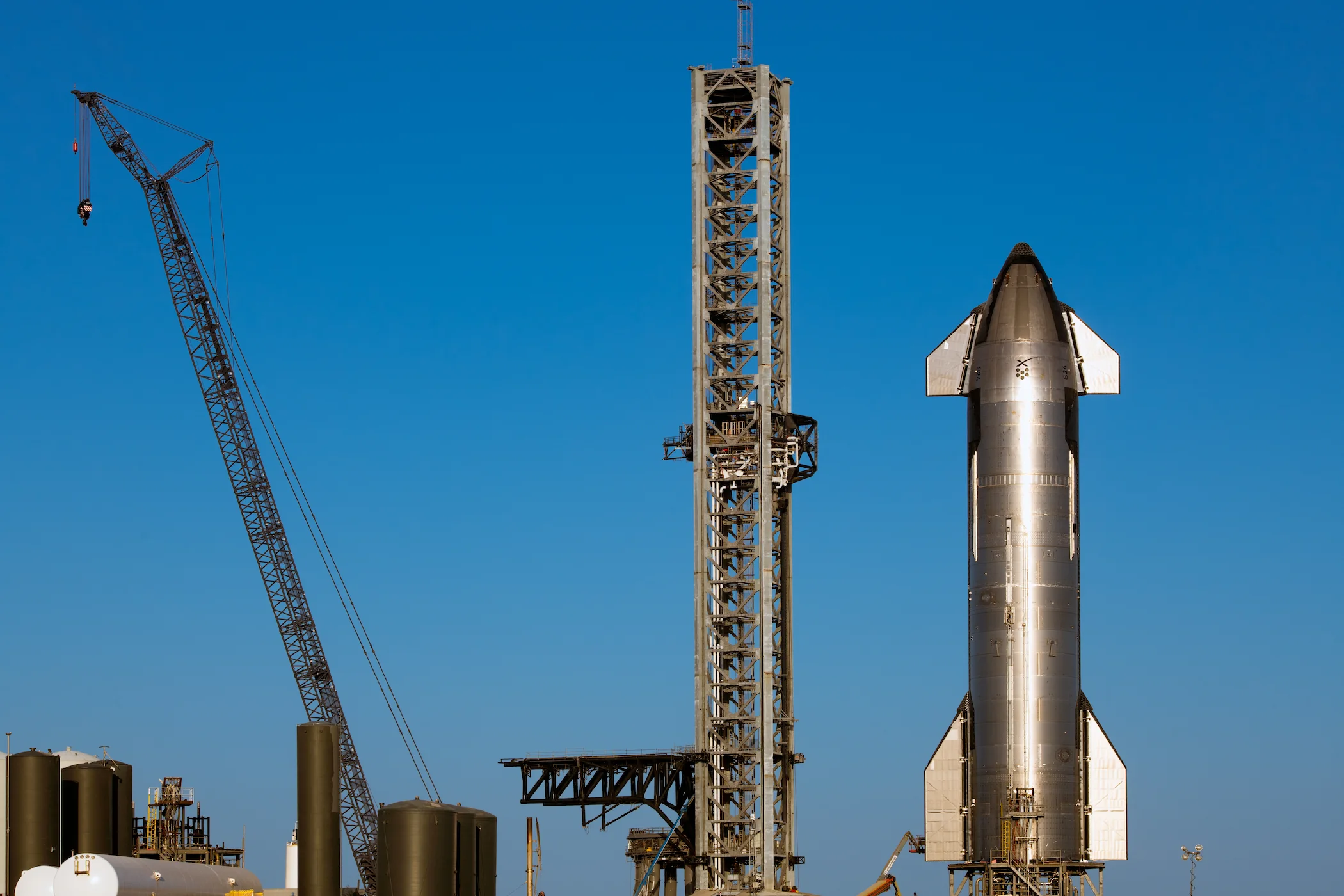
Access to low Earth orbit has undergone a structural transformation over the past fifteen years, shifting from a sovereign undertaking financed by the budgets of major states into a logistics service bought and sold by the kilogram. The global space economy reached roughly $626 billion in 2025, with commercial activity accounting for close to 78% of that total, and projections place it between $1 trillion and $1.8 trillion by 2035 — even though launch services on their own amount to no more than $14 billion. That disparity points to a basic truth: launch is not the market being contested. It is the gateway whose price determines the nature and the scale of everything that can be built beyond the atmosphere.
This structural shift rests on a single pivotal engineering innovation: recovering the first stage of the rocket and flying it again rather than discarding it after every mission. Recovery allows the capital cost of manufacturing to be distributed across multiple flights, and it demolished the price floor that had governed the market for decades. The consequence has been to narrow the technological contest over low-orbit reusability to two principal powers: the United States, which operates a mature fleet flying at an intensive and near-routine cadence, and China, which since mid-2024 has been conducting an accelerated, high-risk test campaign in pursuit of the same capability. The threshold of reaching orbit has therefore ceased to function as the technological dividing line between the two; the real remaining challenge lies in mastering precision guidance through the final metres before a safe landing.
Therefore, this analysis aims to unpack the economics of reusability and locate the true bottleneck within the cost structure; to then measure the gap between Washington and Beijing through two distinct indicators, namely the number of launches and the mass delivered to orbit; and finally to estimate the technical and temporal distance separating China from its first successful recovery, together with what its completion would mean for global launch pricing and for the budgets of the megaconstellations on which satellite internet services depend.

Programmes
10 Feb 2026
Digitising the Space Economy: Who Will Hold Sovereignty as the Shift from Hardware to Software Accelerates?
The global space economy is currently undergoing a profound structural transformation. Whereas the sector has historically been characterised by its heavy reliance on rocket propulsion capabilities and the vast capital investments required to deploy physical hardware into orbit, the focus is now shifting toward an economic model in which value creation is increasingly decoupled from material mass.
In this context, the contours of what may be described as a “software-defined space economy” are becoming increasingly evident. This shift is driven by the convergence of two core digital infrastructures: digital twins and space-based edge computing. At the same time, declining launch costs, resulting from advances in reusable launch vehicles, have shifted the primary determinant of economic efficiency. Rather than centring on mere access to space, value is now anchored in the operational efficiency of on-orbit assets, their embedded intelligence, and the length of their functional lifespan.
This paper argues that the sector’s future economic value—estimated to reach USD 1.8 trillion by 2035—will not be realised solely through an increase in the number of satellites launched, but rather through the digitisation of their life cycles and the processing of data at the source.
This analysis provides a comprehensive economic deconstruction of these technologies. It examines how “virtual modelling” is reshaping cost structures in space manufacturing, enabling companies such as Varda Space Industries and SpaceX to accelerate development cycles at software speed. It also highlights the roles of artificial intelligence and the Internet of Things (IoT) in establishing space systems capable of autonomous fault processing, thereby maximising returns by extending assets’ operational lifetimes. The analysis concludes by linking gains in operational efficiency to the sector’s overall growth, demonstrating how digital infrastructure forms the material foundation for emerging in-space manufacturing (ISM) markets and next-generation Earth observation services.