

Since Brexit, the United Kingdom (UK) has been experiencing a governance issue, as the Conservative Party suffered from instability due to numerous leadership changes, while the recently elected Labour Party lacks the ambition and confidence needed to effectively govern. Combined with the shocks stemming from Brexit, COVID-19, and the Russia-Ukraine War, the UK has experienced economic stagnation and the deterioration of public services, which has resulted in British nationals migrating abroad.
One of these locations is the UAE, more specifically, Dubai. There are approximately 240,000 British nationals currently living in Dubai, with more to join as there was a 420% increase in internet searches in the UK centered on moving to Dubai. Those are staggering statistics, and the number is only going to grow as more British nationals across the socio-economic spectrum continue to migrate to Dubai. However, the reasons explaining British migration to Dubai are not as simple as lower taxes, security, and great weather. One can argue the rise of British migration to Dubai can be attributed to a desire to break from a ridged class system, declinism, and emotional turmoil brought on by the cost-of-living crisis.
Migration in Numbers-Who is Leaving the UK?
There is a net loss in the number of British nationals immigrating to the UK as a result of these economic and social pressures. The number of British nationals immigrating to the UK reached 143,000, while the number of British nationals emigrating from the UK reached 252,000 in the year ending June 2025. This means that there has been a decline of 109,000 British nationals moving to the UK. This can be considered an indicator that British nationals are discontent with life in the UK and are opting to move their lives abroad. As of 2025, there are approximately 5.5 million British nationals living outside of the UK. It should be noted that the largest group of British nationals emigrating from the UK are individuals between the ages of 16-34, which could be due to a sharp rise in youth unemployment in the UK, which was 15.3% among youths in the age group of 16-24.
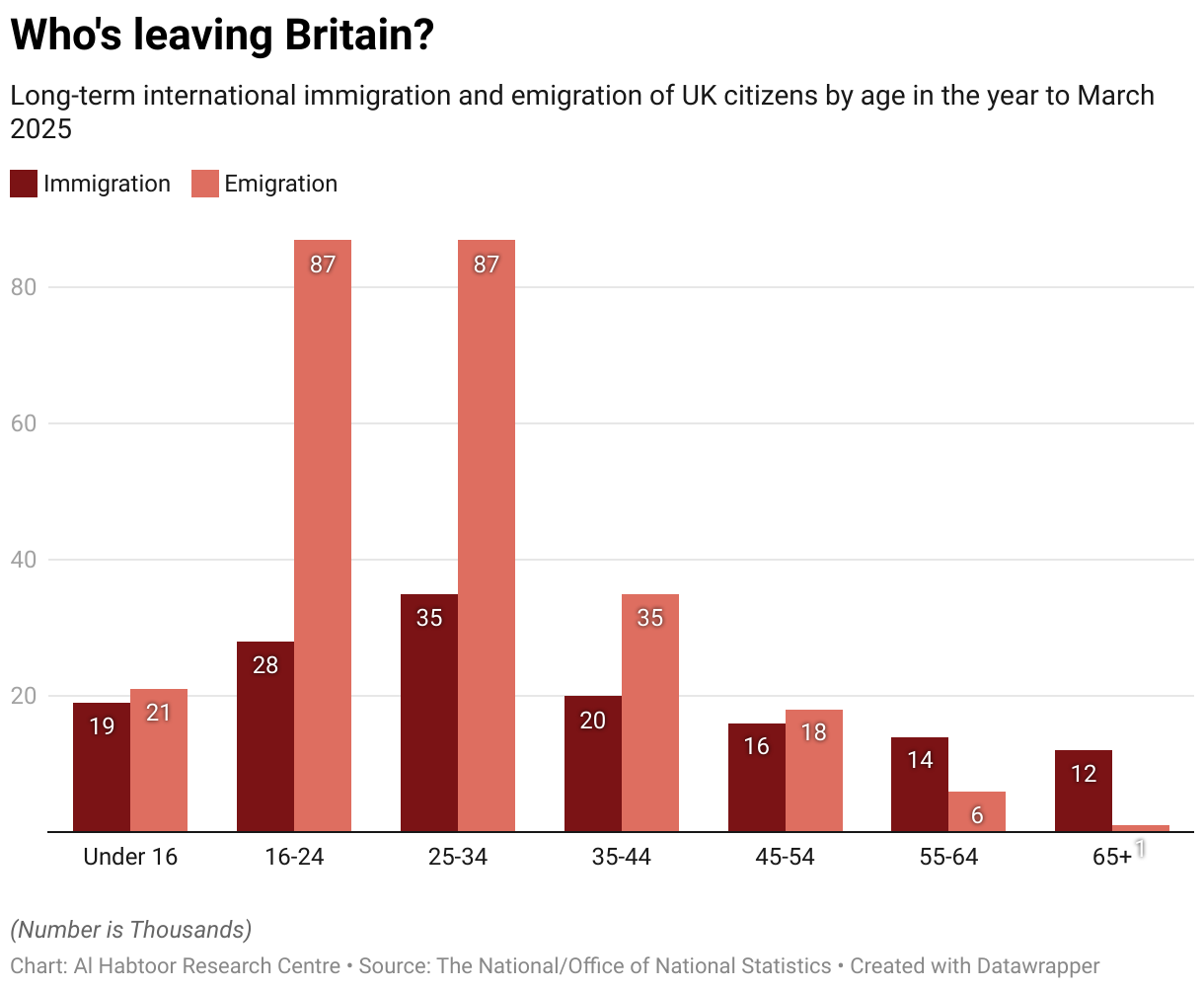
In 2025 the estimated total of British nationals residing in Dubai is 240,000, a significant increase from 2010 when the population was approximately 100,000. Moreover, there has been an increase in economic migration, as the number of British businesses in Dubai has increased to 5,000 and is expected to grow to about 15,000 by 2035.


Class as a Roadblock to Social Mobility
On the surface, the reasons why British people are migrating to Dubai do appear to be straightforward: low taxes, strong economic environment, and efficent provision of public services. However, the desire to migrate to Dubai runs deeper than taxes and government efficiency, as the issue of class has a deep hold over British society. According to YouGov, 48% of all British nationals believe that class matters to a degree, while 84% believe that class is determined by the type of job one has. Naturally, the focus on class in British society has contributed to a stagnation in social mobility of which the UK is considered one of the worst countries when it comes to individuals moving up the social hierarchy. A 2010 report by the Organization for Economic Cooperation and Development mentions how the UK has a poor track record when it comes to social mobility and notes that this is in part due to better education and salary being attributed to high class and generational wealth. Due to this slowing in social mobility, it is not surprising that younger British nationals feel that they are doomed to remain stagnant in the social hierarchy of British society.

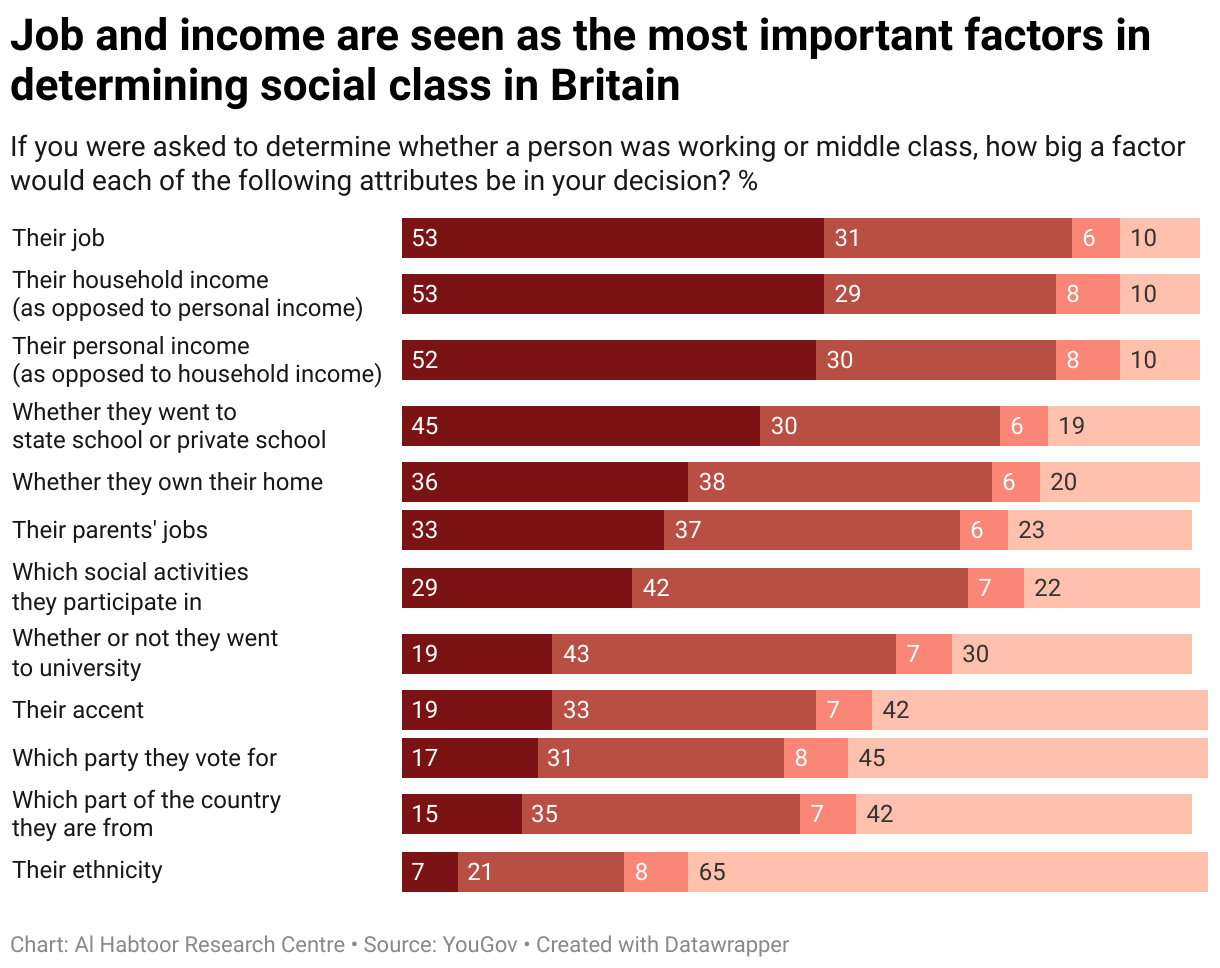
The slowing in social mobility caused by the strong (though divided) belief in class structure combined with generational wealth has contributed to a widening in the gap between social classes. 79% of all adults in the UK believe that there is a large gap between social classes, with 80% of adults aged between 25 and 49 also believing that this gap exists. This gap continues to widen as high value individuals or individuals from privileged backgrounds are more likely to end up with higher salaries and live in more prosperous areas. This is clear as a “A study of 8,118 professionals and higher-level managers found that those who came from a prosperous background were much more likely to move around the UK, and ended up in richer areas when they did move, than those with working-class parents.” A consequence of this is that individuals from working class backgrounds find it difficult to move to such areas of opportunities, thus widening the gap between classes.

The ridged class system that has been the fabric of British society has contributed to slowed social mobility, which in turn leaves British nationals unable to move up the social and corporate pyramids, which forces them to remain in place unable to experience any meaningful progress. It should be noted that Dubai also has a class system in place. However, the class system in Dubai is fluid and allows for greater levels of social mobility due to economic factors such as work performance and faster career progression. Dubai does not only provide opportunities for employment but also long-term opportunities for career growth. Therefore, the assumption can be made that the promise of long-term career progression and economic opportunities offered by the UAE can be a gateway for British expats to move up the social hierarchy in a rapid pace in comparison to the UK, where there is a stagnation in social mobility.
Declinist State of Mind-The Emotion Factor Behind Migration
While the ridged class system of British society can be a contributing factor behind the mass migration of British nationals to Dubai, there is an argument to be made focusing on the emotional factors behind British migration. To explain how the emotional state of British nationals contributes to their move to Dubai, one must focus on two factors, UK declinist mentality and the emotional impact of the cost-of-living crisis.
The UK national mood has been rocked by anxiety and feelings of decline in recent years. Approximately two-thirds of the British population believes that the country is in a consistent state of decline. Declinism is not a new concept in Britian, however, it can be argued that a major aspect of British declinism today is the Brexit referendum. Brexit played a major role in modern British declinism as Brexit has led to the slowing of growth opportunities, while limiting the UK’s influence in the world, more specifically Europe. Declinism resulting from Brexit can also be explained through the false promises of economic prosperity and a united UK. This is clear as Brexit did not fix the UK economy and increased the levels toxicity in British politics and society, which contributed to the increase of a declinist mentality among remain voters. The declinist mentality brought on by Brexit no doubt impacts the emotional state of mind of the average British citizen, which therefore serves as a contributing factor in the increase of British emigration abroad.

Beyond declinism, there is also the emotional impact the persisting cost-of-living crisis has on British nationals. The cost-of-living crisis brought on by the COVID-19 pandemic, Russian-Ukraine War, and political instability has had a significant impact on emotional health in the UK. According to a Sapiens Lab poll, 35% of British people from disadvantaged backgrounds have feelings of distress and anxiety, while individuals aged 18-24 have experienced a severe decline in mental health due to economic troubles. Furthermore, the convergence of numerous ongoing crises, including the cost-of-living crisis, has contributed significantly to the rise of emotional health struggles throughout the UK. The increase in the number of crises in the UK has contributed to increased feelings of exhaustion, survivalist mentality, and loss of agency among British nationals. These sentiments also felt in the UK workforce, as workers also experienced high levels of distress and anxiety in their jobs. This is clear as workers in the UK have experienced an increase in pessimism and disengagement with their jobs due to disruptions brought on by political upheaval as well as the cost-of-living crisis.

These feelings reflect an emotional fatigue stemming from a lack of economic prosperity and the increase in the cost-of-living, which contributes to the concept of British nationals migrating abroad to escape the perceived state of despair afflicting the UK.
While the declinist mentality combined with emotional turmoil have become common place for the UK citizenry, the same cannot be said about Dubai. The emirate has often portrayed itself as a forward thinking and optimisitic place that plans for the future. Dubai is known for initiating futurist projects designed to encourage economic and social optimisim. An example is the Dubai Future Forum, where individuals from all over the world come together to enable “…the global community to keep pace with rapid changes while highlighting new opportunities. The forum’s outcomes will guide governments, societies, and institutions worldwide as they plan their futures.” The language of future optimisim of Dubai is a stark contrast to the declinist language of the UK, and can be considered to be a driving force behind British migration to Dubai. The lanuage of futurism and optimism is echoed by British expat Emma Goode (digital marketeer), who mentions “From here, you can see how globally connected and future-facing everything is,”. It is clear that British expats in Dubai are optimisitc of their futures, which could encourage increased migration to the emirate by UK nationals.
Conclusions
The rationale behind British migration to Dubai is to leave behind a ridged class system that limits opportunities for social mobility and emotional exhaustion brought on by a national declinist mentality and a cost-of-living crisis. The ridged UK social structure contributed to the stagnation of social mobility, resulting in limited opportunities for economic growth, while the declinist mentality and emotional distress caused by the cost-of-living crisis has contributed to the decline emotional health. Dubai’s popularity among British nationals can be attributed to a fluid social hiearchy that provides opportunities for individuals to experience rapid social mobility, while also implementing an optimistic futurist approach toward governance and economy. British nationals are unlikely to return to the UK unless impactful changes are implemented to improve social mobility and the national mood. Until this can be done, the British government should expect more people to migrate abroad.
References
Ahmed, Ashfaq. 2024. “Dubai Remains Resolutely Optimistic about the Future, Says Hamdan Bin Mohammed.” Gulf News. November 19, 2024. https://gulfnews.com/uae/science/dubai-remains-resolutely-optimistic-about-the-future-says-hamdan-bin-mohammed-1.104703950.
Al Oraimi, S. Z. 2020. “Diversity and Social Cohesion in the United Arab Emirates.” RUDN Journal of Sociology 20 (4): 837–46. https://doi.org/10.22363/2313-2272-2020-20-4-837-846.
Difford, Dylan. 2024. “How Do Britons Define Social Class?” Yougov.co.uk. YouGov. December 12, 2024. https://yougov.co.uk/society/articles/51105-how-do-britons-define-social-class.
Edgerton, David. 2022. “Yes, We’re in a Bad Way. But to Wallow in Myths of British ‘Declinism’ Won’t Help Us Thrive.” The Guardian, June 12, 2022. https://www.theguardian.com/commentisfree/2022/jun/12/yes-were-in-a-bad-way-but-to-wallow-in-myths-of-british-declinism-wont-help-us-thrive.
Gillett, Katy, and Nick Webster. 2025. “‘Land of Opportunity and Convenience’: British Residents on Life in the UAE.” The National. November 25, 2025. https://www.thenationalnews.com/news/uae/2025/11/25/land-of-opportunity-and-convenience-british-residents-on-life-in-the-uae/.
Jassem, Fadah . 2025. “UK vs UAE: Why More People Are Rethinking Where Their Future Lies.” The National. November 25, 2025. https://www.thenationalnews.com/news/2025/11/25/uk-vs-uae-why-more-people-are-rethinking-where-their-future-lies/.
MEA Markets. 2025. “British Businesses Migrating to UAE Set to Triple in a Decade.” MEA Markets. July 9, 2025. https://meamarkets.digital/british-businesses-migrating-to-uae-set-to-triple-in-a-decademidd.
PA News Agency. 2025. “Net Migration to the UK: Key Numbers and Trends.” Exmouth Journal. November 27, 2025. https://www.exmouthjournal.co.uk/news/national/25655926.net-migration-uk-key-numbers-trends/.
Roberts, Tracey. 2025. “Where Are UK Citizens Relocating in 2025 – U.K.ABROAD.” U.K.ABROAD. November 25, 2025. https://www.ukabroad.net/where-are-uk-citizens-relocating-in-2025-a-global-ranking-of-top-destinations-for-british-expats/.
Robson, David. 2016. “How Important Is Social Class in Britain Today?” Bbc.com. BBC Future. April 7, 2016. https://www.bbc.com/future/article/20160406-how-much-does-social-class-matter-in-britain-today.
Rosseinsky, Katie. 2025. “Brits Are Moving to Dubai for the Glossy Lifestyle, but Is It All It’s Cracked up to Be?” The Independent. August 31, 2025. https://www.independent.co.uk/life-style/dubai-british-expats-uk-move-uae-lifestyle-b2815094.html.
Siyech, Mohammed Sinan. 2024. “Understanding British Migration to the UAE.” Middle East Monitor. July 15, 2024. https://www.middleeastmonitor.com/20240715-understanding-british-migration-to-the-uae/.
Smith, Jayne. 2023. “Angry, Stressed and Worried. The Utter State of the UK Workforce in 2023 – Workplace Insight.” Workplace Insight. November 7, 2023. https://workplaceinsight.net/angry-stressed-and-worried-the-utter-state-of-the-uk-workforce-in-2023/.
Smith, Matthew. 2024. “In Most Ways, Most Britons Think the UK Is Worse Now than It Was in 2010 | YouGov.” Yougov.co.uk. June 6, 2024. https://yougov.co.uk/politics/articles/49596-in-most-ways-most-britons-think-the-uk-is-worse-now-than-it-was-in-2010.
Social Mobility Commission. 2021. “Social Mobility Barometer – Public Attitudes to Social Mobility in the UK.” GOV.UK. March 11, 2021. https://www.gov.uk/government/publications/social-mobility-barometer-2021/social-mobility-barometer-public-attitudes-to-social-mobility-in-the-uk.
Tahir, Tariq. 2025. “Gen Z Leads Departure of British Workers to Dubai.” The National. November 27, 2025. https://www.thenationalnews.com/news/uk/2025/11/27/gen-z-leads-an-exodus-of-british-workers-to-dubai/.
Tapper, James. 2022. “Income Not Enough to Break British Class Barriers, Research Finds.” The Guardian. September 11, 2022. https://www.theguardian.com/society/2022/sep/11/income-not-enough-to-break-british-class-barriers-research-finds.
The Economist. 2021. “Declinism Is Booming in Britain.” The Economist. January 7, 2021. https://www.economist.com/britain/2021/01/07/declinism-is-booming-in-britain.
Thorp, James. 2022. “Little England or Global Britain? The Declinist State of Mind – Britain’s World.” Council on Geostrategy. January 5, 2022. https://www.geostrategy.org.uk/britains-world/little-england-or-global-britain-the-declinist-state-of-mind/.
Times of India. 2024. “The UK Is the World’s Second-Most Miserable Country, as per Research.” Times of India Travel. March 10, 2024. https://timesofindia.indiatimes.com/travel/travel-news/the-uk-is-the-worlds-second-most-miserable-country-as-per-research/articleshow/108353995.cms.
Tryl, Luke, Anouschka Rajah, Ed Hodgson, and Sophie Stowers. 2025. “Shattered Britain.” United Kingdom: More in Common.


Migrants Not Welcome: The UK’s Safety of Rwanda Bill

Migration: An Everlasting Variable in European Politics?

Clean Commitments, Clean Data Centres?

Orbital Data Centres and the Limits of National Jurisdiction over Technology Firms

Trump’s Prize: How the July 2026 Tariff Package Installed the Middle East as a Global Manufacturing Hub

Comments