

The 2024 General Election in the United Kingdom saw history being made, as the Labour Party under the direction of Sir Keir Starmer scored a landslide victory over the Conservative Party. Despite this landslide victory and the promise of significant change following years of Conservative Party turmoil, the Premiership of Starmer has not been smooth. Prime Minister Starmer’s term has been littered with major policy U-turns, political scandal, and an increase in support for populist movements. Naturally, this has contributed to a loss in confidence in Starmer’s government and leadership abilities, with many in the House of Commons and the British public questioning the government’s judgment, confidence, and competence.
To add insult to injury, the Labour Party lost the Gorton and Denton byelection (a seat held by the Labour Party for 100 years) and is still suffering from the Mandelson scandal, which further contributed to further loss of trust in the system. As the local elections are fast approaching and Starmer’s approval continues to plummet, the question remains: will a loss in these local elections be the final nail in the coffin for the Labour Party and Starmer?
Possible Coalition Collapse
One thing to look out for in understanding whether these elections will be the final nail in the coffin for the Labour Party is whether the Labour voter coalition will collapse. To understand this impending collapse, it is important to understand who makes up this coalition and its fragility. The Labour voter coalition that helped the party can be divided up into four distinct groups: traditional southern constituencies, the red wall, urban areas (big cities) with multicultural background, and university towns. About the southern constituencies, working and middle-class individuals predominantly make up the voter base and have voted for Labour under the presumption that Labour will reduce housing expenses as well as rent. In combination with traditional southern areas, the coalition is made up of “Red Wall” voters made up of individuals from the Midlands and the North (traditional Labour areas) who also are working and middle-class and have been more focused on issues revolving around heating, pensions, and disabilities.
Beyond the traditional voting areas, there are also the voters from urban cities as well as university towns. These voters tend to voter more center-of-left or left-wing due to a more multicultural background as well as being home to a large young population. This is clear as the 2024 General Election resulted in Labour winning in big cities across the UK, as well as performing better in inner city areas. In relation to university towns, students largely voted for the Labour Party as a YouGov poll analyzing the 2024 election mentioned 40% of individuals who identified as students voted for Labour. This can be attributed to the Labour Party campaign in 2024 focusing on major issues concerning university-level students such as the cost-of-living crisis, the NHS, education and student funding.

It is predominantly through campaigning on solving the issues these four groups are facing that the Labour Party was able to build a coalition of voters to successfully combat the failures of the Conservative Party in 2024. However, due to the failure of Prime Minister Starmer to uphold these promises through U-turns that the coalitions cracks are beginning to show.
A possible outcome of this election is the fragmentation of the Labour Party voter coalition, which could signal a collapse of support for the Labour Party and Starmer. This potential collapse in support or the Labour Party can come from the belief that there is a lack of progress in solving the multitude of policy issues. According to More in Common, the number one issue that is turning Labour voters away from the party is their inability to mitigate the cost-of-living crisis, followed by the Starmer government’s many U-turns on major policy promises, the failure to adequately control immigration, failure to improve the state of the NHS, and cuts to winter fuel allowances. The failure to address the core policy issues facing the voter coalition can result in the fragmentation of Labour Party support and potentially see disenfranchised coalition voters shift their support to other parties.

The potential fragmentation and collapse of the Labour voter coalition can be examined through the coalition groups that brought Labour into power in 2024. It is possible on a local level; these voter groups can shift their vote either to the right with Reform UK or to the left with the Green Party. This shift from Labour to Reform UK or Green Party is reflected in the fact that voters, especially from progressive and traditional backgrounds, feel as though the “…economy doesn’t work for working people…” and the Labour Party is not doing much to alleviate the economic and social burdens on society, which contributes to a shift to the populist polices of Reform UK and the Green Party. Furthermore, when it comes to voters from an urban background, Labour is set to lose councils in big cities to leftists and independents. This can be attributed to people in these councils, predominantly from Muslim backgrounds, voting for independents focused on issues such as Palestine and decolonization, which could see the Labour Party lose councils in cities such as Birmingham. Therefore, the failure to reduce social and economic burdens can contribute to the fracture of the Labour voter coalition among traditional, leftist, and big city voters, which could contribute to a failed election bid being the final nail in the Labour Party’s legitimacy.
Reform UK and Green Party rising as Credible Alternatives:
As the Labour voter coalition can potentially fracture from this election, the left-right split can give credibility to alternative parties, which can fracture the structure and legitimacy of the Labour Party. Currently, the Labour Party is projected to lose 1,900 council seats in this election, while the Conservative Party is also projected to lose 1,010 council seats. On the other hand, Reform UK is projected to win 2,260 seats while the Green Party is project to win 450. This signals a political realignment on the local level and speaks to the failures of the traditional parties, and to the potential credibility of traditional party alternatives such as Reform UK as well as the Green Party.
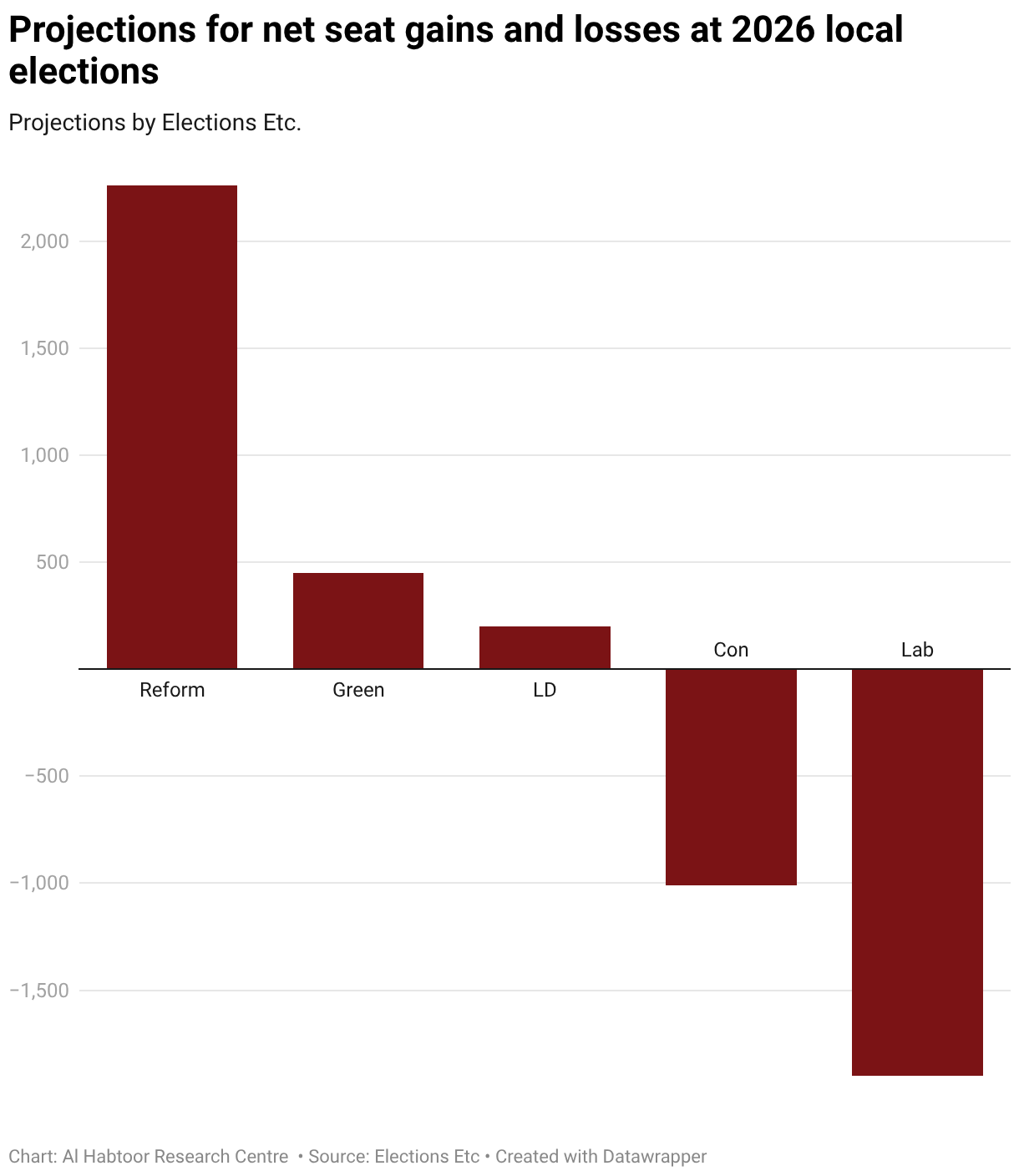
In terms of the immediate threat to the legitimacy and stability of the Labour Party, Reform UK is most likely to rise as a successful alternative to the traditional system. It is possible that Reform UK can poach disillusioned voters away from the Labour Party, as they provide a platform focused on addressing the issues traditional voters are concerned with. This is clearly shown through Reform UK’s manifesto, which focuses on providing solutions to Britains most pressing issues such as the state of the NHS, immigration, and the economy. In terms of the NHS, Reform UK plans to boost spending to 17 billion GBP and eradicate the waiting list when it gets into government, while also planning to cut taxes for small businesses and schools as well as freeze “non-essential” immigration.
Naturally this can result in the more traditionalist working-class wing of the Labour coalition as well as Conservative Party voters shifting to Reform UK, as the party attempts to build its image as a party taking on the political elites. This is shown through last year’s local elections, as support shifted from Labour to Reform UK as “…the government has raised taxes, cut benefits for the elderly and proposed sweeping welfare reforms, alienating the left-wing party’s traditional voter base…”. As the Labour Party continues to ignore the issues facing the working class and more traditional members of its coalition, it is possible that Reform UK can rise as a reliable alternative to replace Labour in the local councils.
Although Reform UK can court voters away from the Labour Party in these local elections, a more likely scenario is that the Green Party will snatch councils away from major Labour strongholds in major cities such as London. Currently, the Green Party under the leadership of eco-populist Zack Polanski, has shifted from exclusively focusing on climate issues to diversifying its platform to link climate issues to social and economic justice. This is clear as Polanski has managed to campaign in a manner that frames the social-democratic platform in a populist manner. Through this populist framing of the social-democratic platform, the Green Party provides disillusioned leftists of the Labour Party with an alternative to the centrist position of the Starmer government.
In terms of credibility, the Green Party under Polanski has proven itself to be capable of posing a threat to the Labour Party and a possible alternative on the local level. This is exemplified by the Green Party win in Gorton and Denton, a Labour Party stronghold, as Green Party candidate Hannah Spencer won by 40.7% of the vote running a progressive campaign focused on social and economic justice. This result is of great significance entering this local election cycle as it shows that the Labour Party platform is no longer working in Labour controlled areas and more voters are shifting towards candidates focused on progressive issues.
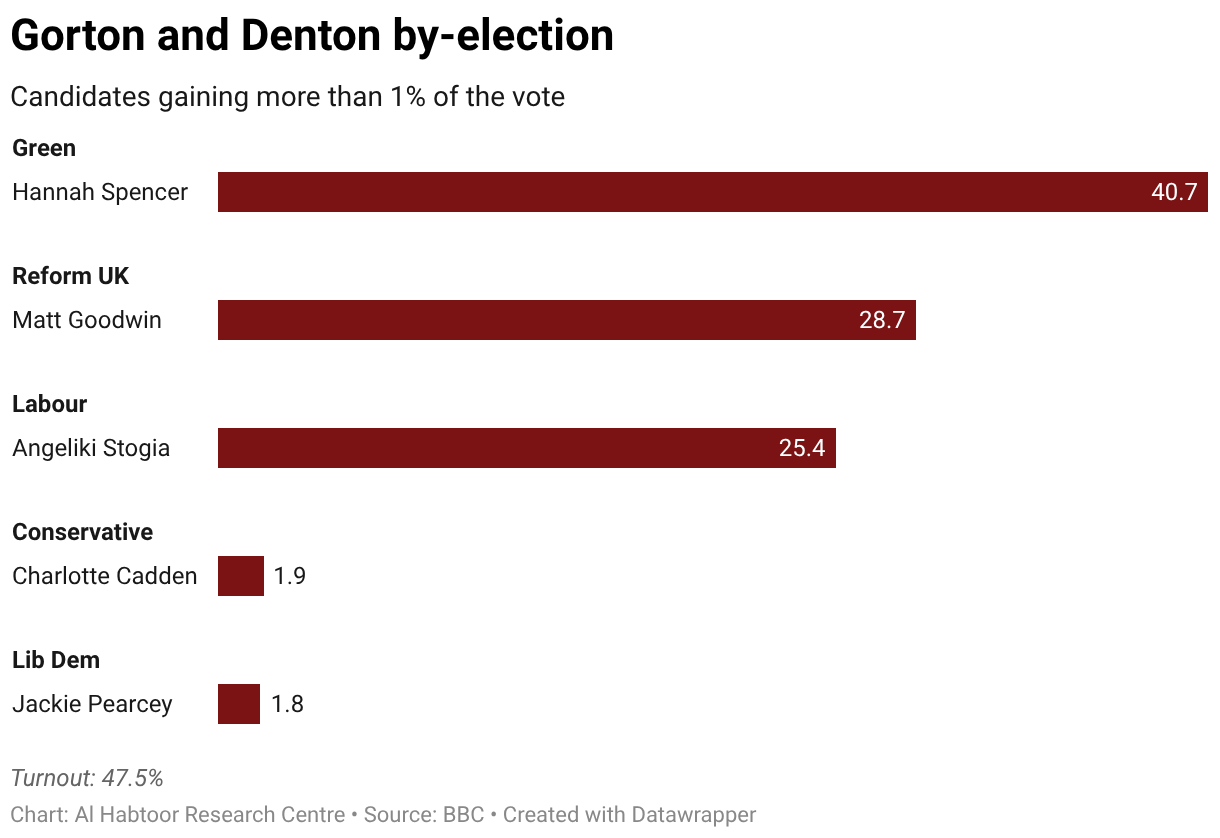
More importantly, this result can represent a surge in Green Party support and public confidence in the party platform, which can potentially lead to a green wave in the local elections. This is primarily the case in London, as a poll by Ipsos UK shows that 49% of Londoners are considering voting for the Green Party, with most doing so because A). They are not the Labour Party and B). It is considered a vote against Nigel Farage and Reform UK. This favorable shift is also further represented in idea that the Labour Party could lose heavily in its own strongholds in London as “The left-wing Green Party is projected to win the highest vote share on four authorities long held by the Labour Party — Hackney, Lambeth, Lewisham and Waltham Forest”. If the Labour Party were to lose these seats, it will signal a deeper crisis of credibility for Labour, while boosting the image of the Green Party as a credible alternative, especially within the major cities.

Can this be the Final Nail in the Labour Party’s Coffin?
With the potential collapse of the Labour Party’s voter coalition and the potential increase in credibility of Reform UK and the Green Party, one needs to ask themselves, if the Labour Party lose this election, are they finished? Usually, these local elections serve as a progress update for the incumbent government and can be considered as predictive tool for events to come as a general election. For example, the Liberal Democrats made significant gains in the 2023 local elections, which translated into a successful evening for the party in the 2024 General Elections, who won 72 seats, the most in their history. These elections can also serve as an early warning system for incumbents who perform poorly and usually are a sign that government policy needs to change to regain public support or trust.
In the case of the Labour Party under Starmer, it will neither serve as a progress update nor an early warning system, it will serve as a reckoning. With the public’s trust all but lost due to scandal, indecisiveness, and poor judgement, these elections will serve as a test of survival for the current Labour Party leader. This election will test whether the current Labour voter coalition will hold, or shatter resulting in voters looking for alternatives in parties such as Reform UK and the Green Party, which can result in an increase in their legitimacy and credibility as competitive parties. If Labour lose as much as they are projected to lose, this can spell the end of Starmer time in 10 Downing Street and the credibility of the Labour Party as a party of change will be forever lost.
References
Bloom, Dan. 2026. “Greens and Reform UK Both Set to Surge in London Elections, Poll Shows.” POLITICO. April 22, 2026. https://www.politico.eu/article/greens-reform-uk-populist-surge-london-elections-poll-polanski-farage-starmer-labour/.
Cecil, Nicholas. 2026a. “Labour ‘Risks Losing 600 Seats’ in London Local Elections in Worse Nightmare than Gorton Disaster.” The Standard. Evening Standard. March 4, 2026. https://www.standard.co.uk/news/politics/labour-local-elections-london-keir-starmer-greens-reform-b1273340.html.
———. 2026b. “‘Sea of Green’ Could Sweep London as Half of Voters Mull Backing Zack Polanski’s Party at May Elections – Poll.” The Standard. Evening Standard. April 22, 2026. https://www.standard.co.uk/news/politics/green-party-zack-polanski-vote-london-labour-reform-farage-b1279519.html.
Crowther, Zoe. 2024. “Labour’s Growing Suburban Support and Tactical Voting Could Deliver ‘Double Whammy’ Defeat to Tories.” Politics Home. May 8, 2024. https://www.politicshome.com/news/article/labours-vote-spread-efficient-appeal-broad-church.
Fisher, Stephen . 2026. “Local Election Seat Projections for 2026.” Elections Etc. March 25, 2026. https://electionsetc.com/2026/03/25/local-election-seat-projections-for-2026/.
Halliday, Josh. 2026. “Green Party Wins Gorton and Denton Byelection, Pushing Labour to Third Place.” The Guardian. The Guardian. February 27, 2026. https://www.theguardian.com/politics/2026/feb/27/green-party-wins-gorton-and-denton-byelection-in-blow-to-keir-starmer.
Hamilton , Carrie . 2026. “More than Just Polanski: The Green Surge in England and Wales.” Green European Journal. January 13, 2026. https://www.greeneuropeanjournal.eu/more-than-just-polanski-the-green-surge/.
Hillman, Nick. 2024. “How Influential Are Student Voters? The HE General Election Issues, Day 1 – HEPI.” HEPI. June 5, 2024. https://www.hepi.ac.uk/2024/06/05/how-influential-are-student-voters/.
Jazeera, Al. 2025. “Radical-Right Reform Party Makes Gains in UK Elections.” Al Jazeera. May 2, 2025. https://www.aljazeera.com/news/2025/5/2/radical-right-reform-party-makes-gains-in-english-elections.
Liberal Democrat History Group. n.d. “Our History Where We Come From.” Liberal Democrats. https://www.libdems.org.uk/history.
Martin, Daniel. 2026. “Divided Britain: Why Labour Is Losing Grip on Power in Birmingham.” The Telegraph. April 25, 2026. https://www.telegraph.co.uk/politics/2026/04/25/divided-britain-labour-losing-power-in-birmingham/.
McDonnell, Adam. 2024. “How Britain Voted in the 2024 General Election.” Yougov.com. YouGov. July 8, 2024. https://yougov.com/en-gb/articles/49978-how-britain-voted-in-the-2024-general-election.
McGregor, Matthew. 2026. “‘Labour Won’t Win Back Left Defectors with Squeeze Messaging Alone’ – LabourList.” LabourList. March 5, 2026. https://labourlist.org/2026/03/revolt-left-matthew-mcgregor-38-degrees/.
McKiernan, Jennifer, and Becky Morton . 2026. “Green Party Wins Gorton and Denton By-Election, Pushing Labour into Third Place.” BBC News, February 27, 2026. https://www.bbc.com/news/articles/cr453rvy6kvo.
More in Common . 2025. “How Can Labour Rebuild Its Electoral Coalition?” Moreincommon.org.uk. More in Common. September 2025. https://www.moreincommon.org.uk/media/mmwlugdh/lab_9-coalition.pdf.
Morton, Becky. 2025. “Act Now to Win Back Red Wall Voters, Labour MPs Say.” BBC News, May 7, 2025. https://www.bbc.com/news/articles/cpdzd29x8dno.
Sandford, Daniel, Simon Jack, Alison Holt, Ben Chu, Elaine Dunkley, Sophie Hutchinson, Katy Austin, Kevin Peachey, Dominic Casciani, and Katie Razzall. 2024. “Reform UK Manifesto 2024: 11 Key Policies Analysed.” Www.bbc.com. June 18, 2024. https://www.bbc.com/news/articles/cqll1edxgw4o.
Sowemimo, Matthew. 2024. “‘The Five Parts of Labour’s Electoral Coalition – and Why They’re All Fragile’ – LabourList.” LabourList. September 2, 2024. https://labourlist.org/2024/09/labour-electoral-coalition-election-2024/.
Swinney, Paul. 2024. “What Do the General Election Results Mean for Urban Britain? – Centre for Cities.” Centre for Cities. July 10, 2024. https://www.centreforcities.org/blog/what-do-the-general-election-results-mean-for-urban-britain/.
Travers, Tony. 2026. “UK Local Elections 2026: What Are the Prospects in London? – Economics Observatory.” Economics Observatory. April 27, 2026. https://www.economicsobservatory.com/uk-local-elections-2026-what-are-the-prospects-in-london.


Related Articles
From Two-Party Politics to Multiparty Competition: Where Is Westminster’s Party Landscape Headed?

Foreign Policy Challenges for 10 Downing Street’s Next Resident
A Fractured Kingdom: Political Fragmentation and the Crisis of Trust in Post-Election Britain

Manufacturing the Narrative: How Western Media Distorted What Really Happened in Dubai

Class, Declinism, and Emotional Turmoil: The Great British Migration to Dubai

Comments