

During the past decade, artificial intelligence (AI) has shifted from being an academic curiosity, becoming a driving force for reshaping economies worldwide. What once felt like speculative capabilities including machines generating code and automating complex workflows as well as optimizing global logistics and producing creative content, now became deployable tools on a larger scale across industries. AI’s rapid adoption raises several key questions among policymakers, economists and business leaders, most notably whether AI can contribute to the growth of national economic growth, and under what conditions do these gains materialize?
Macroeconomic models and strong empirical evidence suggest a positive outcome, however with notable limitations. AI, as a general-purpose technology, has more to offer than just efficiency improvements, it also functions as a key driver of innovation, productivity enhancement and transformation tool of economic structures. AI visibility and adoption have grown substantially, especially with the emergence of generative AI technologies such as exemplified ChatGPT, GitHub Copilot. This growth establishes AI as a valuable source of information and data, benefiting both firms and the border national economy, provided that this widespread adoption is backed and supported by a strong infrastructure and an adequate human capital, prepared to complement these technologies.
How AI Powers Economic Growth
AI adoption is accelerating rapidly, with the share of firms using AI rising from 20% in 2017 to 78% in 2025.

AI’s contributions toward national economies growth are transmitted via interlinked channels; first, AI enhances productivity, achieved by automating and augmenting routine yet complex tasks across both white and blue-collar sectors. AI enables the workforce to concentrate more on high-value activities, such as strategic decision-making, creativity and complex problem-solving. Recent research has shown that AI’s capabilities can significantly raise labour productivity by 40% in sectors characterized by high exposure to these technologies, such as manufacturing and logistics, particularly where complementary investments in infrastructure and skills are in place. AI, beyond task automation, is also deployed for optimizing numerous processes, including the allocation of resources across supply chains, the enhancement of logistical procedures, improvements in energy consumption efficiency and the management of inventory, all which contribute to optimal cost reductions and substantial efficiency gains in capital-intensive sectors such as manufacturing and transport.
Second, AI is widely regarded as a potent driver of innovation and value creation. Firms intensively developing AI features create entirely new products and services, ranging from autonomous vehicles to personalized medicine and advanced financial algorithms, hence unlocking new markets and revenue streams that directly contribute to GDP growth. Moreover, AI is a key contributor to firm’s data-driven transformation based on platforms, and hyper-personalized operations away from a traditional business model. Building on this, the concentration of economic value among AI‑leading firms stimulates further economic expansion, although with potential implications for market concentration.
Third, AI’s adoption is expected to have a booming effect on Total Factor Productivity (TFP)-a measure of efficiency in using labour, capital and other countable inputs. While TFP’s current macro-level gains remain modest- partly due to costs adjustment and concentrated investment in intangible assets like data and software- however long-term projections points toward optimism. Legal consulting firms estimate that AI could contribute to the addition of trillions of dollars to global GDP by 2030, subsequently increasing the annual GDP growth by more than 1.2% for developed economies, primarily through improvements in TFP. Global professional services firm PricewaterhouseCoopers (PwC) projects AI’s contribution toward global GDP to reach about $15.7 trillion by 2030, underscoring the transformative scale of AI adoption across industries and countries.
However, the modest current macro-level TFP gains point to the “AI Productivity Paradox.” This paradox suggests that the true economic value of AI may be mismeasured by traditional economic accounts, which struggle to capture the full economic welfare generated by “free” digital services and the massive investment in intangible assets (like software, data, and organizational capital) that precedes full productivity realization. The full translation of firm-level gains into national TFP growth requires a significant time lag and systemic reorganization.
AI’s contribution is concentrated in both the core AI industry and sectors which adopt its technologies. The AI industry itself, encompassing developers of large language models, AI hardware, enterprise software, and data infrastructure, directly contributes to GDP through capital formation, high‑value employment, and enhanced export competitiveness. At the same time, traditional sectors amplify economic gains through AI adoption. In the manufacturing sector, predictive maintenance and robotic automation help in the reduction of costs as well as enhancing the output quality; in the healthcare sector, AI supports rapid drug diagnosis and prescription, improving patient outcomes. In the financial sector, algorithms applied to trading and fraud detection enhance efficiency and stability, lastly in the retail and e-commerce sectors, AI-driven demand forecasting and automated logistics optimize operations which lead to sales boosting.
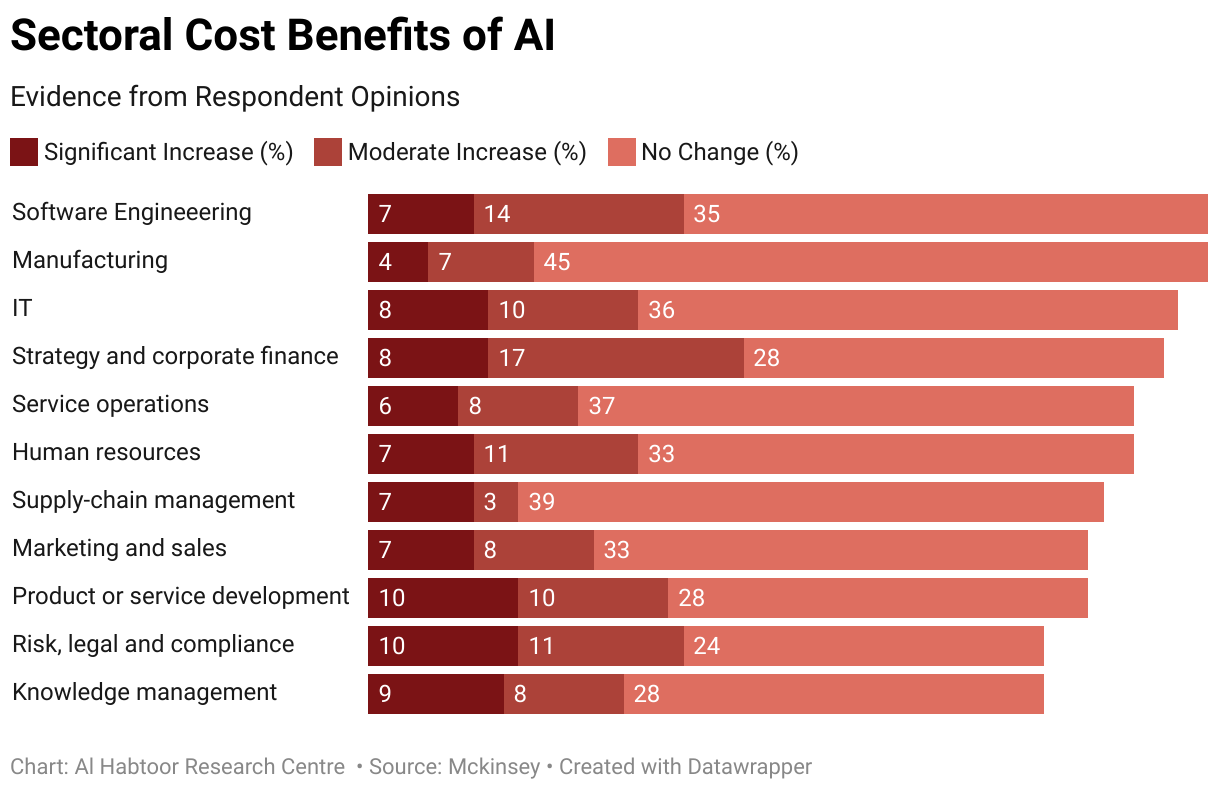
AI in Action
Model-based evidence along with empirical data show that firms deploying AI technologies are more likely to achieve remarkable gains across various indicators, including productivity, efficiency and innovation, which aggregate at the macroeconomic level to influence GDP growth. For instance, a recent working paper by Tatsuru Kikuchi (2025) analysed data from more than 500 Japanese enterprises and finds that AI investment is associated with a statistically significant increase in TFP. The study shows that productivity gains is driven by cost reductions (40 %), revenue growth (35 %), and accelerated innovation cycles (25 %). Broader macroeconomic modelling implemented by the Organisation for Economic Co-operation and Development projects that labour productivity in the G7 economies could potentially grow by approximately 0.4% to 1.3% on an annual based over a projected 10-year basis due to AI adoption. On a similar note, McKinsey & Company had also estimated that generative AI alone could contribute by generating USD 2.6–4.4 trillion in global economic value, largely through improvements in marketing, R&D, software engineering, and operational efficiency. Country based analyses, including studies from China, indicate that AI-related technologies, spanning robotics deployment and high-tech exports, are strongly associated with national output, further suggesting that AI activity could translate into tangible economic growth. Combined, these findings illustrate both the direct and indirect contributions of AI companies toward national economic growth; the direct effects occur at the firm-level including productivity and innovation gains, while the indirect effects consist of sectoral spillovers, infrastructure investment, and unlocking new markets.
Macroeconomic patterns are reinforced by firm-level data, showcasing that AI is already achieving measurable output, revenue stream, and productivity gains across leading technology and services companies. In the United States (U.S.), the development of the AI model is a field mainly dominated by firms, which were able to develop 40 remarkable models during 2024, succeeding in attracting a total of $109.1 billion in private investments. Major technology platforms such as Nvidia, Microsoft, Amazon, Alphabet, and Meta are perfect examples for this claim; Nvidia’s $100 billion scheduled investments plans in OpenAI demonstrates how firms in the U.S. drive growth, with AI infrastructure adding $160 billion to “true GDP” since 2022—equivalent to 0.3 percentage points of annualized growth. Looking ahead, AI projections, in a recent study conducted by Goldman Sachs, show that AI could boost U.S. productivity by 1.5% on an annual basis over the next decade, with measurable GDP impact starting in 2027.
These macro-level significant investments, have direct effects and tangible gains for firms: for instance, Nvidia’s Data Center segment was able to report an approximate of $35.6 billion in revenue in the fourth quarter of 2025, and about $115.2 billion for the full year, driven largely from cloud providers scaling AI workloads. Recent reports from Microsoft indicate than AI capabilities which are embedded in its cloud computing services “Azure”, have significantly contributed by several percentage points of incremental growth with an annual revenue stream now exceeding $75 billion, accelerated by OpenAI-related usage. IBM’s internal “Client Zero” AI adoption program contributed by $3.5 billion in productivity gains since 2023, showcasing how AI enhances efficiency on a large scale. This pattern is reinforced by different consulting and enterprise-based surveys; on AI investments result in above-average returns as reported by 72% of executives, on the other hand, case studies from providers such as Teleperformance reflect remarkable cost reductions as well as efficiency improvements through AI adopted automation in customer service operations.
Combined, these indicators reflect how AI is not merely a theoretical transformative technology, but a main contributor to revenue growth, productivity, and value creation across multiple sectors, which ultimately links firm-level performance to the broader national economic gains. However, while leading companies and advanced economies have captured these benefits, the broader diffusion of AI-driven growth remains uneven. Many smaller firms, traditional sectors, and less-developed regions face significant barriers to adoption, and structural, skill, and policy constraints can limit the translation of AI innovations into broad-based economic prosperity.
Unlocking AI for Broad-Based Growth
Despite its strong potential and significant contributions, AI’s expansion into broad-based national economic growth remains highly conditional, with an uneven distribution of gains, such that only a handful of large firms, particularly global “big tech” benefiting due to their advanced AI infrastructure, research capabilities, and high-tech development resources, while AI adoption and advancements across smaller firms and traditional sectors still lags. These limitations affect the spread of AI-driven benefits across all levels. Additionally, AI capabilities remain skill-biased, routine tasks are more likely to be automated than those requiring creativity or complex judgment, raising risks of labour layoffs, substantially widening the wage inequality gap between workers whose skills complement AI and others.
A critical, long-term challenge is the structural shift in the factor share of income. AI-driven automation functions as a potent substitute for human labour in routine tasks, thus acting as a form of capital. This increases the overall capital-labour ratio and risks a long-term decline in the labour share of national income, resulting in greater wealth inequality. Compounding this, AI is inherently skill-biased: routine or rule-based tasks are more easily automated than those requiring creativity or complex judgment, raising risks of labour displacement and growing wage inequality between AI-complementary workers and others.
Many developing countries suffer from an insufficiency in workforce digital literacy related skills, data science capabilities and other AI-related competencies, further restricting their abilities to leverage AI’s full potential. Moreover, fully unleashing AI’s capabilities requires huge infrastructure and capital, including data centres, reliable connectivity, specialized hardware, energy, and cloud or on-premises computing capacity. Countries or firms who suffer from a lack in these resources are less likely to reap AI’s productivity gains. Hence, to overcome all these obstacles and to shape the extent and equity of AI adoption, a decisive role needs to be played by Institutional and regulatory institutions, with clear governance and data privacy regulations, competition policies frameworks and public investment, without which AI-driven growth risks remain concentrated.
Finally, inherent uncertainty about long-term effects, including the potential erosion of knowledge transmission, uneven accumulation of human capital and welfare capture—underscores that AI’s macroeconomic impact is not guaranteed. Combined, these limitations highlight that AI is a powerful enabler that requires a right ecosystem rather than a magic bullet; this ecosystem includes widespread diffusion across firms and sectors, investments in infrastructure and complementary capital, the development of human capital skills, the strong support for entrepreneurship and SMEs, and the adoption of inclusive policies and governance that anticipate labour displacement, inequality, and structural change. When combined, these enabling conditions can accelerate the unlocking of AI’s full potential, in a more even, sustainable, and inclusive manner, benefiting national economic growth on a broader scale and reaching different parts of the world.
National economic growth driven by productivity gains, innovation, and the emergence of new high-value industries is boosted by AI and by companies that fully adopt and develop these technologies. The unresolved challenge for policymakers is to ensure that these benefits are distributed evenly in a broad-based and sustainable manner, which fosters inclusive prosperity across the economy.
References
Business Wire. “82% of Enterprise Leaders Now Use Generative AI Weekly, Multi-Year Wharton Study Finds as Investment and ROI Continue to Build.” Business Wire, October 28, 2025.https://www.businesswire.com/news/home/20251028556241/en/82-of-Enterprise-Leaders-Now-Use-Generative-AI-Weekly-Multi-Year-Wharton-Study-Finds-as-Investment-and-ROI-Continue-to-Build
Fortune. “How Much GDP Artificial Intelligence Could Add, According to Goldman Sachs.” Fortune, September 17, 2025.https://fortune.com/2025/09/17/how-much-gdp-artificial-intelligence-goldman-sachs-160-billion/
GeekWire. “Microsoft Posts Strong Quarter, Cites Broad AI and Cloud Growth as Azure Revenue Tops $75B Annually.” GeekWire, 2025.https://www.geekwire.com/2025/microsoft-posts-strong-quarter-cites-broad-ai-and-cloud-growth-as-azure-revenue-tops-75b-annually/
Goldman Sachs. “AI May Start to Boost U.S. GDP in 2027.” Goldman Sachs Insights, 2023.
https://www.goldmansachs.com/insights/articles/ai-may-start-to-boost-us-gdp-in-2027
International Monetary Fund (IMF). “AI Will Transform the Global Economy. Let’s Make Sure It Benefits Humanity.” IMF Blog, January 14, 2024. https://www.imf.org/en/blogs/articles/2024/01/14/ai-will-transform-the-global-economy-lets-make-sure-it-benefits-humanity
Kikuchi, Tatsuru. “Artificial Intelligence Adoption and Firm Productivity: Evidence from Japan.” arXiv Working Paper, 2025.https://ideas.repec.org/p/arx/papers/2508.03757.html
McKinsey Global Institute. “The Economic Potential of Generative AI: The Next Productivity Frontier.” McKinsey & Company, 2023.https://www.mckinsey.com/capabilities/tech-and-ai/our-insights/the-economic-potential-of-generative-ai-the-next-productivity-frontier
Nature Scientific Reports. “Economic and Productivity Impacts of Artificial Intelligence.” Scientific Reports 15 (2025).https://www.nature.com/articles/s41598-025-25413-6
NVIDIA. “NVIDIA Announces Financial Results for Fourth Quarter and Fiscal 2025.” NVIDIA Newsroom, 2025.https://nvidianews.nvidia.com/news/nvidia-announces-financial-results-for-fourth-quarter-and-fiscal-2025
Organisation for Economic Co-operation and Development (OECD). The Effects of Generative AI on Productivity, Innovation and Entrepreneurship. Paris: OECD Publishing, 2024.
https://www.oecd.org/en/publications/the-effects-of-generative-ai-on-productivity-innovation-and-entrepreneurship_b21df222-en.html
Organisation for Economic Co-operation and Development (OECD). Macroeconomic Productivity Gains from Artificial Intelligence in G7 Economies. Paris: OECD Publishing, 2025.
https://www.oecd.org/content/dam/oecd/en/publications/reports/2025/06/macroeconomic-productivity-gains-from-artificial-intelligence-in-g7-economies_dcf91c3e/a5319ab5-en.pdf
PricewaterhouseCoopers (PwC). Sizing the Prize: What’s the Real Value of AI for Your Business and How Can You Capitalise? PwC, 2017.https://www.pwc.com/gx/en.html
Stanford Institute for Human-Centered Artificial Intelligence (HAI). AI Index Report 2025. Stanford University, 2025.http://hai.stanford.edu/ai-index/2025-ai-index-report
Vanguard. “The Impact of Artificial Intelligence on Productivity and the Workforce.” Vanguard, 2024.https://corporate.vanguard.com/content/corporatesite/us/en/corp/articles/ai-impact-productivity-and-workforce.html
Zhang, William Xiaoci. “Determinants of AI Performance and Their Effect on National GDP: An Empirical Study.” ResearchGate Working Paper, 2024. https://www.researchgate.net/publication/385545565_Determinants_of_AI_performance_and_their_effect_on_national_GDP_an_empirical_study



Running to Stand Still: Why LDCs are Falling Behind in Digital Trade?

The AI Security Trap: Cheap Attacks, Pricey Defences

Digital Abundance, Experiential Scarcity, and the New Economics of Cinema

The Heat Economy: Assessing the Economic Toll of Europe’s 2026 Heatwaves

The Petrodollar Myth: Why Architecture Beats Ambition

Comments