

Programmes
24 Jun 2026
From Mercedes to BYD: The Full Story of Power Shifts in the Global Automotive Industry
For decades, the automotive sector has been the industrial backbone of the European Union, employing roughly 13.8 million people—8.1% of the bloc’s manufacturing jobs—generating close to 7% of its GDP and a trade surplus exceeding €79.5 billion. Yet this entrenched primacy is now exposed. The legislated phase-out of the internal combustion engine (ICE) by 2035, structurally elevated energy costs, and China’s state-backed scaling of new energy vehicles (NEVs) have converged to erode advantages built over a century. Within a single decade, China has vaulted from an assembler of imported technology to the global pacesetter in battery chemistry, critical-mineral refining, and software-defined vehicle production.
Accordingly, this analysis aims to provide a rigorous quantitative assessment of Europe’s eroding automotive competitiveness against China’s ascent, across three interlocking axes: the empirical evidence of the market shift, the financial and economic root causes, and the strategic outlook for a continent now forced onto the defensive.
Programmes
27 Apr 2026
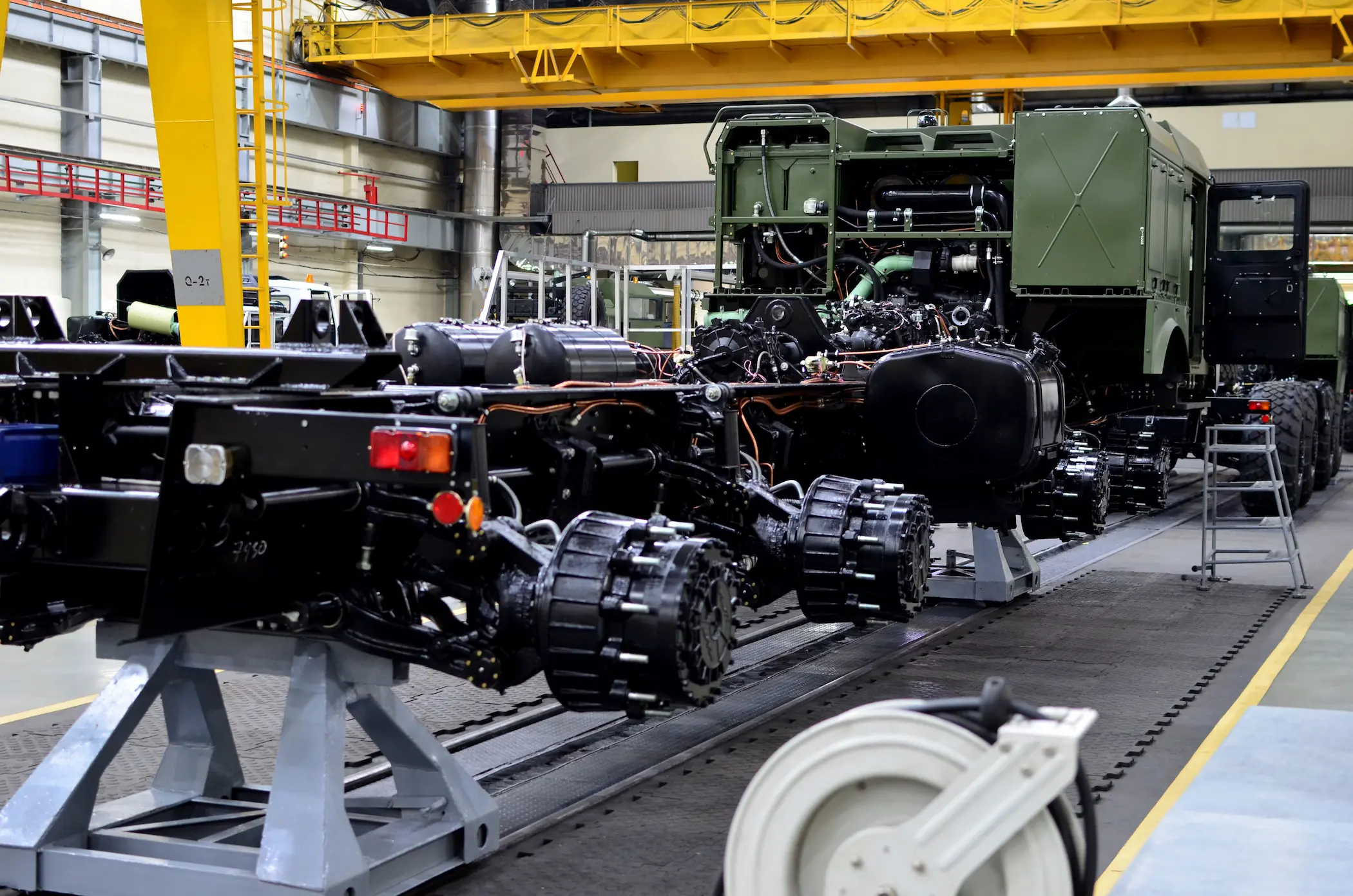
Engines of War: Why the Automotive Sector Is the Fastest to Pivot to Military Production
Modern patterns of armed conflict are shifting from time-limited operations reliant on advanced, low-volume technologies to protracted confrontations driven by industrial attrition and the large-scale deployment of autonomous systems. This transition exposes critical deficiencies in the traditional defence industrial base's production capacity. As munitions stockpiles decline amid ongoing conflicts in Eastern Europe and the Middle East, military assessments increasingly identify manufacturing capability, supply chain resilience, and the speed of industrial mobilisation as decisive factors in strategic competition, alongside technological innovation.
In response to these dynamics, national security institutions are moving to reactivate historically grounded models that integrate the commercial manufacturing sector into military production. This approach was notably deployed during the Second World War, when Ford Motor Company redirected its civilian production lines to manufacture bombers, Chrysler Corporation established dedicated facilities for tank production, and General Motors allocated its industrial capacity to the production of aircraft engines and munitions.
The current operational environment demands a sustained supply of conventional mechanical platforms and expendable systems, including unmanned aerial vehicles and sensor-equipped tactical vehicles. As battlefield requirements increasingly outpace the production capacity of defence manufacturers, the automotive sector emerges as a uniquely positioned industrial base, combining large-scale output with advanced mechanical engineering capabilities. This reality necessitates a focused assessment of the structural and technical attributes that make it the most viable sector for rapid conversion to support military production.