

On June 17, 2026, China published its first comprehensive white paper on global governance titled "More Just and Equitable Global Governance: China's Principles, Proposals and Actions," which constitutes a translation of China's long-standing aspiration to shape the international order. The paper proposes a new model redefining principles and institutions while advocating for multilateralism in the international order. However, it seems that China concentrates on leadership grounded in normative influence rather than the financial and military commitments that have historically accompanied global leadership.
The release of the white paper coincides with new developments China faces, notably economic structural headwinds. Such developments provide strong context for the White Paper’s focus on normative leadership. This raises a crucial question” Can China's cost-averse model of global leadership translate normative influence into sustainable geopolitical leadership?
Vulnerability Mitigation as a Catalyst
China’s reliance on Middle Eastern energy reveals one of the most significant weaknesses underlying its calls for reforming the global order. As the world’s largest importer of fossil fuels and one of the biggest buyers of Iranian oil, any disruption in the Strait of Hormuz directly threatens its economic stability. The closure of the strait following the U.S. strikes on Iran demonstrated that, despite Beijing’s growing economic influence, it lacks the maritime security capabilities to independently secure vital waterways. Consequently, China’s energy security remains dependent on regional stability, diplomatic arrangements, and the policies of other regional powers, highlighting the gap between China’s global economic power and its limited ability to guarantee the security of the trade routes upon which its economy depends.
Similarly, the escalating trade and technology confrontation between the U.S. and China has highlighted Beijing’s structural dependence on economic institutions and networks largely shaped by the United States. Rising tariffs, export controls on advanced semiconductors, and restrictions on artificial intelligence technologies demonstrate how economic interdependence can be weaponized during periods of geopolitical competition. Notably, U.S. tariffs have increased by 26.8 percentage points (pp) since the beginning of Trump’s second administration, compared to a 10.7 percentage points (pp) increase in Chinese tariffs. This dynamic reinforces Beijing’s perception that national security increasingly depends on reducing reliance on Western-dominated supply chains, financial systems, and technological environments.
Furthermore, the Taiwan issue reinforces Beijing’s belief that existing security arrangements remain heavily influenced by U.S. strategic preferences. Continued U.S. military support for Taiwan is interpreted by Beijing as evidence for American intervention in its internal affairs. This, in turn, reinforces China’s emphasis on sovereign equality, non-interference, and reforming international governance to limit the ability of individual states to shape the security environment of others.
This was not the first time China showed interest in architecting the global order. In 2025, Beijing released a White Paper on National Security asserting that “5,000 years of continuous civilization have endowed the Chinese nation with a profound and rich strategic culture on national security.” It highlighted Chinese aspirations and what constitutes the foundation of its national security. One of the prominent pillars was preserving the Communist Party’s governing model and preventing any challenge to it. It centred on preserving the socialist system, the leadership of the Communist Party of China, and the socialist constitutional order. Consequently, China linked its political security to this model of governance.
These vulnerabilities explain why China’s 2025 National Security White Paper and 2026 Global Governance White Paper should be viewed as complementary, not separate, documents. While the National Security White Paper outlines the internal foundations of China’s security, including maintaining the leadership of the Communist Party and the socialist constitutional order, the Global Governance White Paper embodies this vision by proposing an international governance framework aimed at limiting Western-dominated global order.
China's Alternative Model
The Chinese White Paper does not present multilateralism as a rejection of the existing international order, but rather as a strategy to reshape the institutions through which that order operates. Beijing seeks to enhance its influence within these institutions by advocating for reforms.
China attempts to redefine global governance through five normative principles: sovereign equality among all nations, whether developed or developing, in terms of opportunities and participation; the international rule of law as the mechanism for ensuring the proper implementation of the UN Charter; multilateralism, based on collective decision-making and participation through the United Nations; a people-centred approach that prioritizes development while addressing shared challenges such as climate change, public health, and cybersecurity; and, finally, real actions to strengthen both North-South and South-South cooperation.
These principles serve more than a normative framework. Sovereign equality, non-intervention, and multilateral decision-making foster a governance framework that limits unilateral intervention while reinforcing the role of state sovereignty in international affairs. At the same time, the emphasis on these principles diminishes the importance of governance standards based on democracy and human rights used by the West.
Moreover, China championing a UN-centric order, not out of commitment to international law, but because it serves as a strategic purpose. Reforming the current system allows Beijing to operate within organizations where it wields considerable influence, including its veto power on the UN Security Council, as well as the support it enjoys among developing countries in voting within the General Assembly. Hence, Beijing stresses that the UN can perform more effectively through improved governance and broader participation by all nations while advocating reforms to IMF quotas, greater representation on the UN Security Council, improvements to World Bank governance, and enhanced effectiveness of the WTO.
One of the most prominent issues Beijing advocates is expanding the representation of the Global South as they become major contributors to global economic growth. This serves wider geopolitical interests for Beijing; as China expands its economic and diplomatic partnerships with developing countries through initiatives such as BRICS and the Belt and Road Initiative, it sought to strengthen the impact of these partnerships by amplifying the voice of its partners in the multilateral organisations and expand the coalition that supports its global governance vision.
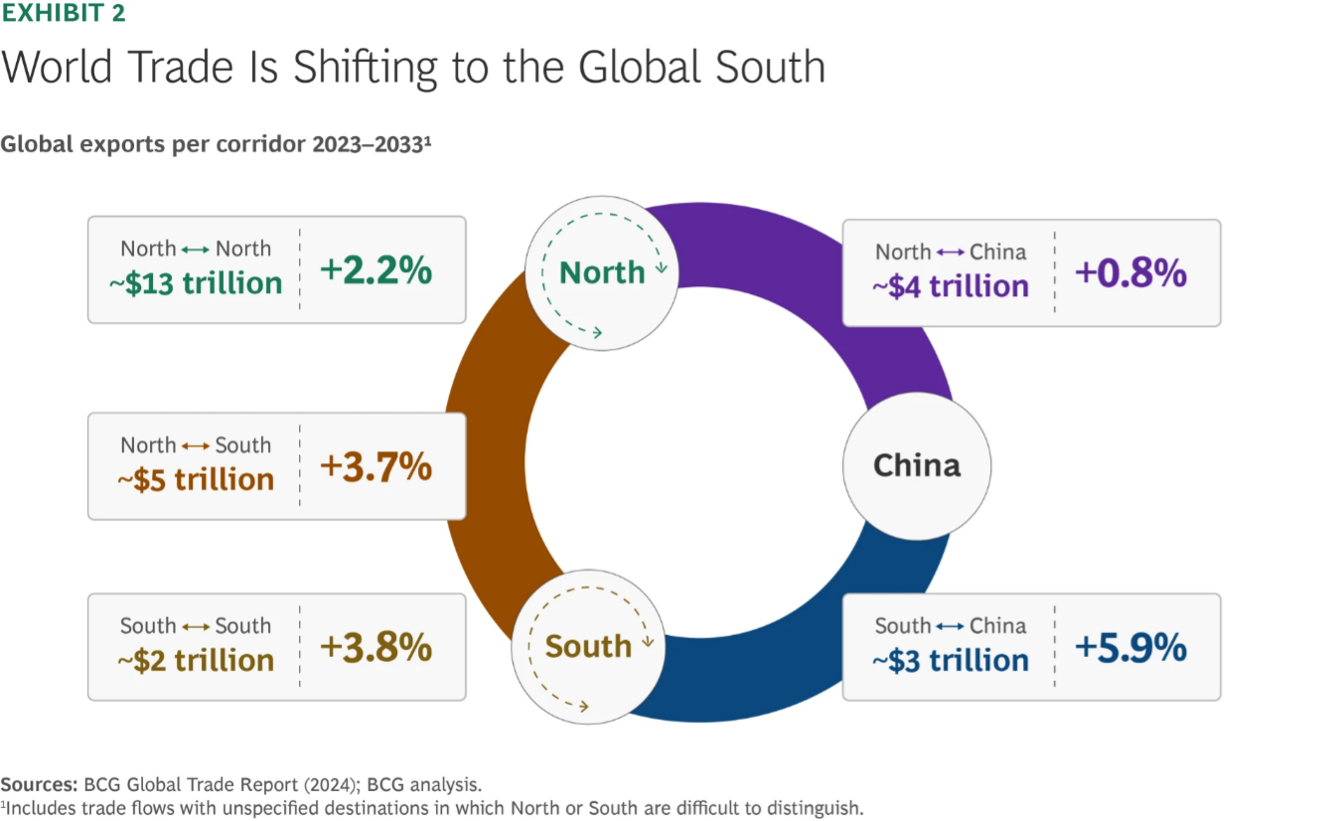
Source: Bharadwaj, Aparna et al.
The Belt and Road Initiative (BRI), the Global Development Initiative (GDI), and South-South cooperation are presented as key instruments for building this development-centered order. However, constructing such an order through collective participation and a development-focused agenda, as envisioned by China, requires substantial financial resources. Major powers, including China itself, are unlikely to continue financing large-scale megaprojects under the Belt and Road Initiative, instead prioritizing selective strategic investments that align with their national interests. Therefore, while advocating normative principles is relatively easy, translating them into financing the current institutions for meaningful reforms, and financing development across the Global South is a far more difficult challenge that few governments are willing or able to undertake.
China’s Cost-lite Model from Hardware to Software
Traditionally, global powers financed their way to hegemony. The United States initiated the Marshall Plan for Western European countries, the Bretton Woods, and co-established NATO. The alternative Chinese model seeks to replace much of this costly instruments (hardware) with less expensive institutional and normative ones (software).
China’s White Paper not only reflects a different concept of global governance but also shifts in domestic realities. Unlike previous phases of Chinese foreign policy, which relied heavily on large-scale external financing through the Belt and Road Initiative, Beijing now faces slowing economic growth, demographic pressures, and increasingly pressing domestic spending priorities. These constraints make the traditional model of financing global leadership increasingly costly, encouraging China to project its influence through institutional reform, governance initiatives, and normative leadership rather than open-ended financial and military commitments.
The slowdown in China’s economic growth trajectory explains this strategic shift. Maintaining growth of around 5% while managing internal structural challenges and needs reduces Beijing’s willingness to finance large-scale external commitments comparable to the first phase of the hyper-expensive Belt and Road projects.

Accordingly, Beijing is forced to export institutional norms and initiatives, because it can no longer afford the hyper-expensive finances, such as massive BRI megaprojects and global military bases. So, the question isn’t whether China can lead without paying; it’s that China must lead this way because its domestic economic reality leaves it no other choice.
A. The Multipolarity Dilemma
The multipolarity China advocates for produces new competitors rather than simply weakening Washington. These competitors have interests that diverge from China’s and therefore constitute a barrier to its vision.
First, India has emerged as one of the world’s fastest-growing major economies and is increasingly viewed as a potential global superpower. Its rise has been fuelled by a combination of economic liberalization, foreign investment, and government initiatives such as Make in India, Digital India, Startup India, and Skills India. These developments have increased India’s attractiveness as an investment hub. Moreover, India is expected to remain among the fastest-growing major economies and is projected to become the world’s third-largest economy by 2027, positioning itself as a key driver of the global economy over the next decade.
Second, Türkiye has emerged as a major defence industrial power within NATO, transforming from a heavily import-dependent military market into one of the world’s fastest-growing arms exporters. Turkish defence exports surged from a mere $248 million in the early 2000s to approximately $10.1 billion in 2025, fuelled by an industrial base that expanded from 56 companies to over 3,500, with local components exceeding 80%. More than half of Türkiye’s defence exports go to NATO, EU, and U.S. markets while simultaneously serving customers across the Middle East, Africa, and Asia. Ankara is emerging as a geopolitically influential actor capable of shaping regional security through its industrial capabilities, technological cooperation, and arms exports.
Third, Brazil’s foreign policy is driven by a deep-seated ambition to be recognized as a global power rather than merely a middle power. Brazil prioritizes strategic independence, multilateralism, and institutional reform over alliance politics, seeking to enhance its influence within the international system. Brasília adopts a strategy of diversified partnerships, balancing its relationships with the United States, China, and other key players. Moreover, the energy transition has become one of Brazil’s most important sources of international influence where it is a major player in both oil and renewable energy production, while possessing substantial reserves of rare earth elements and critical minerals. Although Brazil’s influence remains more limited than China’s, Brazil’s growing influence could nevertheless challenge China’s preferred vision of a horizontal order with China at the top.
Fourth, the Gulf countries possess the strategic assets to shape the emerging multipolar order. They possess growing economic and diplomatic influence which allow them to influence long-term geopolitical trajectories. Furthermore, ambitious national strategies, including Saudi Arabia’s Vision 2030, the UAE’s Vision 2031, and Qatar’s National Vision 2030, are repositioning the Gulf from an oil-dependent region into a global hub for technology, finance, logistics, tourism, and artificial intelligence, thereby enhancing their long-term strategic importance. Moreover, they are becoming an increasingly important pillar of Europe’s defence industrial strategy and broader security architecture. They are now co-financiers, investors, and stakeholders in the future of European defence industries.
The continued rise of these countries has significant implications for the international order China aspires to build. Their growing economic, strategic, and political weight is expected to reshape the global balance of power, as well as alter patterns of international trade and investment. At the same time, countries increasingly recognize the deepening polarisation between the U.S. and China and therefore seek to avoid totally aligning with either side, maximizing their strategic autonomy while reducing their technological and security dependence on the traditional great powers.
B. Fragility of Normative Initiatives
In the white paper, China highlights four initiatives: The Global Development Initiative, Global Security Initiative, Global Civilization Initiative, and Global Governance Initiative, as an alternative governance architecture. These initiatives mainly focus more on normative principles, digital cooperation, dialogue, diplomacy, commitment, and cooperation than on financial spending. The “Four Global Initiatives” (4GIs) reflects China’s gradual shift from costly infrastructure investments to reshaping institution and norms to maintain its global influence.
However, while normative frameworks are cost-effective to produce, they create a “security and development vacuum.” They can’t replace the financial, military, and institutional capabilities traditionally associated with global leadership. During a regional conflict, particularity in a Global South nation, diplomatic dialogue alone is insufficient as a substitute for peacekeeping forces or security guarantees. Similarly, a debt crisis or food insecurity depend on sustained financial commitments and emergency liquidity, not governance principles.
Consequently, financing remains the primary engine behind any successful international initiative. Building a global order based primarily on principles and norms without adequate financial commitments is unlikely to be sustainable and will limit the ability of these initiatives to evolve into comprehensive implementation mechanisms or to be institutionally capable of mitigating global crises.
C. The Prospects for Global South
China’s development of an alternative to the U.S.-led unipolar system relies on establishing a multipolar order based on sovereignty, South-South cooperation, and global governance reforms. The Global South is likely to benefit from a multipolar order through greater autonomy in pursuing its national policies. However, economic constraints continue to affect many developing countries’ ability to finance major development projects, leaving them dependent on external sources of funding. In this context, these countries will likely continue to require substantial financial commitments from governmental organisations and major powers, which, under the proposed multipolar order, may be more constrained or less willing to provide open-ended financing.
China’s strategy is likely to prove effective in accelerating the shift away from the unipolar order by fostering alternative institutions and expanding the political influence of the Global South. However, the Chinses leadership embodied in limited financial commitments and reliance on normative governance, would limit Beijing’s ability to establish itself as centralized leadership for the Global South and emerging powers. These rising regional powers would exercise greater strategic autonomy, engaging selectively with both Washington and Beijing.
In sum, China’s “cost-lite” strategy will successfully accelerate the fracturing of the U.S.-led unipolar order, but it will fundamentally fail to construct a Sino-centric alternative. The ultimate victors of Beijing’s Global Governance Initiative will be the agile middle powers who use China’s normative frameworks to secure their own strategic independence. As emerging regional powers, including India, Brazil, Türkiye, and the Gulf states, continue to expand their economic, technological, and geopolitical influence, they are unlikely to depend on China. Instead, these states will act more independently, leveraging their way to finance massive national projects and strengthen their influence in the multilateral institutions.
Therefore, the emerging international order is unlikely to be unipolar or China-centric. Rather, it will be defined by multiple influential regional powers, flexible alliances, and mutual beneficial partnerships, where leadership is not in hands of a single leader, but in a group of influential countries driven by their aspirations and interests. Ultimately, strategic autonomy becomes the defining characteristic of the new global order.
References
Abdel-Fattah, Pacinte. “Will India Become the Next Global Superpower?.” Al Habtoor Research Centre. April 16, 2023. https://www.habtoorresearch.com/programmes/will-india-become-the-next-global-superpower/
Ahmed, Mostafa. “Ankara’s Defensive Rise: A New NATO Path?.” Al Habtoor Research Centre. June 29, 2026. https://www.habtoorresearch.com/programmes/ankara-defensive-rise-nato/
Al-Jaber, Khalid. “Post-War Dynamics: The Gulf at the Center of a New World Order.” Middle East Council on Global Affairs. (April, 2026) https://mecouncil.org/publication/gulf-post-war-strategy-security-alliances/
Amin, Sherif. “US-China Summit: Not Peace, Rivalry Management.” Al Habtoor Research Centre. May 15, 2026. https://www.habtoorresearch.com/programmes/us-china-summit/
Bharadwaj, Aparna et al. “In a Multipolar World, the Global South Finds Its Moment.” Boston Consulting Group (BCG). April 22, 2025. https://www.bcg.com/publications/2025/in-a-multipolar-world-global-south-finds-its-moment
Baloch, Bilal. “The new non-alignment: How the Middle East is carving out room to maneuver in AI.” Atlantic Council. June 29, 2026. https://www.atlanticcouncil.org/blogs/menasource/the-new-non-alignment-how-the-middle-east-is-carving-out-room-to-maneuver-in-ai/
Barata, Pedro Monzón. “China, the construction of multipolar world, and the pursuit of sovereignty.” Al Mayadeen. November 8, 2025. https://english.almayadeen.net/articles/analysis/china–the-construction-of-multipolar-world–and-the-pursuit
Bown, Chad P. “US-China Trade War Tariffs: An Up-to-Date Chart.” Peterson Institute for International Economics. November 14, 2025. https://www.piie.com/research/piie-charts/2019/us-china-trade-war-tariffs-date-chart
Diaaeldin, Habiba. “Are Europe’s Capability Gaps Choosing Its Defence Partners?.” Al Habtoor Research Centre. July 3, 2026. https://www.habtoorresearch.com/programmes/europes-capability-gaps-defence-partners/
Duchâtel, Mathieu. “Reading China’s White Paper on National Security in the New Era.” Institut Montaigne. May 13, 2025. https://www.institutmontaigne.org/en/expressions/reading-chinas-white-paper-national-security-new-era
Jie, Yu. “China sets out its vision for a new global order – but will it commit the resources to match its ambition?.” Chatham House. June 24, 2026. https://www.chathamhouse.org/2026/06/china-sets-out-its-vision-new-global-order-will-it-commit-resources-match-its-ambition
Prime Minister’s Office. “G7 leaders’ statement on geopolitical issues: 17 June 2026.” GOV. UK. June 17, 2026. https://www.gov.uk/government/news/g7-leaders-statement-on-geopolitical-issues-17-june-2026
SCSP. “Xi’s Four “Global Initiatives”: China’s Blueprint for a Parallel World Order.” SCSP.AI. September 17, 2025. https://scsp222.substack.com/p/xis-four-global-initiatives-chinas
Stuenkel, Oliver. “Multi-Alignment as Strategy: How Brazil Navigates Between Washington, Beijing, and the Global South.” Belfer Center. November 20, 2025. https://www.belfercenter.org/research-analysis/multi-alignment-strategy-how-brazil-navigates-between-washington-beijing-and
Xinhua. “Full text: More Just and Equitable Global Governance: China’s Principles, Proposals and Actions.” (The State Council Information Office of the People’s Republic of China, June 17, 2026). https://english.www.gov.cn/archive/whitepaper/202606/17/content_WS6a326192c6d00ca5f9a0bab7.html


Related Articles

Beyond PEPFAR: How America’s Aid Retreat Is Reshaping Global Health Governance
The Civilian Face of Chinese Sea Power
Modern Warfare: Can Military Components Become China’s Greatest Strategic Weapon?

The Economics of Reusable Launch Vehicles and the Competition over Low Earth Orbit

From Mercedes to BYD: The Full Story of Power Shifts in the Global Automotive Industry

Comments