

In 2025, the rapid acceleration of artificial intelligence (AI) is no longer just expanding digital capabilities, it is reshaping the physical infrastructure that underpins the global economy. Data centres are becoming “AI factories,” designed for unprecedented computational intensity and continuous, large-scale workloads. Nearly 11,800 facilities were operating worldwide by 2024, with an increasing share built or retrofitted to power AI-grade computing. This shift has triggered a structural rise in energy consumption, placing extraordinary pressure on land, water, electricity systems, and financially straining grids and supply chains worldwide.
The defining constraint on the future of AI is no longer hardware or algorithms, it is energy. Without a rapid global shift to renewable and clean power, AI data centres will collide with resource shortages, grid instability, and economic risk, threatening the very growth they are meant to enable. As AI becomes foundational across industries, the challenge is no longer whether data centres will expand, but whether the world can generate enough clean power to sustain them. With demand already outpacing conventional grid capacity in major regions, energy availability not technological innovation will determine global competitiveness in the AI era.

Straining the Grid: AI’s Power and Supply Challenges
The unprecedented power demands of AI data centres are overwhelming global grids, prompting massive investments. According to the International Energy Agency (IEA), global data center investments are projected to hit $580 billion this year, which is $40 billion more than will be spent finding new oil supplies.
The explosive growth of the underlying technology further intensifies the resource issue. The Generative AI market is projected to increase from $43.9 billion in 2023 to approximately $1 trillion in 2032. Furthermore, data centres consume significant quantities of water for cooling, with the United States (U.S.) hyperscale facilities alone expected to consume between 16 billion and 33 billion gallons of water annually by 2028.
The surge in power demand is leading to critical shortages and strain on existing infrastructure. Global power demand from data centres is forecast to increase by as much as 165% by the end of the decade compared with 2023, with global data center energy demand expected to double in the next five years[i]. This strain is rapidly increasing stress on the U.S. energy grid as it’s the highest country for AI data centres. This grid was built in the 1960s and 1970s and was not designed to handle the pull AI is creating, causing “a lower system stability”.
The rapid rise of AI-driven data centres is accelerating a global shift toward renewable energy, yet exposing profound physical constraints across power systems and supply chains. Renewable generation, particularly wind and solar remains the fastest-growing energy source for data centres, expanding at an average annual rate of more than 20% through 2030 and expected to supply nearly half of the sector’s additional electricity demand. Despite this progress, the near-term reality is that natural gas and coal will still provide over 40% of incremental power needed by 2030, underscoring a gap that renewables alone cannot immediately close. Beyond that horizon, small modular nuclear reactors are expected to emerge as a stable, low-carbon baseload option, enabling a significant reduction in coal-based generation by 2035.

Yet, scaling renewables introduces its own physical challenges. Beyond electricity, AI data centres are driving a broader resource-scarcity challenge that threatens to slow deployment. Power infrastructure materials, such as copper for transmission lines, steel for cooling towers, specialized transformers, and high-grade aluminium for server racks, are already experiencing global shortages and rising prices. These materials face competing demand from the renewable-energy sector, electric vehicles, and national grid upgrades, increasing procurement lead times from months to years. Water scarcity is also intensifying due to the massive cooling demands of hyperscale facilities; regions with limited water reserves risk severe environmental and community impacts. Even available land near substations or grid nodes is becoming scarce, creating competition between data centres, industrial projects, housing, and renewable-energy installations. Together, these constraints reveal that the bottleneck for AI expansion is not technical capability, it is the physical supply chain needed to power and build the next generation of data infrastructure.
Besides, power infrastructure bottlenecks and scarcity are now intensifying, leading to extended timelines for building transmission lines and delaying data centre development. A report by “Goldman Sachs Research” warned that, absent intervention, the nation’s power system cannot meet AI growth requirements while maintaining a reliable grid and keeping energy costs low. Significant investment is necessary, with approximately $720 billion of grid spending through 2030 potentially required globally. The rapid expansion of AI data centres is triggering a structural transformation in global energy demand, and the consequences extend far beyond electricity supply. For instance, in the U.S., power requirements from data centres alone could push electricity prices up by an average of 8% by 2030 and by more than 25% in major AI hubs such as northern Virginia.
Economic Consequences of AI’s Energy Appetite
This escalating demand is placing unprecedented pressure on utilities, grid operators, and national energy planning. Infrastructure upgrades, new transmission capacity, and expanded generation are required at massive capital cost, pushing governments and private companies into multibillion-dollar investment cycles just to secure operational continuity. At the same time, material and input costs are rising. Tariffs on key commodities such as copper, steel, and aluminium are driving up construction and operational expenses, directly affecting profit margins and slowing deployment.
The sheer scale of this spending, which in 2024 surpassed global investments in new oil exploration—reflects a major shift in global priorities that risks diverting capital and straining supply chains across other critical economic sectors. The risks are even greater for economies that continue relying on fossil-fuel-heavy energy grids. Dependence on oil, gas, and coal exposes data centres to price volatility, supply uncertainty, and the mounting costs of environmental externalities and regulation. These factors threaten long-term energy affordability and increase systemic risk for the broader economy, delaying build-outs, weakening energy security, and increasing investor uncertainty. As a result, the economic value that AI promises, productivity gains, job creation, and competitiveness, all faces erosion if its power backbone remains tied to conventional and unstable energy sources.
These pressures point to a clear conclusion: renewable and clean energy are not optional, but essential. Without a large-scale shift to renewables and low-carbon power, AI data centres risk becoming economically unsustainable. The more energy they consume from traditional grids, the more they undermine the very economic growth they were designed to accelerate, making the energy mix powering data centres the critical question for the future.
The Transition Toward a Renewable-Powered AI Future
Global electricity demand from data centres is rising at an unprecedented rate. According to the IEA, electricity generation for data Centres is expected to grow from 460 TWh in 2024 to more than 1,000 TWh by 2030 and 1,300 TWh by 2035. Over the next five years, almost half of this additional demand will be met by renewables, but a substantial share will still come from natural gas and coal, highlighting that current power systems are not equipped to serve this expansion without further clean-energy integration.
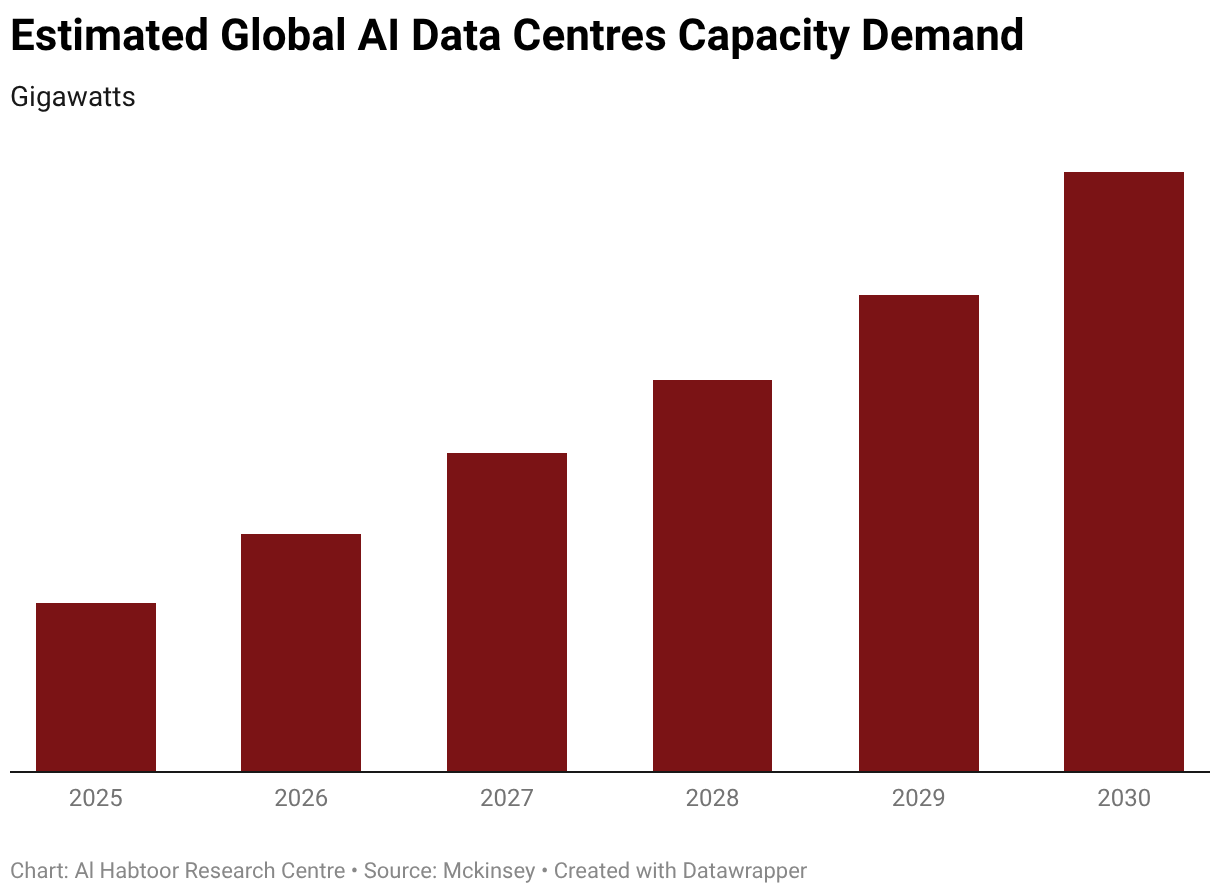
The scale of required capacity makes this transition even more urgent. Goldman Sachs projects that global data center capacity will reach 122 GW by 2030, with most of the new development concentrated in hyperscale and wholesale operators. In addition, McKinsey research shows that the capacity needs for AI could almost triple by 2030, with AI capacity increasing 3.5 times and making up roughly 70% of the total. Thus, meeting this demand would require building more than double the data center capacity deployed since 2000 in less than a decade, which is an impossible target without expanding renewable generation.
To bridge this massive capacity gap and manage the unavoidable strain, the focus must shift immediately from projecting demand to implementing comprehensive, supportive policy frameworks.
Policy Pathways for a Sustainable AI Infrastructure
The solution is not a single technology or policy, it is a coordinated strategy across energy procurement, grid integration, infrastructure planning, and intelligent optimization. Addressing these needs is essential to prevent energy shortages, rising costs, and systemic disruption as AI workloads continue to accelerate. The world’s two largest economies are leading the way, with China’s latest 2025 policy guidelines strengthening its long-running push for efficient, low-carbon, and circular data centers by imposing stricter renewable energy requirements and tightening the Green Electricity Certificate (GEC) system. With data centers driving a significant share of China’s rising electricity demand, national hub facilities must now source at least 80% of their power from renewables by 2030, verified exclusively through GECs. This shift not only accelerates decarbonization but also demands more transparent reporting, improved energy tracking, and strategic investments in Power Purchase Agreements (PPAs), low-Power Usage Effectiveness infrastructure, and site selection in renewable-rich regions such as Inner Mongolia and Gansu.
The U.S. is beginning to introduce ambitious requirements to accelerate the sector’s shift toward clean electricity. Notable examples include New York’s S.6394 bill, which would prohibit fossil-fuel PPAs and require all data centre energy to be renewable by 2040, and Minnesota’s H.F. 2928, which sets a 65% renewable threshold before 2030 and 100% thereafter. Minnesota’s proposal goes further by demanding hourly-level compliance, ensuring data centres meet their real-time 24/7 operational load with renewable electricity rather than relying on deferred credits. Together, these initiatives signal a tightening regulatory landscape and a growing expectation that data centres secure verifiable, time-matched clean power.
Thus, the rapid expansion of AI is driving record growth in data centres, pushing electricity systems, water resources, and supply chains to their limits. With power demand expected to more than double by 2030, traditional fossil-fuel-based grids cannot sustain this trajectory without causing shortages, rising costs, and economic instability. This makes renewable and clean energy the core requirement for AI’s long-term viability. Importantly, China and the U.S. have already begun implementing strict renewable-energy mandates and time-matched clean-power policies for data centres. Their early action demonstrates that transitioning AI infrastructure to verifiable clean energy is no longer an abstract ambition, but an achievable path.
Ultimately, AI’s future will be determined not by computing progress, but by how fast nations scale renewables, modernize grids, and deploy intelligent, flexible energy systems capable of powering continuous AI growth.
References
Baumann, Carsten . “How Data Centers Can Tame the AI Energy Beast While Boosting Performance.” DataCenterKnowledge, 2025, www.datacenterknowledge.com/ai-data-centers/how-data-centers-can-tame-the-ai-energy-beast-while-boosting-performance.
Ciampoli, Paul. “AI to Drive 165% Increase in Data Center Power Demand by 2030: Goldman Sachs | American Public Power Association.” Publicpower.org, 12 Feb. 2025, www.publicpower.org/periodical/article/ai-drive-165-increase-data-center-power-demand-2030-goldman-sachs.
“Data Center Demands.” McKinsey & Company, 20 May 2025, www.mckinsey.com/featured-insights/week-in-charts/data-center-demands.
Dutta, Pratik, and Yogesh Shinde. “Data Centers Statistics and Facts.” Market.biz, 3 Oct. 2025, market.biz/data-centers-statistics/.
“Energy Supply for AI – Energy and AI – Analysis – IEA.” IEA, 2025, www.iea.org/reports/energy-and-ai/energy-supply-for-ai.
“Future of AI: From Massive LLMs to Efficient Agentic Systems | Genta.dev.” Genta.dev, 2025, genta.dev/resources/future-agentic-ai-small-specialized-sustainable
Goldman Sachs. “AI to Drive 165% Increase in Data Center Power Demand by 2030.” Goldmansachs.com, 4 Feb. 2025, www.goldmansachs.com/insights/articles/ai-to-drive-165-increase-in-data-center-power-demand-by-2030.
Ha, Anthony. “How Much of the AI Data Center Boom Will Be Powered by Renewable Energy? | TechCrunch.” TechCrunch, 16 Nov. 2025, techcrunch.com/2025/11/16/how-much-of-the-ai-data-center-boom-will-be-powered-by-renewable-energy/
Leppert, Rebecca . “What We Know about Energy Use at U.S. Data Centers amid the AI Boom.” Pew Research Center, 24 Oct. 2025, www.pewresearch.org/short-reads/2025/10/24/what-we-know-about-energy-use-at-us-data-centers-amid-the-ai-boom/.
Soares, Kristen. “Recap: Data Centers and State Climate Policy.” Climate XChange, 23 May 2025, climate-xchange.org/2025/05/webinar-recap-data-centers-and-state-climate-policy/
West, Darrell M, and Nicol Turner Lee. “The Future of Data Centers.” Brookings, 5 Nov. 2025, www.brookings.edu/articles/the-future-of-data-centers/



The UN and the AI Power Struggle: Who Will Govern the Technology Shaping Global Security?

Water Wars in the Digital Age: Is Technology Coming at the Cost of Our Water Security?
How Washington Built a De Facto AI Licensing Regime

The Age of Vibes: Vibe Coding, Lawyering, and Vibe Everything

Algorithmic Insurgency: How Has AI Enhanced the Capabilities of Terrorist Organisations?

Comments