

Global food security has rarely faced two simultaneous structural shocks of this magnitude. The February 2026 closure of the Strait of Hormuz, triggered by the escalating US-Israel-Iran conflict, severed the world's most critical maritime corridor for energy, fertilizer, and food trade in a single blow. Thousands of miles away, El Niño, a periodic warming of the equatorial Pacific Ocean that triggers droughts, weakens monsoons, and disrupts growing conditions across the globe, is intensifying at a pace forecasters warn could make it one of the most severe events since records began.
Each shock alone would constitute a serious test for global food systems. Together, they converge on a region structurally designed to withstand neither. In 2026, both shocks are unfolding simultaneously, stacked on top of fertilizer markets already in crisis — a compounding that no previous El Niño episode has faced. The question is no longer whether they will converge, but how severe the consequences will be for a region structurally unprepared for either.
Shock One: The Hormuz Disruption and the Fertilizer-Food Chain
The Strait of Hormuz is conventionally understood as an energy chokepoint. This framing is accurate but dangerously incomplete. The strait carries approximately 25 percent of global seaborne oil, 20 percent of liquefied natural gas, and up to 30 percent of internationally traded fertilizer. What makes this combination uniquely dangerous is that these three flows are not independent: energy prices determine fertilizer costs, fertilizer costs determine crop yields, and crop yields determine food prices. A disruption at the strait does not produce three separate shocks, it produces one cascading shock, amplifying itself at each stage.
The conflict in the Middle East has turned the Strait of Hormuz into a critical failure point for global food security. The strait’s closure has reduced tanker traffic by more than 95 percent, disrupting millions of tonnes of fertilizer shipments each month and resulting in an unprecedented shock to agricultural inputs. Unlike the energy crisis of 2022, this disruption hits supply and demand simultaneously, with no viable alternative supply response. Unlike oil, the fertilizer sector has no internationally coordinated strategic reserves, making disruptions structurally harder to absorb.
The consequences cascade through four channels simultaneously. Middle Eastern and North African countries, reliant on imports for 70 to 90 percent of their staple food supply, are cut off from inbound shipments at the same moment Gulf fertilizer exports are stranded. Rising energy prices drive up the cost of living at the consumer level. Fertilizer and fuel costs are squeezing farmer margins, threatening future crop yields. And reduced economic activity in the region economies is compressing remittance flows to households across South Asia, Southeast Asia, and Africa.
The crop calendar sharpens the urgency: fertilizer applications must align precisely with planting windows that cannot be rescheduled without permanent yield losses. FAO estimates that cereal producers could face income losses of up to 5 percent in 2026, with lasting impacts through 2030, while the UN World Food Programme projects that 45 million additional people could face acute hunger if the disruption persists. Across the region, approximately 874,000 people in Lebanon face acute food insecurity, while over 17 million in Yemen are already experiencing high levels of food insecurity — populations for whom this shock arrives with no fiscal buffer and no relief pipeline. Egypt, Jordan, and Sudan face compounding pressures as import costs rise against already-strained foreign currency reserves.
Across the region, where food imports exceed 80 percent of consumption in many states, this transforms an energy disruption into a direct food security risk.
Shock Two: El Niño and the Agricultural Cascade
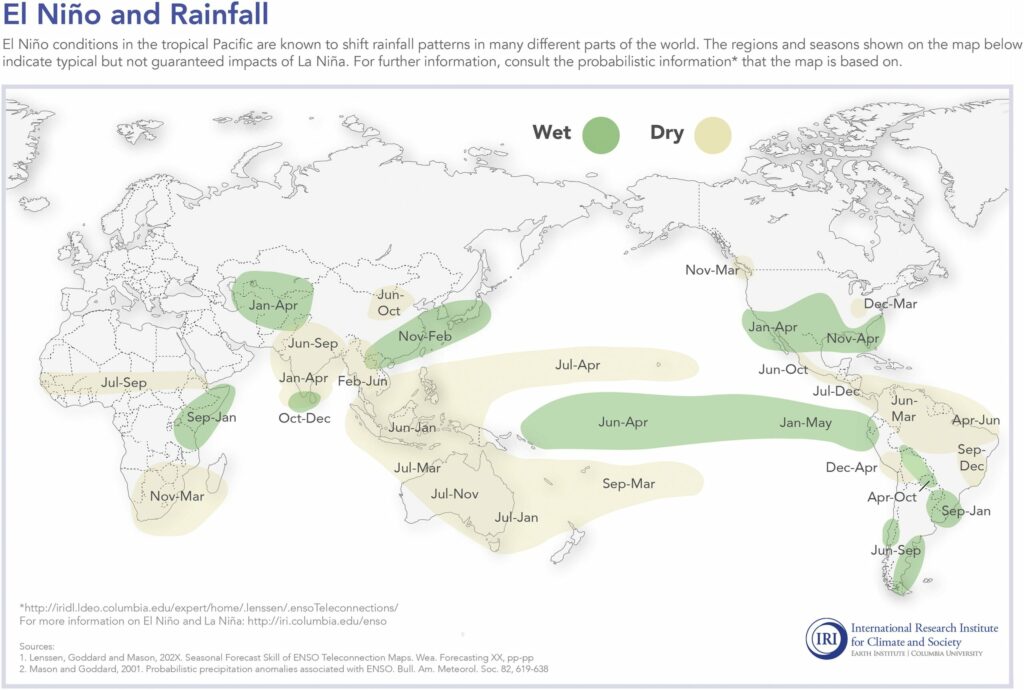
El Niño is a periodic warming of the equatorial Pacific Ocean that reshapes rainfall, temperature, and growing conditions across the globe. It does not produce a single weather event, it redistributes the planet’s heat and moisture, triggering droughts in some regions while flooding others, and consistently disrupting the agricultural systems that the world’s most food-import-dependent nations rely upon.
On June 11, 2026, U.S. National Oceanic and Atmospheric Administration, officially declared El Niño, issuing an El Niño Advisory as sea surface temperatures in the equatorial Pacific exceeded 0.5°C above average for several consecutive months. Forecasters predict a 63 percent chance that the event reaches “very strong” status, with sea surface temperatures exceeding 2.0°C above baseline, by autumn 2026, placing it among the most significant El Niño episodes recorded since 1950. The World Meteorological Organization places the probability of El Niño conditions persisting until at least November at or above 90 percent.
The historical record makes the stakes concrete. The 1991–1992 El Niño triggered severe drought conditions across Southern Africa, virtually halving cereal production across the region, doubling import requirements, and leaving approximately 18 million people facing famine conditions. The 1997–1998 event, the last benchmark for a very strong El Niño killed an estimated 21,000 people and caused infrastructure damage worth $36 billion worldwide. The 2015–2016 event, the strongest since, extended its reach across eastern and southern Africa, Central America, and Oceania, leaving over 10.2 million Ethiopians requiring emergency food assistance, with more than one-third of the country’s districts classified as facing a food security and nutrition crisis, while droughts parched crops and pasturelands across multiple continents, leaving millions hungry and many forced to migrate in search of food. Each of these episodes unfolded under normal global supply conditions. Globally, the same cycle left more than 60 million people in need and prompted $5 billion in humanitarian appeals across 23 countries.

The globalisation of food systems has amplified all of these vulnerabilities. When El Niño strikes, crops face drought and water stress at the same moment fertiliser becomes scarce, logistics networks struggle with rising fuel costs, farmers delay planting decisions, and already-stressed supply chains begin to collapse, driving food prices upward and fuelling hunger, displacement, and social unrest across vulnerable regions.
Individually, each of these shocks has historically strained global food systems. The strategic question for 2026 is not whether either shock is manageable in isolation, but what happens when both occur simultaneously. The Middle East sits at the intersection of these two crises.
The region’s most import-dependent economies are concentrated precisely in the regions expected to experience these climatic disruptions.
The Regional Dimension: Where Both Shocks Converge
No region enters this convergence more structurally exposed than the Middle East and North Africa, and none has less room to absorb it quietly. The blocking of the Strait of Hormuz has made fertilizer scarce just as many farmers need it for their next crop cycles – The announcement of a partial reopening on June 14th by the Trump administration offers limited relief, arriving too late for planting decisions already made and too uncertain to restore market confidence. The consequences extend across the broader region: Egypt, the world’s largest wheat importer, faces acute pressure as import costs surge against dwindling foreign reserves; Jordan and Tunisia, with limited fiscal buffers, face accelerating food price inflation; and Yemen and Sudan, already in humanitarian crisis, have no capacity to absorb further supply shocks.
The Middle East states occupy a uniquely precarious position in this crisis, simultaneously victims of both shocks and transmission points for their regional consequences, a structural vulnerability that no amount of sovereign wealth can fully offset. The first shock constrains the movement of food, while the second reduces the amount of food available to move. Together they simultaneously affect both supply and distribution, leaving few viable substitutes.
Across the Middle East and North Africa (MENA), reliance on imported food is a longstanding structural feature of the region’s food system. The GCC imports approximately 85 percent of its food requirements, while countries such as Egypt, one of the world’s largest wheat importers, source around half of their wheat consumption from international markets. Jordan and Lebanon also depend heavily on food imports to meet domestic demand. More than 70 percent of GCC food imports transit through the Strait of Hormuz, making the region particularly vulnerable to disruptions along this critical maritime corridor. While alternative routes and ports exist, they cannot easily replace the capacity and efficiency of the Strait of Hormuz in the short term. Following the 2008 global food crisis, several Gulf states reduced water-intensive domestic agriculture and increasingly relied on food imports, strategic reserves, and overseas agricultural investments to strengthen food security. That model is now being tested by the convergence of geopolitical disruption and climate-related risks.
This is where El Niño compounds the challenge. The Region depends heavily on food imports from countries that are also among those most vulnerable to El Niño-related weather disruptions. India, the region’s largest rice supplier, is expected to experience below-average monsoon rainfall, while its 2023 rice export restrictions demonstrated how domestic production pressures can quickly translate into tighter global supplies. Australia, an important wheat supplier, faces an elevated risk of drought as El Niño strengthens, while parts of Southeast Asia—key exporters of rice, palm oil, and sugar, are expected to experience drier-than-average conditions that could affect agricultural production. At the same time, disruptions to fertilizer supplies resulting from instability in the Strait of Hormuz could further constrain crop yields. Some market analysts have warned that severe fertilizer shortages could reduce rice production significantly under a worst-case scenario, reinforcing climate-related production losses. The result is a compound risk in which geopolitical disruption constrains the movement of food and agricultural inputs, while El Niño reduces the availability of food from many of the region’s principal suppliers, limiting the region’s ability to diversify imports during a period of heightened global market stress.
While fertiliser shortages and dryness are already curbing yields of smaller crops being harvested in Southeast Asia, the next crop will likely face a bigger reduction.

The result is a multiplier effect that neither shock would produce alone. The Hormuz disruption raises the price of the food the region can access and restricts the volume it can receive, while El Niño reduces the supply available from the countries that would otherwise fill the gap. Consumers across the Gulf and wider region are already reporting rising prices for fruits and vegetables, and local fish markets have been disrupted, early signals of a pressure that is still building across MENA. The Hormuz closure has stranded Gulf fertilizer exports while blocking the inbound food those exports were meant to finance. El Niño now threatens to reduce the global supply available to replace what the strait cannot deliver. The two shocks do not simply add together. They multiply.
Detecting the convergence of these two shocks requires monitoring both climate and geopolitical signals. Key indicators include strengthening El Niño conditions, below-average monsoon rainfall in South Asia, drought forecasts in Australia and Southeast Asia, rising global wheat and rice prices, fertilizer price spikes, and export restrictions by major food-producing countries. At the same time, developments around the Strait of Hormuz, such as increased military activity, higher shipping insurance premiums, tanker rerouting, and disruptions to maritime trade, would signal escalating supply chain risks. Monitoring these indicators together, rather than in isolation, would provide governments with valuable lead time to activate strategic reserves, diversify import sources, and implement anticipatory measures before a full-scale food security crisis emerges.
Preparedness: Acting Before the Window Closes
The convergence of two simultaneous shocks demands a response architecture that no single institution or government has yet designed. The good news is that the tools, frameworks, and early warning systems needed to act already exist. The critical variable is not capability yet, it is speed.
On the El Niño front, FAO’s Agricultural Stress Index System, drawing on 41 years of historical satellite imagery, now allows detailed mapping of where El Niño-linked drought is most likely to impact crops and pasturelands, giving governments and partners the ability to decide where to move first, what support is most urgent, and which communities are least equipped to handle another failed season. In response, FAO and WFP have launched a joint anticipatory action appeal seeking $202 million to protect 8.8 million people across 22 high-risk countries, funding a proven package of interventions including cash transfers, drought-tolerant seeds, livestock support, and water storage systems. FAO Deputy Director-General Beth Bechdol has stated that experience has repeatedly shown that acting before crisis thresholds are reached is both more effective and less costly than emergency response after disasters unfold. The precedent is clear: during the 2023–2024 El Niño event, FAO and WFP supported more than three million people through anticipatory action, delivering assistance months before peak impacts occurred.
On the Hormuz front, the FAO Director-General has outlined a three-horizon response: immediate measures including developing alternative trade routes, enhancing market monitoring, avoiding export restrictions on energy and fertilizers, and providing financial support for farmers; medium-term strategies focused on diversifying import sources and supporting vulnerable countries through emergency food aid; and long-term measures prioritising sustainable agriculture and renewable energy investment. FAO has also activated real-time supply chain surveillance and is collaborating with regional governments to prevent simultaneous panic buying.
Yet the most sobering constraint is time. FAO predicts no more than a three-month window for action before risks escalate significantly, affecting global planting decisions for 2026 and beyond. Early warning becomes effective prevention only when it is acted upon timely and decisively. What happens next depends entirely on how quickly decisions follow. With El Niño intensifying through autumn and the Hormuz situation still unresolved, that window is not a policy horizon, it is a countdown.
Thus, the convergence of the Hormuz disruption and El Niño is not a theoretical risk scenario — it is an unfolding reality, and the Middle East sits at its most exposed point. Strategic reserves were built for single shocks. Import networks were designed for stable geopolitics. Subsidy architectures were calibrated for manageable price fluctuations. None of these buffers were engineered for what 2026 is now delivering simultaneously. The fertilizer markets are already in crisis, the supplier countries the region depends on are already under climate stress, and the maritime corridor that carries the region’s food is only partially and uncertainly reopened. What this moment demands are not emergency response; it is anticipatory governance. The early warning signals are visible, the risk geography is mapped, and the institutional frameworks for action exist. The only variable that remains is political will, and the cost of delay is being measured not in policy cycles, but in harvests already lost and hunger already deepening.
References
Arab News. 2026. “GCC States ‘Face Reliance on Saudi Arabia for Food Imports.’” Arab News. Arabnews. March 6, 2026. https://www.arabnews.com/node/2635430/middle-east.
“Climate Prediction Center: ENSO Diagnostic Discussion.” 2026. Www.cpc.ncep.noaa.gov. June 11, 2026. https://www.cpc.ncep.noaa.gov/products/analysis_monitoring/enso_advisory/ensodisc.shtml.
“El Niño / La Niña Phenomena.” 2022. World Meteorological Organization. December 16, 2022. https://wmo.int/topics/el-nino-la-nina-phenomena.
FAO. 2026. “FAO Cereal Supply and Demand Brief | Food and Agriculture Organization of the United Nations.” WorldFoodSituation. July 3, 2026. https://www.fao.org/worldfoodsituation/csdb.
Lenssen, Nathan J. L., Lisa Goddard, and Simon Mason. 2020. “Seasonal Forecast Skill of ENSO Teleconnection Maps.” Weather and Forecasting 35 (6): 1–60. https://doi.org/10.1175/waf-d-19-0235.1.
OECD (2026), Policies for the Future of Farming and Food in Egypt, OECD Agriculture and Food Policy Reviews, OECD Publishing, Paris, https://doi.org/10.1787/cab0cefd-en.
Safty, Sarah El, and Maha El Dahan. 2026. “Gulf Food Strategy Tested as Iran War Snarls Shipping Routes.” Reuters, March 5, 2026. https://www.reuters.com/world/middle-east/gulf-food-strategy-tested-iran-war-snarls-shipping-routes-2026-03-05/.
Thukral, Naveen, and Panarat Thepgumpanat. 2026. “From Surplus to Strain: World Rice Supply Threatened by Iran War, El Nino.” Reuters, April 30, 2026. https://www.reuters.com/world/asia-pacific/surplus-strain-world-rice-supply-threatened-by-iran-war-el-nino-2026-04-30/.
“UN World Food Programme (WFP).” 2026. Wfp.org. March 17, 2026. https://www.wfp.org/news/wfp-projects-food-insecurity-could-reach-record-levels-result-middle-east-escalation.
Zahedi, Kaveh. 2026. “El Niño Is Coming. At the FAO We Know Where Drought Will Hit Hardest.” Reuters, June 29, 2026. https://www.reuters.com/sustainability/el-nio-is-coming-fao-we-know-where-drought-will-hit-hardest–ecmii-2026-06-29/.


Related Articles
What If: The Middle East Burns Next?
Navigating Climate Risk in the Era of Green Transition
Racing Against Time: Climate Action in Crisis
Clean Commitments, Clean Data Centres?

Red Alert: Pneumonic Plague in Siberia
Comments