

Economic and geopolitical relations between China and Israel have undergone significant changes following the War on Gaza. Chinese regulatory authorities moved to classify certain areas within Israel under what is known as the Red Category, an official administrative designation that identifies these locations as high-risk investment zones. This classification imposes legal restrictions that prevent the injection of new financial investments into these areas.
As a result, a legal environment has emerged in which Chinese companies rely on security warning protocols and personnel safety considerations as a formal justification for controlling capital flows and suspending the implementation of certain financial obligations under previously signed contracts. This development necessitates a careful examination to understand how these risk assessment mechanisms operate and their tangible impact on the economic relationship between the two countries.
The Commercial and Legal Dispute Surrounding Hanita Lenses
The District Court in Tel Aviv is currently examining a prominent legal dispute between members of Kibbutz Hanita and the Chinese investment fund Ballet Vision. This case illustrates how geopolitical risk assessments can influence commercial contracts concluded in Israel.
The origins of the dispute date back to 2021, when the administration of Kibbutz Hanita sold a 74% controlling stake in Hanita Lenses, a company specialising in the manufacture of medical lenses, to the Chinese fund. The total value of the transaction reached $35 million, with $25 million distributed among the kibbutz members, while $10 million was injected directly into the company to support and expand its operations.
Notably, the contract included a clause granting Israeli shareholders the option to compel the Chinese fund to purchase their remaining stake, estimated at between 20% and 26%, by early December 2025. The execution price for this option was set at $9.5 million, while its current adjusted financial value is estimated at approximately $11 million.
When the Israeli shareholders attempted to activate this option in late 2025, the fund refused to complete the purchase. The fund justified its position by submitting documents to the court indicating that the Chinese government had designated Israel as an area classified as extreme risk, known as the Red Category. This designation prohibits the injection of any new investments.
On this basis, the fund grounded its legal defence in the argument that this governmental classification constituted a force majeure that prevented it from fulfilling its contractual obligations. It maintained that it lacked the operational capacity to transfer funds as long as these restrictions remained in force.
On the other hand, available data indicate that Hanita Lenses’ financial position has been deteriorating steadily. In December 2025, a letter from Liu Yuxiao, a director of the Chinese fund and the company’s chief executive officer, revealed that the company had accumulated operating losses amounting to $15 million over three years, in addition to $4 million in outstanding debt. The letter further confirmed that the company was experiencing a severe financial crisis and that its parent company in China was unable to provide additional funding, forcing the firm to rely on shareholder loans to sustain operations.
An analysis of these figures suggests that the Chinese fund may be invoking Chinese government guidelines to avoid injecting an additional $11 million into a financial asset that is already loss-making and geographically located in an active war zone. The following figure presents the company’s financial data for the period 2021–2025.

Deconstructing Risk Classification and Regulatory Mechanisms in the Chinese System
To understand how the Chinese fund invokes these guidelines, it is necessary to examine the mechanisms of risk classification and regulatory oversight within the Chinese system. The Chinese government relies on multiple instruments to control capital outflows and direct overseas investments, deliberately avoiding the issuance of explicit economic sanctions to minimise the risk of diplomatic disputes.
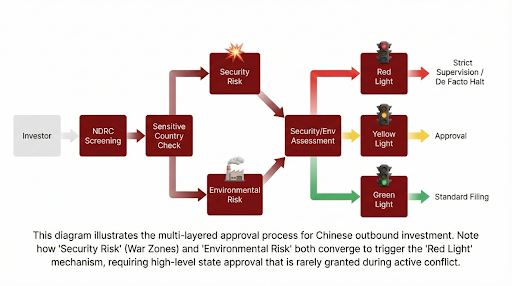
One of the most prominent instruments is the “Traffic Light” system administered by the Chinese Ministry of Commerce (MOFCOM), which categorises outbound investment projects into three principal groups. The green category includes encouraged projects, while the yellow category encompasses projects with neutral impact. The red category, by contrast, includes projects deemed to carry high risk and therefore subject to strict governmental supervision, which often results in the suspension of investment activity.
Following 2023, Chinese authorities expanded the definition of risk within this framework to include security and public order considerations. Under this approach, a project may be classified directly within the red category if foreign investment is assessed to pose a threat to the safety of assets or personnel in areas experiencing armed conflict.
In addition, the National Development and Reform Commission (NDRC) administers a second regulatory framework through what is known as “Order No. 11”, which governs the channels of outbound investment for all Chinese companies and classifies countries worldwide into sensitive and non-sensitive categories.
The sensitive list includes countries experiencing armed conflict or subject to international sanctions, where investment requires prior government approval. By contrast, investment in non-sensitive countries is subject only to standard administrative registration procedures. As Chinese authorities currently classify Israel, particularly areas affected by military operations, among the sensitive jurisdictions, regulatory bodies refrain from granting such approvals for Israeli projects.
As a result, private companies suspend financial transfers and invoke this administrative refusal as a legal justification for terminating commercial contracts, a practice often described as “silent sanctions”. This strategy allows the Chinese government to preserve its diplomatic relations and deny the existence of an official boycott. At the same time, capital flows effectively cease as government institutions halt the processing of foreign currency transfer requests without providing formal explanations.
This regulatory architecture is further complemented by a third mechanism issued by the Chinese Ministry of Foreign Affairs (MFA) in the form of safety and travel advisories directed at Chinese citizens. In February 2026, the Chinese embassy in Israel clarified that the Red Category classification applies geographically to areas bordering the Gaza Strip and Lebanon.
This point is central to the legal dispute. The headquarters of Hanita Lenses is located in Kibbutz Hanita, situated directly along Israel’s northern border with Lebanon, an area that has been subjected to continuous rocket fire. Because the company falls within the geographic scope covered by the security warning, the internal compliance mechanisms of Chinese companies prohibit the transfer of capital in order to safeguard personnel.
Through this layered system of administrative controls, the Chinese government can effectively reduce exposure to high-risk investments while providing Chinese firms with a strong legal framework to withdraw from costly obligations and exit unstable markets. The following figure illustrates the multi-layered approval structure governing Chinese outbound investment.
Statistical Divergence Between Investment Volumes and Bilateral Trade Levels
While the regulatory and administrative mechanisms outlined above provide Chinese companies with a convenient legal framework to withdraw from unstable markets, their tangible impact is evident in economic statistics from 2024 and 2025, which show a sharp decline in the volume of Chinese foreign direct investment (FDI) directed towards Israel.
This gradual contraction began after Chinese investment peaked in 2018 and has accelerated significantly in recent years. China’s share of total foreign investment in Israel has declined markedly to below $0.5 billion, while the United States has retained its position as the dominant investor, accounting for 62% of total inbound investment flows in 2024.
This investment decline in Israel aligns with a broader contraction in China’s global outward direct investment (ODI), which fell by 27% in 2024 due to the slowdown in China’s domestic economic growth and the implementation of stricter capital outflow controls.
Israel’s advanced technology sector has also undergone a fundamental structural shift in the nature of its economic cooperation with Chinese investors. The era of large-scale direct acquisitions by Chinese entities aimed at taking full ownership of Israeli technology firms has effectively come to an end. In its place, a new operational model has emerged, commonly described as the “Idea-to-Product” pathway. This model is based on a clear division of roles. Israel provides intellectual property rights (IP) and develops prototype designs, while China contributes its extensive capabilities in mass manufacturing and large-scale commercial expansion.
In line with this emerging approach, Israeli technology firms such as Foresight Autonomous, which specialises in autonomous driving technologies, have begun establishing subsidiaries within the Chinese market. This arrangement enables Israeli companies to access the Chinese market directly without granting Chinese investors equity ownership in the parent company headquartered in Israel.
In this way, commercial cooperation between the two sides can continue while avoiding the sensitivities surrounding ownership and regulatory scrutiny that have increasingly constrained foreign direct investment flows.
At the same time, Chinese venture capital (VC) funds have significantly scaled back their participation in financing Israeli companies. To fill this funding gap, data from 2025 show that United States investors intervened decisively, participating in 62% of total deals, while Chinese involvement declined sharply. No major new Chinese investment funds were announced during this period. This retreat was largely driven by the risks associated with the Red Category classification, which heightened concerns among Chinese limited partners (LPs). As a result, many refused to commit capital to investment cycles that typically extend for ten years in a region experiencing active conflict.
In stark contrast to this investment decline, bilateral trade flows have followed a strong and opposite trajectory. In 2024, Israeli imports from the Chinese market reached a record level of $13.5 billion, up 19.8% year-on-year, while total bilateral trade between the two countries reached $22.7 billion. Estimates for the period January to October 2025 indicate that this momentum continued, with total bilateral trade rising to $27.4 billion, even as new direct investment nearly halted, remaining below $0.5 billion.
This clear divergence confirms that the restrictions associated with the Red Category classification apply exclusively to the capital account, meaning long-term investments and financial commitments, and do not extend to the current account, which encompasses daily commercial transactions and the export of goods. By maintaining this strict separation between trade and investment channels, Beijing adopts a pragmatic approach that allows it to preserve profitable export markets while simultaneously limiting the exposure of its long-term capital assets to geopolitical risk.
Immediate Economic and Geopolitical Repercussions for the Israeli Market
The negative effects associated with the Red Category risk classification have not been confined to the advanced technology sector or the decline in financing. They have extended to other vital sectors of the Israeli market. The construction sector, in particular, has faced a severe and ongoing crisis due to a significant shortage of skilled labour following the Chinese government’s prohibition on its citizens travelling to Israel for work in compliance with safety advisories.
This decision coincided with the suspension by Israeli authorities of work permits previously granted to Palestinian labourers. The combined effect produced an exceptional disruption to the labour supply, slowing the pace of real estate development and delaying the delivery of major infrastructure projects, thereby imposing substantial financial losses on developers.
To interpret this Chinese approach, current risk management policies can be compared with Beijing’s stance towards the conflict in Ukraine. China maintained a formally neutral position while simultaneously suspending large-scale new investments in order to avoid the material risks associated with the war.
Within this context, the Chinese classification can be viewed as a pragmatic and rational response aimed at protecting assets and personnel from the direct dangers of military operations and the mobilisation of reserve forces, rather than a purely ideological boycott.
Nevertheless, broader geopolitical factors that influence the relationship cannot be ignored. Among the most significant are the tensions surrounding Taiwan, particularly in light of reports indicating that Israel has provided defence technologies to Taiwan, including components associated with the Green Pine radar system. These developments prompted China to issue explicit warnings to Israel. Accordingly, the freezing of investments may also function as a strategic warning signal and a calibrated instrument of economic pressure, conveying the message that continued economic cooperation remains conditional upon respect for Beijing’s core strategic interests.
Over the long term, greater risks arise from the Israeli economy’s growing reliance on Chinese companies not only in construction but also in the operation and maintenance of critical infrastructure projects, including ports and power stations. The most serious concern is that the Chinese government could, in the future, expand the scope of Red Category restrictions to include service and maintenance contracts, which would pose a direct challenge to Israeli national security.
For example, if a Chinese company such as HEI were to withhold technical support for the turbines at the Dalia power plant during a military emergency, the consequences could be decisive. Such a disruption would negatively affect the stability of the electricity grid and potentially threaten Israel’s entire energy security.
In conclusion, the current trend of declining Chinese investment in Israel is likely to deepen over the short and medium term until regional geopolitical conditions stabilise and Israel reduces its military cooperation with Taiwan. The trajectory of this development will become clearer through the careful monitoring of three key indicators.
The first indicator concerns the anticipated judicial ruling in the Hanita Lenses case. Should the court recognise the Red Category classification as a form of force majeure that exempts the Chinese fund from its contractual obligations, this would establish a legal precedent that could encourage other Chinese firms to withdraw from their contractual commitments in Israel.
The second indicator involves monitoring the project timelines of the Dalia Energy power stations. Any delays or withdrawal by Chinese contractors from these critical infrastructure projects would signal a transition from passive investment restraint to the active use of economic coercion.
The third and final indicator relates to the official approvals issued by the National Development and Reform Commission (NDRC). A complete halt in the issuance of outbound investment licences, even for projects classified as non-sensitive, would confirm the emergence of a silent Chinese governmental blockade and an undeclared financial boycott of the Israeli economy.
References
Nova, Redazione Agenzia. 2026. “Israeli Media: China Reportedly Banned New Investments in the Jewish State.” Agenzia Nova. February 5, 2026. https://www.agenzianova.com/en/news/media-israele-la-cina-avrebbe-vietato-nuovi-investimenti-nello-stato-ebraico/
Tomer Gonen. 2026. “‘The Chinese Government Bans All New Investment in Israel.’” Ynetglobal. February 2, 2026. https://www.ynetnews.com/business/article/skeqnl08wg
Ganon, Tomer. 2026. “Chinese Fund: ‘the Chinese Government Has Imposed a Ban on Any New Investment in Israel.’” Ctech. February 2, 2026. https://www.calcalistech.com/ctechnews/article/rlw9l86qt.
Editor. 2026. “China Labels Israeli-Occupied Lands as ‘High Risk Area,’ Bans All New Investments: Report – MR Online.” Mronline.org. 2026. https://mronline.org/2026/02/09/china-labels-israeli-occupied-lands-as-high-risk-area-bans-all-new-investments-report/.
“Chinese Embassy in Israel Refutes False Reports Claiming ‘China Bans Investment in Israel’ – Global Times.” 2026. Globaltimes.cn. 2026.https://www.globaltimes.cn/page/202602/1355318.shtml
“February 6, 2026 – European Palestinian Council for Political Relations.” 2026. Eupac.org. February 6, 2026. https://www.eupac.org/2026/02/06/.
Losos, Elizabeth C, and T Robert Fetter. 2022. “Building Bridges? PGII versus BRI.” Brookings. September 29, 2022. https://www.brookings.edu/articles/building-bridges-pgii-versus-bri/


Related Articles
Geography Under Siege: How the Sea Became Israel’s Greatest Vulnerability

Beyond PEPFAR: How America’s Aid Retreat Is Reshaping Global Health Governance

The Civilian Face of Chinese Sea Power
Modern Warfare: Can Military Components Become China’s Greatest Strategic Weapon?

The Economics of Reusable Launch Vehicles and the Competition over Low Earth Orbit
Comments