

Iran has blocked maritime navigation through the Strait of Hormuz since the first week of March, following the attacks it sustained during Operation Epic Fury. This disruption has hindered the movement of nearly 20 million barrels of crude oil per day. It has trapped shipments of liquefied natural gas, accounting for around 20% of global consumption, within the waters of the Arabian Gulf. As a result, international energy markets are experiencing sharp price volatility affecting Brent crude futures and European gas contracts.
At the same time, maritime shipping lines have been compelled to reroute their commercial fleets, forcing them to navigate around the historic Cape of Good Hope route at the southern tip of Africa. This enforced geographic diversion adds approximately 19 days to maritime transit times to and from Asia, generating weekly losses for global supply chains estimated at between $2 billion and $3 billion in additional operating and fuel costs.
This operational disruption directly affects the technological infrastructure of East Asia, where advanced semiconductor fabrication facilities in Taiwan and South Korea require vast, continuous electricity supplies to operate lithography systems around the clock. These critical facilities, which account for approximately 68% of global semiconductor production, rely on imported liquefied natural gas to ensure the stability of their power networks and prevent disruptions.
In parallel, the precision manufacturing processes involved depend on highly specialised raw materials whose primary sources are concentrated in regions currently affected by the crisis. In particular, production lines require ultra-high-purity helium gas, extracted as a by-product from Gulf LNG liquefaction facilities, which represent roughly 35% of global supply, as well as bromine, which Korean factories import at a rate of 97.5% from the Dead Sea coast for chemical etching processes. Accordingly, technology firms are accelerating efforts to assess their exposure to the dual energy and critical chemical input shortages. At the same time, economic stakeholders monitor the crisis's trajectory with heightened caution to safeguard supply chain continuity.
Accordingly, this analysis examines the strategic and operational implications arising from the closure, focusing on three principal dimensions. First, it addresses the disruption of liquefied natural gas supplies and their direct impact on the security of power grids that sustain major Asian semiconductor manufacturing hubs. Second, it examines the sharp interruption in the supply of critical raw materials, particularly specialised gases and petrochemical inputs required for precision manufacturing processes. Finally, it explores the logistical repercussions of the forced rerouting of maritime shipping routes, as well as the strategic measures states are considering to mitigate future geopolitical risks.
The Liquefied Natural Gas Crisis and its Direct Implications for the Asian Semiconductor Industry
The Strait of Hormuz exerts decisive control over global liquefied natural gas distribution routes, serving as a critical artery for energy flows to major industrial economies. In 2024, Qatar exported approximately 9.3 billion cubic feet per day of liquefied natural gas through this maritime corridor, while the United Arab Emirates contributed an additional 0.7 billion cubic feet per day. Combined, these volumes account for nearly 20% of global LNG trade. Moreover, the overwhelming majority of these shipments, ranging between 83% and 90%, are directed toward Asian markets. Against this backdrop, the suspension of production at Qatar’s large-scale liquefaction facilities following military strikes, coupled with the physical closure of the strait, abruptly removed roughly one-fifth of global supply from the market. Consequently, QatarEnergy Company declared force majeure as a legal measure to halt deliveries, causing liquidity in the spot market to evaporate and leaving dozens of large LNG carriers stranded within the waters of the Arabian Gulf.
Conversely, major Asian economies import vast volumes of liquefied natural gas to ensure the stability of their power grids and sustain advanced industrial production. China ranked as the world’s largest importer in 2024, with total imports reaching 77 million tons annually, followed by Japan (66 million tons), South Korea (more than 47 million tons), and Taiwan (approximately 22 million tons). Against this backdrop, the industrial architecture of the semiconductor manufacturing sector in East Asia faces a structural threat that directly affects overall production capacity and infrastructure stability. Collectively, these economies account for nearly half of global LNG demand. At the same time, their fabrication facilities, which host some of the world’s most critical semiconductor foundries, depend fundamentally on the uninterrupted arrival of these refrigerated maritime shipments to prevent power outages. The following figure illustrates the import structure of these economies and Qatar’s share within their supply mix:

Taiwan’s technological infrastructure is the most severely affected by the sharp decline in gas supplies. Taiwanese manufacturing facilities produce roughly 70% of the world’s advanced semiconductors used in smartphones, computers, and data centres. In addition, Taiwan Semiconductor Manufacturing Company (TSMC) and other domestic firms account for approximately 68% of global chip production, with these facilities operating at energy consumption levels that exceed those of conventional industrial models.
At the same time, this large industry faces a structural shortage of domestic energy resources. Taiwan is implementing a gradual phase-out of its nuclear power infrastructure based on earlier policy decisions, including the closure of unit two of the Maanshan nuclear power plant in May 2025. As a result, Taiwan’s dependence on imported fossil fuels has intensified, with Qatari supplies alone accounting for about 33.5% of the island’s total LNG imports in 2025, alongside additional shipments from the United Arab Emirates. Analytical projections further indicate that by 2030, the electricity consumption of Taiwan’s semiconductor industry will exceed twice that of New Zealand. Consequently, the sudden evaporation of baseload supply places Taiwan’s power grid under severe strain. It threatens the continuity of electricity flows required to operate silicon foundries running continuously, twenty-four hours a day and throughout the year.
Conversely, South Korea’s power grid faces significant exposure to the repercussions of the unfolding crisis in the Arabian Gulf, posing a direct threat to its industrial stability. Seoul currently imports more than 70% of its crude oil requirements and about 20% of its natural gas from the Middle East, despite maintaining long-term strategic plans to gradually reduce reliance on gas over the coming decade in favour of renewable and nuclear energy. At present, however, the country depends heavily on liquefied natural gas to balance its electricity grid and ensure stable energy supplies for major semiconductor facilities such as Samsung and SK Hynix, which together produce more than half of the world’s dynamic and flash memory chips.
The fundamental reason for the severity of this situation lies in the extreme sensitivity of precision manufacturing processes to even minor fluctuations in electricity supply. Any momentary drop in voltage or a brief interruption lasting only fractions of a second within a fabrication facility can instantly destroy tens of thousands of silicon wafers during the deposition and etching stages, which require months of continuous processing. Such technical disruptions impose losses worth hundreds of millions of dollars on companies through damaged inventory, compromised equipment, and prolonged shutdowns of industrial facilities. Consequently, even the mere prospect of such interruptions has triggered waves of alarm across global financial markets. Following the military strikes in the Middle East, South Korea’s KOSPI index recorded its largest single-day decline of 12.06% amid heavy selling in Samsung and SK Hynix shares. In comparison, Taiwan’s TAIEX index fell 4.4% as investors reacted to the risk of paralysis in the technology infrastructure.
The Helium Supply Crisis and its Direct Implications for the Global Semiconductor Industry
Helium possesses exceptional physical and thermodynamic properties, rendering it a highly scarce strategic resource. The element is classified as the most stable and inert, as it neither combusts nor reacts with other chemical elements under standard conditions. Moreover, helium has the lowest melting and boiling points among all known substances, remaining liquid even at temperatures approaching absolute zero. Accordingly, advanced semiconductor fabrication facilities rely on this specialised gas to continuously cool silicon wafers during plasma etching and chemical deposition processes. In addition, helium plays a critical role in operating superconducting magnets used in medical imaging systems and quantum computing technologies.
To understand helium’s connection to the Strait of Hormuz, it is first necessary to recognise that helium is rarely extracted directly from underground in its pure form. Instead, it is recovered as an exclusive by-product during natural gas processing, and the process becomes economically viable only when its concentration exceeds 0.1%. For this reason, helium extraction facilities are fully integrated into the large-scale liquefied natural gas infrastructure of countries such as Qatar and Algeria.
This complex engineering process relies on recovering evaporated gases and residual gases generated during deep cryogenic cooling. The helium-rich stream then passes through multiple compression stages using specialised systems developed by companies such as Linde and ExxonMobil, with pressure ratios increasing by approximately 1.4 to 2.2 per stage until reaching final levels between 1,500 and 4,000 kilopascals. The gas is subsequently subjected to intense cooling to -169 degrees Celsius to separate nitrogen from heavier impurities, followed by catalytic filtration to remove hydrogen and water. Finally, the resulting stream enters cryogenic purification systems based on pressure swing adsorption to achieve ultra-high purity of 99.999%. The purified helium is then liquefied and transported globally in highly insulated, specialised containers. The following figure illustrates global helium production and each country’s share of total output:
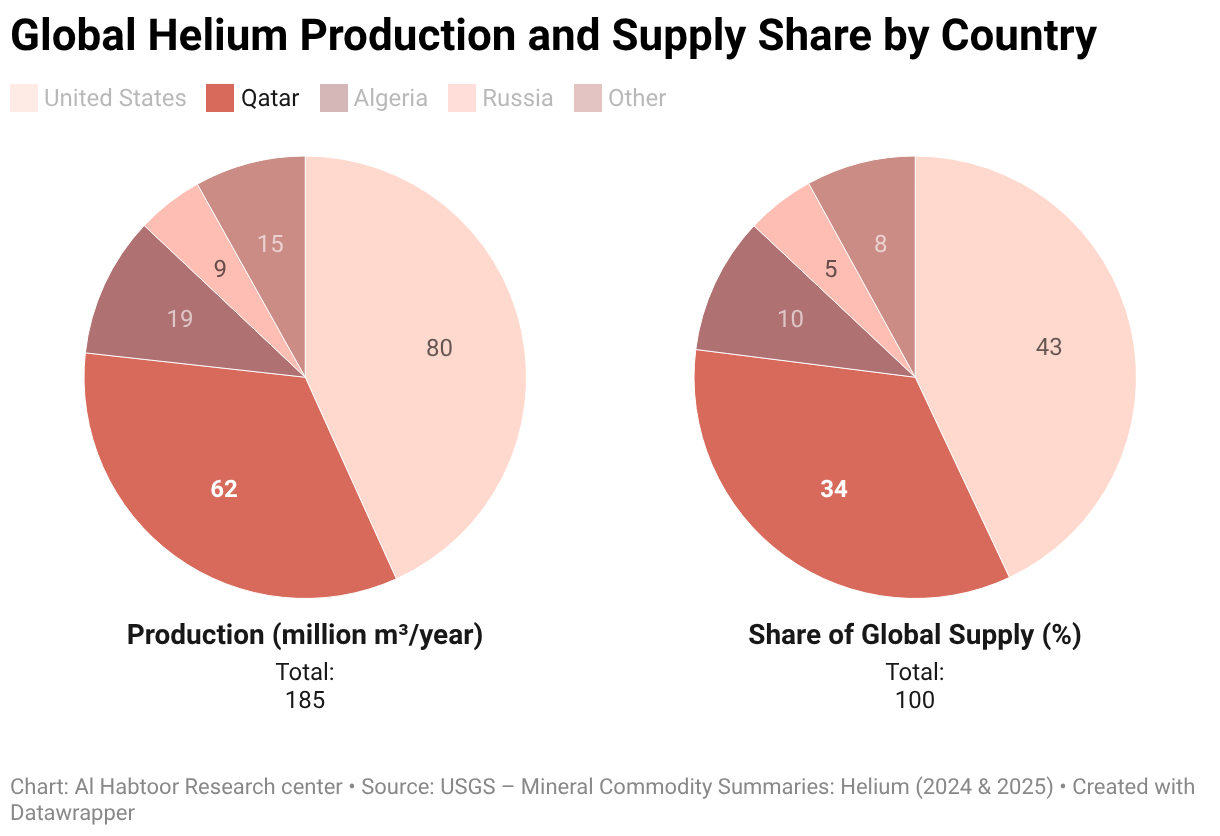
On the demand side, the global helium market exhibits a high degree of concentration in supply sources, as commercial production requires vast, continuous volumes of natural gas. Global helium demand reached 177.3 million cubic meters in 2025, while total production capacity stood at approximately 175 million cubic meters annually. As a result, the market operates within a structurally tight environment where demand closely matches supply, generating persistent upward pressure on prices.
Meanwhile, the semiconductor sector alone accounts for between 24% and 30% of total global helium demand, surpassing cryogenic medical applications. Analytical projections indicate that demand will continue to expand at a compound annual growth rate of 5% to 6% through 2035, driven by the rapid expansion of artificial intelligence infrastructure. Within this context, Qatar plays a dominant role in global supply chains, providing roughly 35% of the world’s commercial helium, supported by ongoing expansion projects such as Qatar-3. Consequently, the suspension of Qatari liquefaction facilities following military strikes, combined with the physical closure of the Strait of Hormuz, has abruptly removed more than one-third of global helium supply from the market.
In this context, data from the Korea International Trade Association (KITA) indicate that Korean manufacturing facilities relied on Qatar to supply 64.7% of their total helium imports in 2025. Major memory chip producers, particularly Samsung and SK Hynix, require massive and uninterrupted flows of ultra-high-purity helium to manage the intense thermal density associated with the development of advanced 2-nanometer and 3-nanometer chips. Although these firms have attempted to diversify their supply sources and build strategic reserves following the neon gas disruption triggered by the Russia–Ukraine war in 2022, alternative markets have not been able to replace the large volumes lost from Qatar quickly enough. Emerging helium projects in Canada’s Saskatchewan province, as well as new exploratory wells in northern Montana in the United States, lack the immediate production capacity needed to close the gap. Consequently, the continued closure of maritime routes translates directly into severe financial pressures on procurement costs. It inevitably reduces output levels of advanced memory chips due to cooling constraints that limit the operational capacity of global semiconductor foundries.
Fracturing of Supply Chains and Maritime Logistics Amid Escalating Global Tensions
The physical closure of the Strait of Hormuz is forcing a costly and comprehensive reconfiguration of global maritime shipping routes, effectively amplifying the logistical disruptions that affected the Red Sea and the Suez Canal in early 2024. Following the issuance of strict warnings by Iran’s Islamic Revolutionary Guard Corps (IRGC) prohibiting the passage of commercial vessels, alongside direct operational attacks using drones and missiles, the United Kingdom Maritime Trade Operations (UKMTO) promptly raised the security threat level in this strategic corridor to critical. Consequently, maritime insurers immediately cancelled war-risk coverage policies or imposed sharply higher premiums on vessels operating in the area. As a result, commercial transit through the strait declined by approximately 90% almost immediately, reducing the historical daily average of between 138 and 153 vessels to only between four and thirteen maritime passages.
At the same time, major global shipping companies, notably Maersk, Hapag-Lloyd, MSC, and CMA CGM, adopted coordinated strategic decisions to suspend all voyages through the waters of the Arabian Gulf within 48 hours of the escalation of military operations. These maritime alliances activated pre-established contingency plans, redirecting their large commercial fleets toward an alternative route around the Cape of Good Hope at the southern tip of Africa. This forced geographic diversion to avoid the Middle East adds approximately 19 days to westbound journeys along the main trade corridors linking Asia with Europe or the eastern coast of the United States, while adding about seven days to eastbound routes, thereby imposing substantial burdens on the global maritime transport sector.
Modern container vessels operate within strict six-week operational cycles, imposing fixed daily costs on operators ranging from $20,000 to $40,000, regardless of cargo utilisation rates. Consequently, the imposition of a 19-day delay per voyage reduces the annual shipping capacity of the global transport fleet by an estimated 10-15%. Moreover, the extended route requires approximately 200 additional hours at sea, consuming hundreds of tons of supplementary fuel and increasing crew labour costs. Accordingly, this forced rerouting imposes an unavoidable structural burden on global trade flows, with analytical assessments estimating additional operating costs of between $2 billion and $3 billion per week.
In the same context, this logistical delay deals a severe blow to the semiconductor manufacturing sector, which relies heavily on precise supply timing to receive large-scale fabrication equipment worth millions of dollars, as well as highly sensitive chemical inputs required for cleanroom operations. Moreover, the logistical paralysis directly affects manufacturing activities within zones of geopolitical tension.
Tower Semiconductor in Israel, regarded as one of the leading global foundries specialising in analogue integrated circuits, power management, and radio-frequency technologies, faces acute disruptions to inbound and outbound shipments due to the state of emergency and the closure of airspace and commercial ports. The company’s products hold significant industrial importance in the automotive, aviation, and heavy manufacturing sectors, industries characterised by lengthy engineering certification cycles and limited availability of rapid technological substitutes, factors that have historically supported the company’s pricing power and elevated profit margins.
As a result, global chip design firms and fabless technology companies, including Broadcom, Intel, and ON Semiconductor Corporation, have been compelled to activate urgent contingency plans to prevent finished silicon wafers from becoming stranded within Israel. Accordingly, these companies have rapidly redirected their industrial orders toward alternative foundries operating within Taiwan’s comparatively stable geopolitical environment, particularly Vanguard International Semiconductor Corporation and Powerchip Semiconductor Manufacturing Corporation (PSMC). This tactical shift reflects the close technological compatibility and alignment of engineering processes between these Taiwanese facilities and Tower Semiconductor’s specialised operations. The sudden and unexpected migration of international orders has consequently absorbed nearly all surplus production capacity within the Taiwanese market, placing significant operational pressure on legacy chip fabrication lines and inevitably driving up global average selling prices while extending scheduled delivery timelines for end customers.
The Systemic Implications of the Closure for the Semiconductor Manufacturing Sector
These three concurrent crises, namely the disruption of liquefied natural gas supplies, the shortage of specialised gases, and the breakdown of maritime shipping routes, are imposing an exceptionally complex operational environment on the economics of global semiconductor manufacturing. The threat to the stability of power grids in Taiwan and South Korea is forcing major foundries to reduce capacity utilisation as a strict precaution to avoid sudden power outages that could damage extreme ultraviolet lithography machines, each costing more than $350 million.
At the same time, the sector faces a severe shock from the loss of approximately 35-40% of global helium supply from Qatar, driving spot helium prices above $450 per thousand cubic feet in 2026. Consequently, fabrication facilities are facing significant engineering and financial challenges in securing the critical cooling required for advanced 3-nanometer and 2-nanometer silicon chips during chemical etching.
Moreover, the forced rerouting of maritime shipping around the Cape of Good Hope imposes substantial additional burdens, as insurance and transport costs rise while supply chains for precision equipment face delays of approximately 19 additional days. As a result, the baseline cost of silicon chip production increases sharply. To illustrate the scale of this impact, the manufacturing cost of a single wafer using 3-nanometer technology stands at around $20,000 under standard conditions. At the same time, projections indicate that the cost of producing 2-nanometer wafers will exceed $30,000. In this context, logistical disruptions and the scarcity of critical materials further intensify overall cost pressures, compelling Asian foundries to pass these unavoidable increases directly on to technology design firms to protect their profit margins.
This accumulating financial and temporal burden is transmitted directly and progressively to end-consumer markets, reshaping the pricing structure of both consumer and enterprise technology products. In this context, the global automotive industry faces a sharp shortage of analogue integrated circuits and legacy chips, recalling the historic supply chain crisis of 2021, which cost automakers approximately $210 billion in lost revenue and forced them to scale back production and raise vehicle prices.
In the same context, manufacturers of smartphones and personal computers are compelled to raise retail prices by noticeable margins of 10% to 15% to offset higher electronics transport costs, which historically increase by around 20% during comparable logistical crises. This is accompanied by extended waiting periods for consumers, with delivery timelines for new devices stretching to several months. At the same time, the infrastructure sector supporting artificial intelligence technologies bears the most significant economic impact of this dual structural crisis. Major data centres rely heavily on advanced graphics processors and high-bandwidth memory chips, which in turn require complex packaging processes that depend on petrochemical resins, whose prices have risen alongside higher oil import costs. Consequently, the scarcity of these sophisticated components and the rising costs of their production significantly increase the capital expenditures required to build and expand regional artificial intelligence server infrastructure by millions of dollars.
In conclusion, these combined repercussions are laying the groundwork for a phase of broad price inflation across the technology sector, as the availability of smart devices and industrial semiconductors contracts while their commercial value rises sharply amid geopolitical disruptions and the breakdown of critical supply chains.
References
“What a Middle East Oil and LNG Crisis Means for China and East Asia.” Atlantic Council. March 5, 2026. https://www.atlanticcouncil.org/dispatches/what-a-middle-east-oil-and-lng-crisis-means-for-china-and-east-asia/
Energy, an. 2024. “Why Taiwan and Its Tech Industry Are Facing an Energy Crisis.” Yale E360. 2024. https://e360.yale.edu/features/taiwan-energy-dilemma
“Hormuz Is the Hidden Risk to the AI Economy.” 2016. Advisorperspectives.com. 2016. https://www.advisorperspectives.com/articles/2026/03/06/hormuz-hidden-risk-ai-economy
华尔街见闻. 2026. “Key Material for Chip Cooling! Helium ‘Locked’ by the Strait of Hormuz; 64.7% of South Korea’s Imports Come from Qatar.” Bitget.com. Bitget. March 10, 2026. https://www.bitget.com/amp/news/detail/12560605251333
Global Taiwan Institute. 2025. “Losing the Buffer: What a Less Diverse Energy Mix Means for Taiwan’s Security | Global Taiwan Institute.” Global Taiwan Institute. November 12, 2025. https://globaltaiwan.org/2025/11/less-diverse-energy-mix-taiwans-security/
Yoon Ju-heon. 2026. “Korea, Taiwan Markets Swing, Show AI Optimism amid Tensions.” The Chosun Daily. 조선일보. March 5, 2026. https://www.chosun.com/english/world-en/2026/03/06/CHTY6PAAWJA7PATY3IKVPB7RLQ/


Related Articles
The Implications of China’s Acquisition of a Lithography System
Modern Warfare: Can Military Components Become China’s Greatest Strategic Weapon?
The Economics of Reusable Launch Vehicles and the Competition over Low Earth Orbit
The Price of Principles: Can China Build a Cost-Averse Global Order?
From Mercedes to BYD: The Full Story of Power Shifts in the Global Automotive Industry

Comments