

December 2025 marked a structural shift in the global technological balance of power, as a state-backed Chinese industrial consortium, coordinated by Huawei, approved the operation of a functional prototype of an extreme ultraviolet (EUV) lithography system at a facility in Shenzhen. This announcement dismantles a core assumption that has dominated geopolitical thinking in Washington, Brussels, and Tokyo over the past decade, namely that the extreme engineering complexity of EUV technology would permanently confine China behind a technological barrier, preventing it from advancing beyond the 7-nanometre threshold in leading-edge semiconductor manufacturing.
Western containment strategies were grounded in a firm conviction that the Dutch firm ASML’s monopoly over highly complex supply chains would guarantee the exclusion of the world’s second-largest economy from producing the advanced semiconductors required for artificial intelligence applications. The new Chinese prototype, however, has invalidated this assumption, not by replicating Western engineering paradigms, but by pursuing an alternative physical and engineering pathway, shaped by imperatives of national sovereignty and enabled by effectively unconstrained state capital.
This prototype, based on laser-driven plasma (LDP) technology, demonstrates that Chinese engineering teams have mastered the core physical principles of optical control at 13.5 nanometres. In doing so, they have moved beyond a phase long framed as one of "scientific impossibility", shifting the contest decisively into a new stage defined by engineering scale-up and operational viability. This development signals the end of an era of unipolar technological dominance. It inaugurates a new phase of dual ecosystems within the semiconductor industry. This transformation will require a comprehensive reassessment of the economic and security assumptions that have governed the sector for decades.
The Physical Architecture of Advanced Lithography Systems and Its Role in Shaping Western Containment Strategies
To grasp the strategic implications of this breakthrough, it is necessary to examine the technology’s physical complexity, which is subject to export controls. The transition to EUV lithography does not constitute an incremental upgrade of earlier manufacturing tools; rather, it represents a fundamental rupture with conventional optical systems.
For decades, the semiconductor industry relied on deep ultraviolet (DUV) lithography at a wavelength of 193 nanometres. Engineers succeeded in extending the viability of this approach through workaround solutions such as immersion lithography and multiple patterning, enabling fabrication nodes as small as 5 nanometres, albeit at the cost of exponentially rising expenses and error rates. The requirements of manufacturing transistors at 3 nanometres and below, now essential for powering contemporary artificial intelligence systems, however, rendered the adoption of a far shorter wavelength of 13.5 nanometres unavoidable.
Operating at this wavelength introduces unprecedented physical and engineering challenges, as EUV radiation is classified as ionising and is absorbed by virtually all materials, including air and conventional optical glass. As a result, the entire lithography process must be conducted in fully evacuated chambers, with refractive lenses replaced by ultra-precision multilayer mirrors that direct light with extreme accuracy.
The Dutch firm ASML established the global industrial standard for this process through an exceptionally specialised and complex supply chain, in which EUV light is generated by bombarding droplets of molten tin with laser pulses at a rate of 50,000 times per second, transforming them into plasma that emits photons at the required wavelength.
Western geopolitical strategy was built on the assumption that replicating this technological ecosystem, which integrates German optical components with United States laser systems, would be impossible for any state operating outside the global supply chain. Policymakers in Washington presumed that the technology’s structural complexity constituted an insurmountable defensive barrier, thereby imposing a permanent technological ceiling on China’s semiconductor industry.
The announcement of the Chinese prototype in Shenzhen exposed the limitations of this view, as Western assessments underestimated both the capacity of a state-directed economy to absorb substantial economic inefficiencies in pursuit of strategic objectives and the possibility of achieving comparable outcomes through alternative physical pathways.
China’s Centralised Mechanisms for Resource Mobilisation under Western Containment
The announcement of the Shenzhen prototype in December 2025 did more than establish physical feasibility; it revealed China’s adoption of an organisational and financing model fundamentally distinct from market-driven Western research and development frameworks. Direct oversight of the project was assumed by the Central Science and Technology Commission. At the same time, operational responsibility was assigned to Huawei, which acted as system integrator through its internal SiCarrier initiative, thereby overcoming the traditional separation between research and manufacturing that characterises Western innovation ecosystems.
This effort required the mobilisation of vast capital resources through the National Integrated Circuit Industry Investment Fund Phase III, Big Fund III, which committed more than $47 billion to addressing equipment bottlenecks and explicitly prioritised technological sovereignty over short-term investment returns.
This technical choice entails tangible trade-offs in operational efficiency. Output power in the Chinese system falls to approximately 100 to 150 watts, compared with Western platforms, reducing throughput to roughly 40 to 60 wafers per hour and introducing additional challenges related to by-product management arising from the discharge process. Nevertheless, this reduction in economic efficiency is acceptable within the context of state-backed foundries serving strategic and military sectors, where the value of ensuring domestic chip availability outweighs marginal cost considerations.
This ecosystem was complemented by parallel efforts at the Changchun Institute of Optics, Fine Mechanics and Physics, which developed an optical system based on molybdenum-silicon (Mo/Si) mirrors, achieving a reflectivity of approximately 65%. To compensate for optical losses due to lower reflectivity compared to Western benchmarks, the system relied on extended exposure times.
Technical assessments indicate that the final machine is a hybrid platform, combining indigenous innovations in light sources and optics with refurbished components from legacy equipment and secondary parts sourced from non-sanctioned machinery. This integrative approach enabled China to overcome the barrier of starting from scratch by consolidating all available resources into a single, operational architecture.
To clarify the fundamental differences between the two technological trajectories, the following table presents a precise analytical comparison of the prevailing Western standard and the newly introduced Chinese innovation, highlighting divergences in operating mechanisms and the strategic implications of each approach.
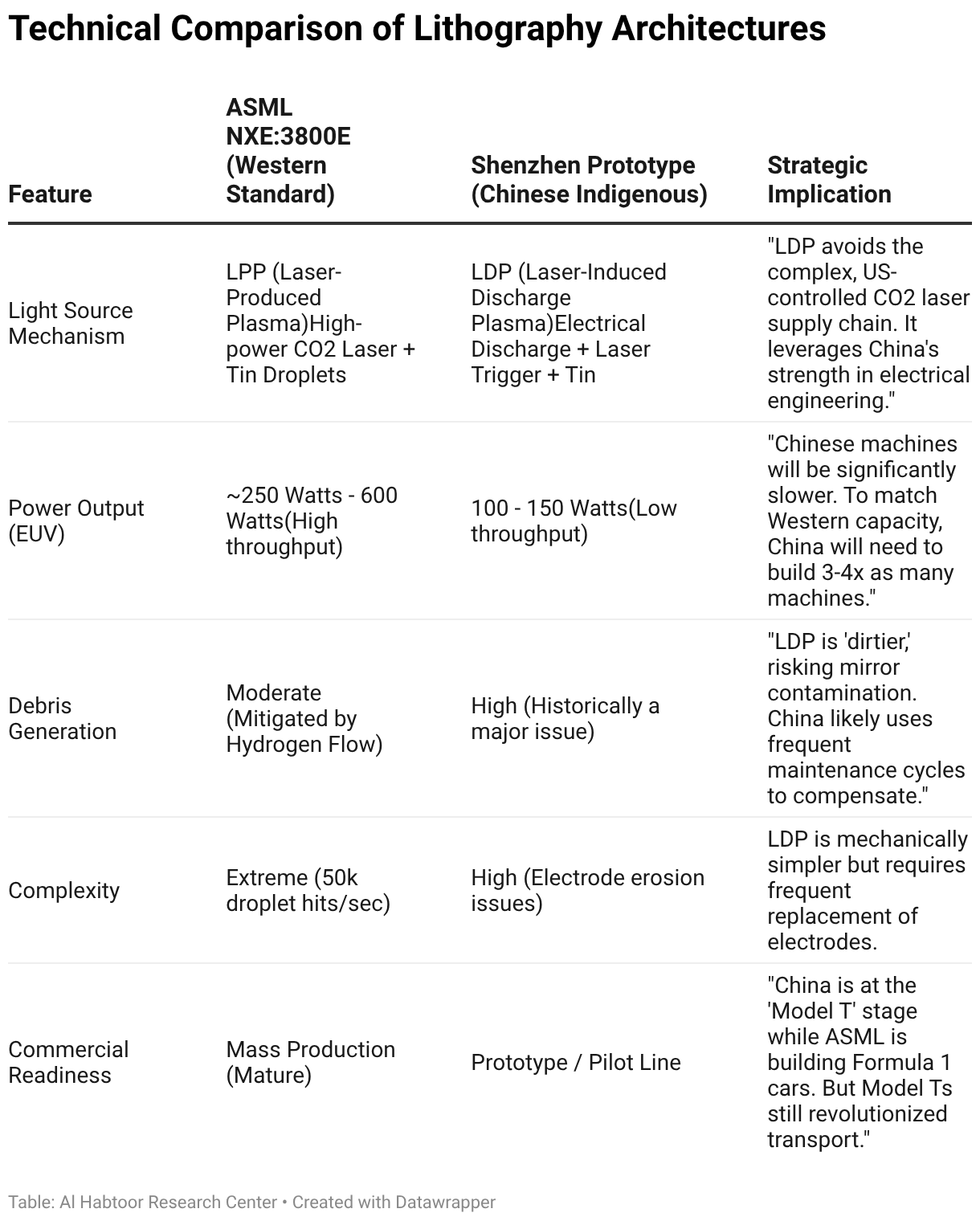
This comparative analysis underscores the fundamentally asymmetric nature of China’s strategy. Rather than seeking to rival Western operational efficiency in the near term, Beijing has deliberately accepted lower productivity and reduced process purity in exchange for achieving independence from technologies controlled by the United States.
The reliance on LDP technology signals a decisive shift away from the logic of economic efficiency, which governs commercial fabs such as TSMC, toward a logic of strategic necessity that defines sovereign and defence-oriented industries. Within this framework, the mere possession of domestic production capability, even at a higher cost, becomes the primary criterion of success.
The Political Economy of Tacit Knowledge and the Role of Foreign Talent Attraction in Circumventing Containment
Despite the structural deconstruction of the technical dimensions in the preceding section, the decisive variable tipping the balance in this achievement was the human factor. This rests on the premise that advanced technology is not embodied solely in engineering schematics or physical machinery subject to export controls, but resides primarily in engineers’ minds and in the cumulative expertise of highly specialised workforces. China’s strategy has demonstrated that while trade restrictions and technological embargoes may succeed in interrupting the cross-border flow of equipment, they are far less capable of constraining the movement of minds and human capital.
Project leadership pursued an aggressive recruitment strategy aimed at attracting seasoned engineering talent from firms that dominate the technology, including ASML and Japan’s Nikon and Canon. This approach involved offering financial incentives far exceeding Western benchmarks, with signing bonuses alone ranging from approximately $420,000 to $700,000, supplemented by substantial research grants and generous housing benefits. These inducements were designed to offset the professional and legal risks such experts might face, and clearly indicate that China treated the acquisition of human capital as a national security priority, superseding conventional economic considerations.
These moves assume their full significance when viewed against the nature of knowledge in the lithography industry. Such knowledge is inherently tacit; it cannot be fully codified in patents or technical documentation but instead depends on engineering intuition accumulated through years of trial and error in tuning highly complex systems.
In this context, Lin Nan, the former head of light-source technology at ASML, exemplifies this phenomenon. After joining the Shanghai Institute of Optics and Fine Mechanics, he led his team to register eight pivotal patents within just 18 months, providing clear evidence of a substantial transfer of tacit knowledge. To shield these human assets from legal action or Western intelligence scrutiny, Chinese authorities implemented stringent security protocols, including the use of pseudonyms and alternative identities for foreign experts working at the Shenzhen facilities.
These imported human capabilities were integrated with emerging approaches that deploy artificial intelligence in the service of physics, often described as compute-for-physics, through which engineers applied advanced simulation methodologies to compensate for limitations in physical hardware.
While domestically produced mirrors may lack the absolute precision of their German counterparts, software systems dynamically adjust the wafer stage and light source positions in real time to correct optical aberrations. This points to a fundamental shift toward software-defined manufacturing, in which operational performance is governed by the capacity of human expertise to adapt available resources and achieve efficiency through computational solutions, thereby reducing exclusive reliance on mechanical manufacturing precision.
High-Cost Transitional Solutions and Future Physical Leapfrogging
Building on the analysis of the technical and human dimensions of this transformation, a deeper understanding of China’s strategy requires viewing it as a multi-track system rather than a single technological wager. In contrast, the Shenzhen prototype based on laser-driven plasma technology serves as the cornerstone of the medium-term phase; central planning in Beijing has adopted a policy of strategic hedging through two parallel tracks: one long-term and radical, aimed at surpassing current Western benchmarks. The other immediate approach is to leverage existing industrial capacity to fill production gaps until domestic technologies reach full maturity.
The long-term, radical pathway is embodied in research led by Tsinghua University on steady-state microbunching (SSMB) technology. This approach differs fundamentally from conventional light-generation methods, relying instead on a circular particle accelerator, with a circumference of roughly 100 to 150 metres, to produce extreme ultraviolet radiation.
The underlying objective is to address the structural limitations inherent in pulsed plasma techniques, whether Western LPP or Chinese LDP. An SSMB-based accelerator could generate a continuous, exceptionally pure, high-power beam, potentially exceeding one kilowatt, thereby resolving the low-throughput constraint that characterises current systems. Although prevailing timelines place commercial deployment beyond 2030, this line of research represents a deliberate attempt at technological leapfrogging. It seeks to establish a post-EUV standard in anticipation of Western technologies approaching their ultimate physical limits.
At the immediate level, and to bridge the temporal gap until EUV tools are expected to reach volume production between 2028 and 2030, China’s semiconductor industry has turned to engineering solutions that intensively exploit available resources, most notably self-aligned quadruple patterning (SAQP). This method repurposes legacy DUV lithography tools to fabricate 5-nanometre chips by exposing a single circuit layer through four successive patterning steps.
This approach carries severe economic penalties. It increases manufacturing costs and cycle times by a factor of three to four, while depressing yields to roughly 30-50%, compared with yields exceeding 90% at commercial manufacturers such as TSMC.
The persistence of this economically inefficient production approach underscores the character of Chinese strategic thinking, which subordinates commercial logic to national security calculations. The primary objective is to ensure the uninterrupted supply of advanced chips, such as the Kirin 9030 and Ascend 910C processors, to sustain critical civilian and military infrastructure, irrespective of material cost. These interim mechanisms, therefore, serve as a vital bridge, preserving the viability and continuity of the domestic semiconductor industry until a fully sovereign lithography ecosystem is completed.
The Erosion of Containment Pillars and the Emergence of Dual Economic Polarity
Building on the analysis of the technical and strategic dimensions of digital sovereignty, the current geopolitical landscape demands a reappraisal of global power equilibria. The operation of the Shenzhen prototype, even at limited productive capacity, marks a structural inflexion point in the international system and in the effectiveness of the instruments of economic statecraft. It compels a comprehensive reassessment of the traditional theories that governed international relations during the era of technological globalisation.
Empirical developments have exposed the limitations of the “small yard, high fence” strategy adopted by the United States administration to preserve dominance in selected technologies. That technological fence has now been irreversibly breached. Although Washington moved in December 2025 to tighten controls through new regulations targeting spare parts and legacy tools, such measures constitute, from a strategic perspective, a belated response. The competitive dynamic has shifted from a logic of containment and denial to one of acceleration. As a result, the United States no longer has the capacity to prevent China from producing 3-nanometre chips; its options have narrowed to accelerating its own transition to 1.4-nanometre technologies to retain a margin of relative advantage, thereby signalling the end of the era of absolute exclusion.
These developments carry direct implications for regional security in East Asia, particularly regarding Taiwan’s long-standing reliance on the “Silicon Shield” doctrine. That doctrine has rested on the assumption that global, especially Chinese, dependence on TSMC would deter any kinetic military action that could devastate China’s own economy.
Beijing’s growing capacity to domestically manufacture advanced military-grade chips for missile guidance and unmanned systems, however, reduces its strategic dependence on Taiwan for defence-related semiconductors. This shift lowers the economic threshold for the use of force and, in turn, increases the fragility of stability across the Taiwan Strait.
Economically, this breakthrough points toward the emergence of a bipolar global trading system, as the world moves toward a bifurcation into two distinct supply chains: a “red chain” anchored by China and countries aligned with the Belt and Road Initiative, and a “blue chain” led by the United States and its allies. While the West concentrates investment at the apex of the technological pyramid, the breakthrough enables China to free up its vast fleet of DUV tools to mass-produce mature-node chips, at 28 to 14 nanometres, at high volume and low cost. This is likely to flood global markets with foundational components essential to civilian industries.
Such dynamics will confront major Western firms with a stark strategic dilemma: sourcing inexpensive Chinese chips at the risk of punitive tariffs, or relying on higher-cost Western alternatives at the expense of price competitiveness.
In conclusion, the successful operation of the Chinese lithography system prototype constitutes a watershed moment in contemporary industrial history. Achieved under conditions of enforced isolation, this breakthrough subjected the effectiveness of international sanctions to a severe stress test. It demonstrates that technological containment, regardless of its severity, ultimately fails to restrain a state that possesses the capacity for comprehensive resource mobilisation and the ability to direct those resources toward a clearly defined strategic objective.
The technical evidence presented in this report demonstrates that the Chinese model, despite its architectural divergence from the Western paradigm, is operationally viable enough to break the existing monopoly. As a result, the expected timeline for achieving volume production of 3-nanometre chips has been radically compressed, with industrial deployment now likely between 2028 and 2030. This would place China fully five years ahead of even the most “optimistic” Western projections, underscoring the failure of the “high fence” strategy, as unlimited state financing and aggressive human capital acquisition have overcome the structural constraints imposed by export controls.
At the national security level, this achievement has consolidated the foundations of sovereign artificial intelligence, as Huawei has secured an independent pathway for developing the hardware required to run advanced algorithms, insulated from United States technologies embodied in NVIDIA products. This development ensures China’s continued status as a peer competitor in the artificial intelligence era and affirms its capacity to preserve strategic decision-making autonomy in this critical domain.
This transformation ushers the semiconductor sector into a post-globalisation era, one characterised by the end of absolute Western monopoly over advanced technologies. In the phase ahead, the nature of geopolitical competition will shift fundamentally, as the contest will no longer centre on who possesses EUV technology, but on who has the capacity to scale its production faster.
References
China may have reverse engineered EUV lithography tool in covert lab, report claims — employees given fake IDs to avoid secret project being detected, prototypes expected in 2028 | Tom’s Hardware, accessed December 31, 2025, https://www.tomshardware.com/tech-industry/semiconductors/china-may-have-reverse-engineered-euv-lithography-tool-in-covert-lab-report-claims-employees-given-fake-ids-to-avoid-secret-project-being-detected-prototypes-expected-in-2028
China Shatters the Silicon Ceiling: Shenzhen Validates First Domestic EUV Lithography Prototype, accessed December 29, 2025, https://markets.financialcontent.com/wral/article/tokenring-2025-12-29-china-shatters-the-silicon-ceiling-shenzhen-validates-first-domestic-euv-lithography-prototype
China’s EUV breakthrough: Huawei, SMIC reportedly advancing LDP lithography, eye 3Q25 trial, 2026 rollout – Global SMT & Packaging Asia, accessed December 31, 2025, https://globalsmtasia.com/chinas-euv-breakthrough-huawei-smic-reportedly-advancing-ldp-lithography-eye-3q25-trial-2026-rollout/
China EUV Breakthrough and the Rise of the ‘Silicon Curtain’ – EE Times, accessed December 29, 2025, https://www.eetimes.com/china-euv-breakthrough-and-the-rise-of-the-silicon-curtain/
Chinese SMIC Achieves 5 nm Production on N+3 Node Without EUV Tools | TechPowerUp, accessed December 30, 2025, https://www.techpowerup.com/344000/chinese-smic-achieves-5-nm-production-on-n-3-node-without-euv-tools
EUV lithography systems – Products – ASML, accessed December 29, 2025, https://www.asml.com/en/products/euv-lithography-systems
China Completes EUV Prototype in ‘Manhattan Project’ Push, accessed December 31, 2025, https://www.chosun.com/english/industry-en/2025/12/18/FSYQ3AKZP5GO5DRQTE3EBJER5I/
China’s ‘Semiconductor Manhattan Project’ Tests the Limits of a State-Driven Model, accessed December 30, 2025, https://www.visiontimes.com/2025/12/23/chinas-semiconductor-manhattan-project-tests-the-limits-of-a-state-driven-model.html
Chipping away at West dominance? Not yet because China still struggles with silicon chip making, accessed December 31, 2025, https://www.indiatoday.in/technology/features/story/chipping-away-at-west-dominance-not-yet-because-china-still-struggles-with-silicon-chip-making-2843249-2025-12-29
‘You Are Wrong’: How ex-engineers of the European chip giant whose CEO said China is way behind may have proved him incorrect, accessed December 29, 2025, https://timesofindia.indiatimes.com/technology/tech-news/you-are-wrong-how-ex-engineers-of-the-european-chip-giant-whose-ceo-said-china-is-way-behind-may-have-proved-him-incorrect/articleshow/126090606.cms
Beijing’s Silicon Sovereignty: Inside China’s ‘Manhattan Project’ to Break the EUV Barrier, accessed December 30, 2025, https://markets.financialcontent.com/wral/article/tokenring-2025-12-24-beijings-silicon-sovereignty-inside-chinas-manhattan-project-to-break-the-euv-barrier
Big Fund III: China’s Long Game To Control The Chips That Make The World Work – Analysis – Eurasia Review, accessed December 29, 2025, https://www.eurasiareview.com/10122025-big-fund-iii-chinas-long-game-to-control-the-chips-that-make-the-world-work-analysis/
High-NA EUV Era Begins: Intel Deploys First ASML Tool as China Signals EUV Prototype Breakthrough – FinancialContent, accessed December 31, 2025, https://markets.financialcontent.com/wral/article/tokenring-2025-12-26-high-na-euv-era-begins-intel-deploys-first-asml-tool-as-china-signals-euv-prototype-breakthrough
China’s ‘Manhattan Project’ Realized: Secret Shenzhen EUV Breakthrough Shatters Global Export Controls – FinancialContent, accessed December 29, 2025, https://markets.financialcontent.com/wral/article/tokenring-2025-12-18-chinas-manhattan-project-realized-secret-shenzhen-euv-breakthrough-shatters-global-export-controls
China Secretly Prototypes EUV Lithography Machine, Defying US Sanctions – WebProNews, accessed December 29, 2025, https://www.webpronews.com/china-secretly-prototypes-euv-lithography-machine-defying-us-sanctions/
[News] China Reportedly Builds EUV Prototype Using Older ASML Components, Eyes 2028 Chipmaking – TrendForce, accessed December 30, 2025, https://www.trendforce.com/news/2025/12/18/news-china-reportedly-builds-euv-prototype-using-older-asml-components-eyes-2028-chipmaking/
China’s all-or-nothing race for chip independence – IO+, accessed December 31, 2025, https://ioplus.nl/en/posts/chinas-all-or-nothing-race-for-chip-independence
Made-in-China EUV machine targets AI chip output by 2028 – Asia Times, accessed December 29, 2025, https://asiatimes.com/2025/12/made-in-china-euv-machine-targets-ai-chip-output-by-2028/
 1
1

Related Articles
Strait of Hormuz Closure: Strategic Implications for the Global Semiconductor Industry

Congress Has a New Invisible Lobbyist: The Rise of the Political Chatbot

What If: AI Erases the Books It Learns From?

Water Wars in the Digital Age: Is Technology Coming at the Cost of Our Water Security?

Pulse: Who Controls the Region’s Food?

Comments