

Europe has spent the last few years watching its tech anxiety go from background hum to full orchestra. It's not hard to see why. In June 2026, France's intelligence services announced they were dropping Palantir, the American data analytics firm long embedded in European defence and policing work, in favour of a domestic provider, explicitly citing the need for "strategic autonomy." Germany's military reportedly will not touch Palantir at all, and the UK is now fielding parliamentary debates over a quarter-billion-pound contract with the company, partly because, as one legal analysis bluntly put it, even European data sitting in European data centres can still be pulled by U.S. authorities under American law, contracts or no contracts. It's the kind of detail that makes "data sovereignty" sound less like a policy buzzword and more like a genuine catch.
Then, just days before this was written, the U.S. government ordered Anthropic to cut off access to its most advanced AI model, Mythos, for anyone who wasn't a U.S. citizen, citing national security concerns. Anthropic's response was to switch the model off for everyone, Americans included, rather than build a citizenship checkpoint overnight. The episode lasted only days, but it landed exactly where Europe's anxieties already live: the frontier of AI doesn't just sit outside Europe's control, it sits inside one government's control, and that government can flip a switch.
None of this means Europe should panic, or try to build its own version of everything from scratch by Thursday. As the cost estimates make clear, chasing full autonomy across the entire AI stack would run into the trillions of euros, well past the point of being realistic. The more sensible response, is for Europe to get serious about which parts of the stack actually need to be sovereign, where partnership is a perfectly good substitute for ownership, and where its real strength, regulatory leadership, can be used deliberately rather than as a consolation prize. Sovereignty, in other words, isn't about owning everything. It's about knowing exactly what you can't afford to depend on.
The Necessary Conversation
Any discussion of AI sovereignty inevitably begins with tech sovereignty as the broader concept it sits under. The globalist assumptions of the post-Cold War period, the idea that stable, mutually beneficial agreements could be struck with all nations regardless of ideology, have largely fallen apart. Recent geopolitical and geo-economic shifts have pushed a previously quieter, mostly political, risk dimension into plain view. Accordingly, technology sovereignty has become a prominent theme in national and international debate. AI sovereignty itself is not a new idea. Its core aim, greater autonomy and control over technology, builds on earlier debates around internet, cyber, data and digital sovereignty. These debates for example were used to justify investment in secure 5G networks, data localisation rules, stricter procurement requirements and similar measures, yet they never settled on a stable definition of what “sovereignty” actually means.

That vagueness has been politically convenient but also problematic: it gave states room to build broad coalitions around sweeping policy agendas, while also giving authoritarian governments a vocabulary to justify censorship, suppression and surveillance. China, for instance, has invoked the language of internet and data sovereignty, citing protection of national security and social stability, to justify laws requiring data localisation and granting the state broad access to information flows, measures that also underpin censorship and surveillance of its own citizens.
AI sovereignty has inherited this same loose vocabulary and the tensions that come with it, making the concept hard to define consistently, hard to measure in terms of trade-offs, and hard to translate into policy without people talking past each other. Given how central AI has become to geopolitics, though, working towards a clearer, more specific understanding of AI sovereignty matters more now than ever. The question of how independent governments can be in shaping their own AI futures is increasingly tied to today’s economic and geopolitical realities, and governments worldwide are racing to secure what they call “AI sovereignty”. Driven by concern over dependence on a small number of AI providers, such as OpenAI, DeepSeek and Nvidia, and the countries behind them, chiefly the United States and China, governments are drafting new strategies and stepping up investment in domestic AI capability to gain more control over their technological future. At the same time, the rapid pace of AI development, including the possible emergence of artificial general intelligence, has raised concerns about security risks, among them chemical and biological threats, as well as the displacement of large parts of the workforce through automation. This mix of risk and opportunity has turned sovereignty into one of the defining questions of the AI era.
Approaches to sovereignty differ depending on how the concept is interpreted. Chile and Taiwan, for instance, are investing heavily in homegrown open-source AI models in pursuit of cultural autonomy, while France and Brazil are focused on building regulatory capacity, also framed as a path to AI sovereignty. The UK has gone a different route, setting up a Sovereign AI Unit backed by £500 million, aimed at driving AI-led economic growth and strengthening national security at home.
So what does achieving AI sovereignty actually involve? Given how deeply interdependent global supply chains are, sovereignty cannot reasonably be treated as a binary, a country either has it or it doesn’t. Instead, countries need to shape domestic and international AI strategies around their own strengths and weaknesses across what’s known as the “AI stack”. Together, the layers of this stack reveal just how complex frontier AI ecosystems are, and why no country is likely to excel across every layer. Policymakers therefore need to assess their position across the stack, deciding where to build domestic capability, where partnerships can fill gaps, and where a degree of managed dependency actually makes sense. Energy-rich countries, for example, might use cheap electricity to attract new data centre development, while countries with strong talent pools and innovation-friendly regulation could position themselves as hubs for model development or AI services.
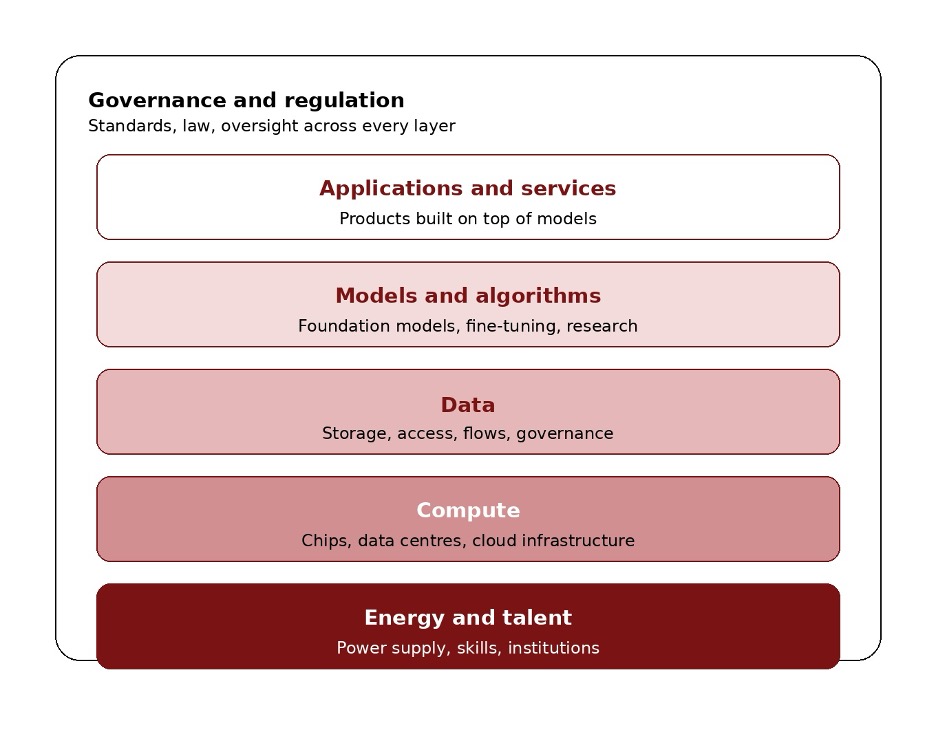
Building sovereignty in the AI era will then require governments to navigate a series of trade-offs across the layers of the AI stack. A decision made at one layer can open up or close off options at another, compute capacity depends on energy supply, data access shapes model relevance, and governance relies on the skills and institutions that sustain it. Together, these interdependencies define the practical decision space within which strategic choices about AI sovereignty actually get made.
Europe, You Can Never Walk Alone
Geopolitical strain, regulatory complexity and deep digital interdependence have laid bare some serious vulnerabilities, nowhere more so than in Europe, which imports more than 80% of its digital products, services, infrastructure and intellectual property. According to the stack framework set out earlier, Europe is dependent on outside suppliers across nearly every layer, from compute and cloud through to applications and services, leaving the regulatory layer as one of the few areas where it can claim real control.
In September 2025, Ursula von der Leyen called for what she described as Europe’s independence moment, framing it as the point at which Europe needs to take control of the technologies underpinning its economy. Similar ambitions are playing out elsewhere, with the U.S. pushing to secure semiconductor production and China continuing to double down on self-reliance, suggesting a broader global investment race aimed at protecting sensitive data, ensuring business continuity and retaining control over critical technologies. This push sits within a wider shift in European economic strategy, one shaped by the pressure of being squeezed between U.S. dominance in technology and Chinese strength in manufacturing. In the first quarter of this year, the EU ran a trade deficit with China of roughly 145 billion euros, around 170 billion dollars, driven partly by a surge of Chinese-made machinery and electric vehicles entering European markets.
In response, the European Commission has put forward the European Technological Sovereignty Package, a set of measures meant to strengthen Europe’s position in semiconductors, AI, cloud and open source. It includes two legislative proposals, the Chips Act 2.0 and the Cloud and AI Development Act, alongside an Open Source Strategy and a Strategic Roadmap for Digitalisation and AI in Energy. Mapped onto the stack, this is essentially an attempt to shore up the compute layer (chips), the data and infrastructure layer (cloud), and parts of the models and applications layer (AI, open source) all at once, while leaning on the governance layer, where Europe already has comparative strength, to coordinate the effort.
These measures are meant to support Europe’s ambition to position itself as an AI continent, strengthen its digital autonomy and contribute to a more sustainable digital future, while widening the range of core technologies available to EU businesses, citizens and public administrations. The package responds directly to Europe’s continued reliance on non-EU suppliers for core digital technology, at a moment when demand for computing capacity is rising sharply alongside the spread of AI. The intention is to cut structural dependencies and ensure Europe can develop, deploy and secure the technologies its citizens rely on, marking a significant shift in the EU’s overall approach to technology policy.
Europe, in particular, needs a pragmatic approach here rather than a maximalist one. Sovereignty strategy should rest on a clear, honest assessment of urgency: which layers of the stack genuinely require domestic control, and where can partnerships or managed dependency reasonably substitute for it.

Europe currently produces around 10% of the world’s chips, with the U.S., Taiwan, South Korea and China dominating global output. In stack terms, this is Europe’s clearest point of weakness at the compute layer, the foundation the rest of the stack depends on. The European Commission has proposed a Critical Raw Materials Act in an attempt to close the gap, though the scale of catch-up required is substantial. Achieving real autonomy would mean rebuilding not just one layer but several at once: the hardware layer, the software layer, the services layer and, perhaps most importantly, the innovation layer that keeps generating new technology in the first place. This is the clearest illustration yet of why the stack framework matters: these layers are interdependent, so a shortfall in one (compute) constrains what’s achievable in the others (models, applications, services), and trying to fix all of them simultaneously multiplies the cost enormously.
Consider what each layer would actually require. Building state of the art semiconductor fabs is the obvious starting point. Taiwan’s TSMC spent at least 40 billion dollars, around 34 billion euros, on its advanced facilities in Arizona alone, and Europe would conservatively need a dozen such facilities to achieve genuine autonomy across different chip types, putting the fab cost alone at roughly 408 billion euros, or 480 billion dollars. That figure doesn’t include the surrounding supply chain, materials processing, packaging and testing equipment, which would add a further 200 billion euros, or 233 billion dollars.
Move up to the software layer, and the picture isn’t much easier. Operating systems and productivity software, the likes of Microsoft Office, Windows, Adobe’s Creative Suite and Google’s tools, represent decades of iterative development and network effects that make them difficult to dislodge. Even under an optimistic scenario, where a crash programme compresses thirty years of US development into ten, the price tag is steep: Microsoft alone spends around 30 billion dollars, about 26 billion euros, on R&D annually, and five major tech firms together spent 229 billion dollars, roughly 197 billion euros, on R&D between March 2023 and March 2024. Multiplying even one company’s annual R&D spend by a decade puts the cost of reaching competitive parity at around 300 billion euros, or 349 billion dollars.
Cloud and AI is where costs escalate further still. Amazon Web Services, Microsoft Azure and Google Cloud represent hundreds of billions of dollars in capital expenditure on data centres, networking and software, while companies such as Google DeepMind and OpenAI have poured similarly vast sums into research and talent, and Meta alone spent more than 30 billion dollars, about 26 billion euros, on AI infrastructure in 2024. Matching current US capability in cloud and AI would cost Europe a minimum of 500 billion euros, or 582 billion dollars, over a decade.
Then there are the services layered on top of all this: mapping tools, video platforms, social media, messaging and search, each the product of billions in development and each requiring continuous investment to operate at scale. Building European alternatives that people would genuinely choose to use is estimated at a further 200 billion euros, or 233 billion dollars. In sum, the cost would be massive.
Scenarios and Recommendations
Given that full autonomy is financially out of reach and not even the goal Europe is actually pursuing, and given how exposed its current position already is, a few scenarios stand out as the more likely paths forward.
Europe falls behind: Europe fails to close the gap across the layers where it’s weakest, compute, cloud and frontier models, as the cost and speed required outpace its political will and funding. The EU remains structurally dependent on US and Chinese infrastructure, and its main lever, the regulatory layer, gradually loses force as US and Chinese firms simply route around or absorb the cost of EU rules. Europe ends up a rule taker on technology that’s built and controlled elsewhere. Probable if current funding and political commitment stay at today’s levels.
Europe specialises strategically: Rather than chasing autonomy across the whole stack, Europe makes deliberate choices, building real strength in a small number of layers where it has genuine comparative advantage, parts of model development, energy-linked compute hosting, or specific industrial applications of AI, while accepting structured dependency elsewhere through partnerships, joint ventures and trade arrangements with the US or others. This is the path implied by the Commission’s current package, betting on a few winnable layers rather than the whole stack. Most consistent with current policy direction and stated intent, though EU industrial policy has a mixed record on turning ambition into delivery, so this scenario is probable on paper but carries real execution risk in practice.
Europe leads through rules alone: Europe continues to invest in its regulatory and standards capability, exporting frameworks like the AI Act as its primary form of global influence, but makes little headway on the underlying technical layers, compute, cloud and frontier models stay firmly outside EU control. Influence here rests entirely on the strength of European markets and the willingness of foreign firms to comply with EU rules to access them, a position that holds only as long as Europe remains commercially indispensable. Probable only if technical investment stalls while regulatory ambition continues.
It is then recommended that Brussels should resist treating sovereignty as a single goal to be pursued evenly across the stack, and instead prioritise the layers where dependency is most strategically dangerous, compute and energy first, since these constrain everything else built on top. Partnerships, whether with the U.S., like-minded democracies, or industry consortia, should be used deliberately to extend capacity in layers where full European autonomy isn’t realistic within the next decade, rather than treated as a fallback once autonomy efforts stall. Europe should also be honest internally about the limits of regulatory leadership as a substitute for technical capability, since rules retain force only as long as European markets stay commercially indispensable to the firms being regulated. Finally, given how quickly both the technology and the geopolitical landscape are moving, Europe’s sovereignty strategy needs built-in review points rather than fixed multi-year targets, so that today’s bets on where to build, partner or depend can be adjusted as conditions change.
References
Brunet, Karine. “Why the Race for Tech Sovereignty Is a Balancing Act.” World Economic Forum, January 13, 2026. Accessed June 11, 2026. https://www.weforum.org/stories/2026/01/race-for-tech-sovereignty-is-a-balancing-act/.
Carrera, Sergio, and Marco Stefan. “Digital Sovereignty: Can Europe Afford It?” Center for European Policy Analysis (CEPA). Accessed June 10, 2026. https://cepa.org/article/digital-sovereignty-can-europe-afford-it/.
European Commission. “Strengthening Europe’s Tech Sovereignty.” Shaping Europe’s Digital Future. Last modified June 3, 2026. Accessed June 13, 2026. https://digital-strategy.ec.europa.eu/en/policies/eu-tech-sovereignty.
Fleming, Sam, and Chris Yiu. “Sovereignty in the Age of AI: Strategic Choices, Structural Dependencies.” Tony Blair Institute for Global Change. Accessed June 16, 2026. https://institute.global/insights/tech-and-digitalisation/sovereignty-in-the-age-of-ai-strategic-choices-structural-dependencies.
“AI Sovereignty’s Definitional Dilemma.” Stanford Institute for Human-Centered Artificial Intelligence (HAI), Stanford University. Accessed June 8, 2026. https://hai.stanford.edu/news/ai-sovereigntys-definitional-dilemma.
Yang, Guangshi, and co-authors. “Technological Sovereignty and Innovation Performance.” Research Policy 52, no. 6 (2023): Article 104767. Accessed June 12, 2026. https://www.sciencedirect.com/science/article/pii/S0048733323000495.



Clean Commitments, Clean Data Centres?

Red Alert: Pneumonic Plague in Siberia

The UN and the AI Power Struggle: Who Will Govern the Technology Shaping Global Security?

Running to Stand Still: Why LDCs are Falling Behind in Digital Trade?

Are We Living in an Era of Green Colonialism?

Comments