

What if the sea lanes were no longer free? For seventy years, the assumption that ships pass through the world's strategic straits without permission, payment, or political approval has underpinned global trade so completely that it was rarely stated, let alone defended. In 2026, that assumption stopped being safe. In one of the world's most critical waterways, passage is now vetted, priced, and rationed by political alignment. At another, a price for safe transit has been openly announced. Along the polar routes, permits and fees are already the law, and older managed regimes are quietly expanding. These are not isolated crises. Taken together, they form the early signal of something larger: the transformation of maritime chokepoints from global commons into sovereign assets, and with it, the quiet repricing of the geography on which world trade depends.
From Commons to Assets
For seven decades, the world’s strategic waterways have functioned as shared infrastructure: physically located within the territory of coastal states, but governed by a legal regime that guaranteed passage to all. That settlement, codified in UNCLOS (the United Nations Convention on the Law of the Sea), which obliges states bordering a strait not to hamper passage, prohibits the suspension of transit passage, and prohibits charging ships fees simply for passing through a state’s territorial sea unless specific services are offered, without discrimination, rested less on enforcement than on habit. What recent events across several waterways suggest is that the habit is breaking. A pattern is emerging in which coastal states and armed non-state actors convert transit routes from global commons into sovereign assets, sources of leverage, revenue, and differential treatment of the world’s shipping. This transformation is proceeding along four distinct pathways, which increasingly operate in combination.
The first is coercive interdiction, the outright denial of passage by force or credible threat. Following U.S. (United States) and Israeli military operations against Iran beginning in February 2026, Iranian forces declared the Strait of Hormuz “closed” on March 4, threatening and carrying out attacks on ships attempting to transit. The market response did the rest: Maersk, MSC (Mediterranean Shipping Company), CMA CGM (Compagnie Maritime d’Affrètement – Compagnie Générale Maritime), and Hapag-Lloyd all suspended transits, and over 150 tankers anchored outside the strait rather than risk attack. By early May, 22,500 mariners were trapped on more than 1,550 commercial vessels in and around the strait, with traffic running at approximately 5% of its pre-war average. Notably, the effective instrument of closure was commercial, not military: war-risk premiums surged from roughly 0.05% before the war to over 5%, a 100-fold increase that effectively priced commercial traffic out of the strait.
The second pathway, and analytically the more consequential, is the toll-and-vetting regime, in which passage is not denied but conditioned. Within weeks of the closure, denial evolved into discrimination. Vessels permitted to move were routed through a narrow corridor along the Iranian coastline under monitoring by the IRGC (Islamic Revolutionary Guard Corps), rather than the standard international shipping lanes, replacing the Traffic Separation Scheme agreed by Iran and Oman and adopted by the IMO (International Maritime Organisation), the UN agency for shipping. Lloyd’s List Intelligence reported the emergence of a “toll booth” system requiring ship operators to submit to an IRGC vetting scheme, while exemptions were extended selectively. Controls applying only to “enemy countries”. Transit, in short, became a foreign-policy instrument priced by alignment.
The third pathway is legal reclassification, achieving through domestic law what interdiction achieves through force. In the Arctic, Moscow treats the NSR (Northern Sea Route) as internal national waters, requiring foreign vessels to obtain advance permission, carry Russian pilots, and pay Russian icebreaker fees, and, significantly, Russia is not the only state to make such claims. Canada similarly treats the Northwest Passage as its internal waters and requires prior authorisation for the transit of all non-Canadian vessels. Norm erosion, in other words, is systemic rather than ideological.
The fourth is regulatory pretext, transit conditions imposed under the banner of safety, environmental protection, or security, of which the century-old Turkish Straits regime is the institutional prototype and Arctic pilotage requirements the modern variant.
What distinguishes 2026 is that these pathways are converging, and that erosion now comes from every direction. The most striking evidence is not Tehran’s declaration that it will “definitely” charge transit fees, with “special treatment” possible for friendly nations, a wartime measure hardening into a peacetime governance claim that survived the U.S.–Iran memorandum of June 17 and the strait’s reopening. It is that the norm’s traditional guarantor briefly joined the bidding. The U.S. President publicly mooted setting up his own toll booth in the strait and charging a 20% fee on all cargo before retracting the idea. When both the challenger and the defender of freedom of navigation treat a strait as a revenue asset, the question is no longer whether the norm is under stress, but how far the precedent will travel.
The Global Map of Exposure
If the Gulf demonstrated the pattern, the question for early warning is where it can replicate. Three things decide that for any waterway: how much trade depends on it, how solid its legal protections are, and what those who control its shores stand to gain from restricting it. Measured this way, the world’s chokepoints no longer look uniformly protected. They look unevenly exposed.
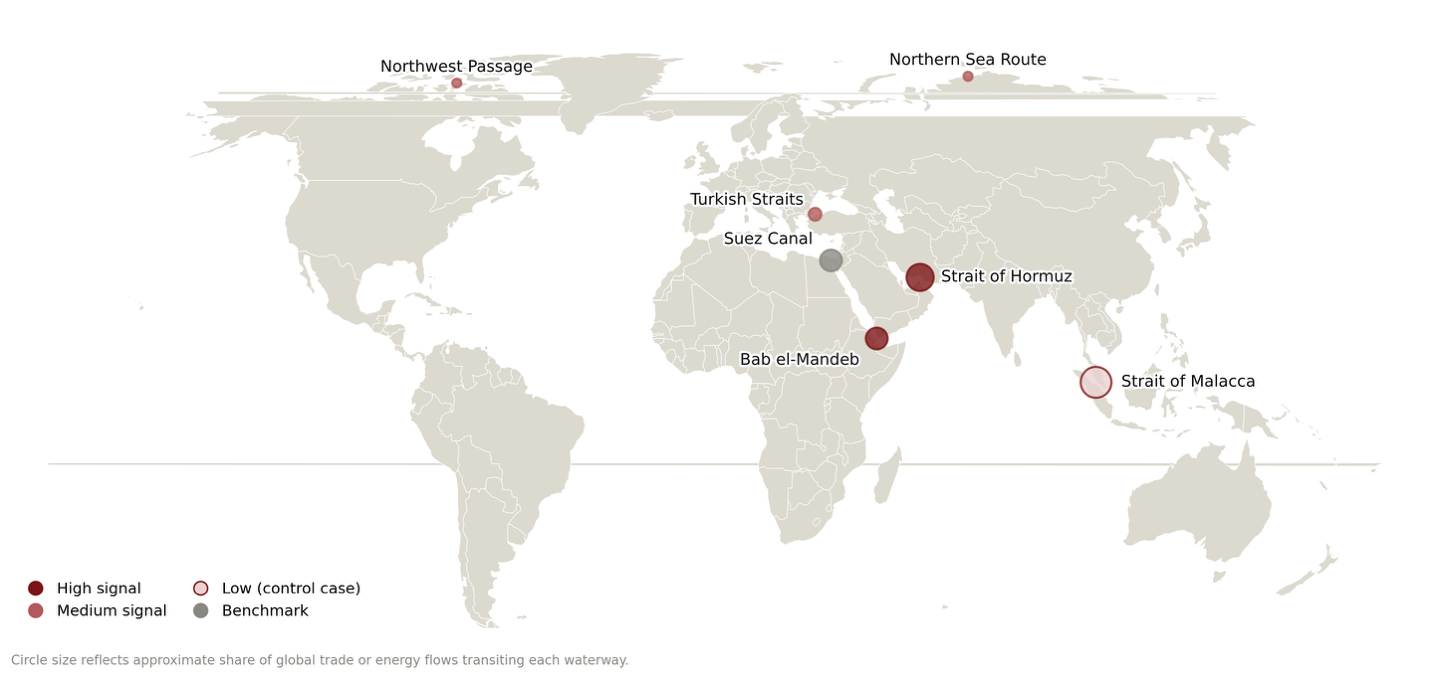
The most acute contagion risk sits at the Bab el-Mandeb. Roughly 30 km wide at its narrowest point, the strait carries around 10-15% of global maritime trade, including a significant share of Europe’s oil and gas imports. The Houthis have already demonstrated the model once. Their 2023-24 campaign cut crude and petroleum flows through the strait from 9.3 million barrels per day in 2023 to 4.1 million in 2024, largely through insurer withdrawal rather than sustained attack. What is new in 2026 is the explicit price list. According to an Iranian lawmaker, Houthi forces have completed preparations to close the strait, and ships face a choice: bypass it at an extra cost of around $30 million, or pay $5 million for safe transit. Whether or not the figures are credible, the framing matters. This is a protection-fee model, openly advertised, and copied from the Gulf. The EU is responding in kind, weighing an expanded mandate for its Aspides naval operation, including minesweeping. The waterway’s defence, like its disruption, is becoming permanent.
The Arctic shows the legal version of the same trend, restriction without a shot fired. Russia runs the NSR through a system of permits, mandatory Russian pilots, and icebreaker fees, based on its claim that the route passes through internal waters. The US disputes the claim but has never tested it with a FONOP (Freedom of Navigation Operation). More telling than the claim is the compliance. South Korea’s oceans ministry has confirmed it is preparing talks with Russian authorities over transit permission and fees. Every such negotiation turns a contested claim into accepted practice. Canada treats the Northwest Passage the same way, as internal waters requiring prior authorisation. The result is that both polar routes are set to enter their commercially viable era already fenced off, without ever having been open in the first place. Russia projects 90 million tons of NSR cargo by 2030, up from roughly 3 million tons of transit today, so the fenced-off model would grow with the traffic.
The Turkish Straits show where such regimes end up. The Montreux Convention of 1936 is the world’s oldest managed-strait arrangement, lawful, internationally accepted, and quietly expanding. Ankara has used its wartime provisions to close the straits to warships since 2022 and has sharply raised transit fees. Montreux is not itself a violation. Its significance is as a template. It proves that a conditioned strait can be normalised for decades, and it gives every aspiring gatekeeper a respectable precedent to cite.
The Strait of Malacca is the test of how far the trend has spread, and so far the reassuring one. Carrying roughly a quarter of global trade, it is the system’s single most valuable artery, yet its three littoral states (Indonesia, Malaysia, Singapore) impose no restrictions, and past proposals to charge transiting ships have died quickly. Its risks come from outside, great-power naval competition and piracy, not from the shore. Malacca defines what normal still looks like. Movement there would be the sign that the trend has gone global.
Finally, the canals offer a useful contrast. Suez and Panama are sovereign infrastructure operating under long-established legal frameworks, with tolls that are lawful, transparent, and applied to all flags without discrimination. In June 2026 the Suez Canal Authority announced its first broad fee adjustment in three years, on the back of a 23.6% rebound in traffic, a sign of returning confidence in the route after two difficult years of regional disruption. The canals in fact demonstrate what the emerging restriction trend is not: predictable, rules-based management of a strategic waterway that serves global trade rather than leveraging it. The concern raised in this analysis is the departure from that model, not sovereign stewardship itself.

If conditioned passage becomes the norm rather than the exception, the costs can be estimated in three layers. The first is a permanent toll: applied across the roughly 110 daily pre-war transits at Hormuz alone, fees at the level reportedly demanded in the Red Sea would extract tens of billions of dollars a year from world trade, an arithmetic that scales with every chokepoint that adopts the model. The second is a standing risk premium: Goldman Sachs estimates that even a 50% flow restriction adds around $4 per barrel, a full closure $10-15, and Bloomberg Economics calculates that oil at $110 adds a full percentage point to euro-area inflation and cuts 0.6% from GDP. The third is the systemic scenario: one model of the 2026 crisis put 180-day global GDP at risk between $3.6 trillion and $6.9 trillion depending on escalation. These are illustrative magnitudes built on published estimates, not forecasts. But they establish the order of the stakes: normalised chokepoint restriction would function as a permanent tax on world trade measured in hundreds of billions annually, with tail risks in the trillions.
Reading the Signal
Does all this amount to a trend, or a coincidence of crises? The honest answer is that each case has its own local logic. The Gulf restrictions grew out of a war. The Houthi threat is an extension of a regional conflict, not a settled policy. The Arctic claims predate both by decades. Markets have adapted before, rerouting around Africa at great cost but without collapse, and coalitions are forming in response, from the EU’s Aspides expansion to US calls at the United Nations for a “coalition for maritime freedom”. Malacca, the most valuable chokepoint of all, remains untouched.
Yet this is precisely what a weak signal looks like: individually explicable events that all point the same way. Three features distinguish 2026 from previous chokepoint crises. First, restrictions are outlasting the fighting that created them, hardening into fee systems and vetting regimes with peacetime ambitions. Second, the practice is spreading across actor types, from states to armed groups to, briefly, the norm’s own guarantor. Third, open violations of UNCLOS transit provisions have drawn no effective legal response, teaching every coastal state that the rules are cheaper to break than anyone assumed.
Whether the signal strengthens can be tracked. Over the next 12-18 months, the clearest confirmation would be transit fees formalised in any final US-Iran agreement, which would convert a wartime practice into a negotiated entitlement, or the first confirmed payment of a passage fee to the Houthis by a commercial operator or flag state. In the Arctic, the equivalent milestone runs in either direction: a first Western commercial payment for NSR passage would entrench the enclosed model, while a first FONOP would signal that it will finally be contested. Beyond these, watch for new transit conditions or fee structures under the Montreux framework, for any littoral levy proposal at Malacca gaining official sponsorship, and for the insurance market itself, where the emergence of standing transit-risk products priced by waterway and flag alignment would show that commerce has begun treating conditioned passage as the new normal.
The implications run on three tracks. For trade, the rerouting premium becomes structural: freight and insurance, not blockades, are the mechanism by which geography now taxes commerce. For energy security, import-dependent economies in Europe and Asia face a world in which supply reliability depends on political alignment with gatekeeper states. For international law, the stakes are foundational. UNCLOS rested on a bargain: coastal states gained extended maritime zones in exchange for guaranteed passage through straits. If passage becomes negotiable, the bargain unravels, and with it one of the last broadly respected pillars of the rules-based order.
Two futures follow. In the contained scenario, the current restrictions resolve with the conflicts that produced them, and Malacca-style normality reasserts itself. In the cascading scenario, each unpunished restriction lowers the cost of the next, and strategic geography becomes a routinely priced asset. The evidence of 2026 does not yet settle the question. It does, however, shift the burden of proof. The default assumption for seven decades was that straits stay open. That assumption now requires active defence, and the states with the most to lose have only begun to mount it.
References
Baker Institute for Public Policy. “Maritime Chokepoints and Risks to Global Shipping and Energy Security.” Rice University, March 2026. Accessed July 22, 2026. https://www.bakerinstitute.org/sites/default/files/2026-03/20260316-Maritime%20Chokepoints.pdf.
Bloomberg. “Iran War: How High Could Oil Prices Get with Strait of Hormuz Closure?” March 30, 2026. Accessed July 22, 2026. https://www.bloomberg.com/graphics/2026-iran-war-hormuz-closure-oil-shock/.
Loft, Philip. “Israel/US-Iran Conflict 2026: Reopening the Strait of Hormuz.” Research Briefing CBP-10636. House of Commons Library, June 8, 2026. Accessed July 23, 2026. https://commonslibrary.parliament.uk/research-briefings/cbp-10636/.
Paraskova, Tsvetana. “Goldman Sachs Hikes Q2 Brent Oil Price Forecast by $10.” Oilprice.com via Yahoo Finance, 2026. Accessed July 22, 2026. https://finance.yahoo.com/news/goldman-sachs-hikes-q2-brent-103500577.html.
SolAbility. “Strait of Hormuz Closure 2026: Cost Model.” April 2026. Accessed July 24, 2026. https://solability.com/news-insights/iran-war-marginal-cost.
Strauss Center for International Security and Law. “Strait of Hormuz: Other Chokepoints.” University of Texas at Austin. Accessed July 24, 2026. https://www.strausscenter.org/strait-of-hormuz-other-chokepoints/.
Türkiye Today. “Houthis Say Preparations Complete to Close Bab el-Mandeb Strait.” May 2026. Accessed July 22, 2026.
United Nations. United Nations Convention on the Law of the Sea. Opened for signature December 10, 1982.
U.S. Energy Information Administration. “World Oil Transit Chokepoints.” Updated March 3, 2026. Accessed July 23, 2026. https://www.eia.gov/international/content/analysis/special_topics/World_Oil_Transit_Chokepoints.
Visual Capitalist. “Mapped: The World’s Oil Chokepoints.” March 2026. Accessed July 23, 2026. https://www.visualcapitalist.com/mapped-the-worlds-oil-chokepoints/.


The Civilian Face of Chinese Sea Power

Clean Commitments, Clean Data Centres?

Red Alert: Pneumonic Plague in Siberia
The UN and the AI Power Struggle: Who Will Govern the Technology Shaping Global Security?

Running to Stand Still: Why LDCs are Falling Behind in Digital Trade?

Comments