

In recent years, the Eastern Mediterranean has witnessed growing attention to air defence, maritime security and infrastructure protection. Against this backdrop, on 31 August 2026, Greece and Israel signed an agreement to develop an integrated air and missile defence network, known as ‘Achilles Shield’, at a cost of approximately €3 billion. The project aims to strengthen Greece’s capacity to detect and intercept aerial and missile threats through a unified early warning, command and control system.
The project forms part of the comprehensive modernisation of the Greek armed forces and does not replace Athens’ commitments within the North Atlantic Treaty Organization or its alliances with the United States and the European Union. The decision to establish this system reflects the changing character of regional military threats, particularly the growing reliance on unmanned aircraft and precision missiles, alongside the continuing development of Turkey’s defence industries in reconnaissance and unmanned maritime and aerial systems.
This analysis therefore examines the implications of the Greek–Israeli agreement and its place within military modernisation programmes. It assesses its potential impact on the deterrence balance between Greece and Turkey, as well as its implications for security cooperation and managing regional tensions in the Eastern Mediterranean in the period ahead.
Filling the Strategic Vacuum
The announcement of the Achilles Shield project reveals Athens’ intention to develop its air and missile defence capabilities within a comprehensive programme of armed forces modernisation. The project extends beyond the procurement of weapons systems: it seeks to establish an integrated defensive network linking detection, early warning, command and control, and interception capabilities. This initiative comes amid the growing importance of countering unmanned aircraft, cruise missiles and ballistic missiles, while protecting facilities, critical infrastructure, command centres and military bases.
The project forms part of Greece’s military modernisation programme, which runs until 2036 with an estimated budget of €28 billion; the Achilles Shield agreement with Israel is valued at approximately €3.1 billion. The programme is expected to incorporate multiple layers of air and missile defence, including interceptor missiles, radars, command and control systems, and dedicated counter-drone capabilities. Athens thus seeks to reduce its reliance on disparate systems and enhance integration across its air, naval and land forces. The project rests on the integration of Israeli technology, bringing Israeli defence doctrine onto European territory to establish a national deterrence architecture that does not depend directly on consensus within NATO or rapid US intervention.
The project’s timing is also linked to changes in the Eastern Mediterranean security environment. Although the United States retains a military and political presence in the region, its strategic priorities are increasingly divided between countering Chinese influence in the Indo-Pacific and managing threats associated with Iran and the Middle East. This reorientation has prompted regional states to construct independent local security structures to manage tensions. Greece faces an institutional challenge in that Article 5 of the North Atlantic Treaty, which provides for collective defence, does not apply legally or politically to disputes among member states, limiting the Alliance’s role in addressing Greek–Turkish disagreements. Consequently, Athens has sought to move beyond NATO mechanisms through bilateral and minilateral alliances, most notably the strategic partnership agreement signed with France in September 2021, whose Article 2 provides for mutual assistance in the event of an attack on either country’s territory. Greece has also extended its Mutual Defense Cooperation Agreement (MDCA) with the United States to ensure the continuation of a permanent US logistical presence on Greek territory.
NATO’s role also remains limited in addressing political and sovereignty disputes between its members. The Alliance provides a framework for military coordination and collective deterrence but lacks a practical mechanism for imposing a settlement in disputes concerning airspace, territorial waters or maritime boundary delimitation. Athens therefore regards the development of its national defences as essential to managing immediate risks, while continuing to benefit from Alliance membership and its defence relationships with the United States and European states.
The project’s acceleration coincides with Turkey’s progress toward near-complete defense-industrial autonomy. Domestic production accounted for 80 per cent of its defence requirements by 2025, supported by military exports worth US$10 billion. These developments included the production of advanced platforms such as the KAAN fifth-generation fighter, the Kızılelma unmanned combat aircraft and the Tayfun short-range ballistic missile. In addition, Turkey incorporated the domestically manufactured ‘Steel Dome’ (Çelik Kubbe) system into its armed forces’ inventory in August 2025. This trajectory is supported by substantial government investment, including the US$1.5 billion Oğulbey technology base, expected to become Europe’s largest air defense systems production complex by 2027.
Nevertheless, the proliferation of relatively inexpensive unmanned aircraft and precision missiles poses a direct challenge to states reliant on maritime and energy infrastructure, ports and military bases dispersed across a wide geographical area. For Greece, this challenge is intensified by the geography of the Aegean, with its numerous islands, sea lanes and facilities situated close to areas of tension. Achilles Shield therefore aims to improve the capacity to detect, track and intercept aerial targets, providing a graduated response calibrated to the nature, range and speed of each threat. It also enhances Athens’ crisis-management capacity by improving early warning and allowing more time for decision-making, force deployment, and coordination with partners.
The implementation timetable for Achilles Shield, which envisages operational readiness within 35 months, reflects a Greek attempt to establish an integrated aerial anti-access/area-denial (A2/AD) zone before Turkey’s independently developed military systems achieve quantitative and qualitative superiority. By accelerating implementation, Athens seeks to establish a technological reality that ensures the neutralisation of the airspace, thereby avoiding future negotiations or crises under conditions of military asymmetry favouring Turkish systems that are independent of Western supply constraints.
Challenging the Blue Homeland Doctrine
The Turkish maritime doctrine known as ‘Blue Homeland’ (Mavi Vatan), formulated by Admiral Cem Gürdeniz in 2006, does not constitute a geopolitical framework asserting Turkish jurisdiction over approximately 462,000 square kilometres across the Black Sea, the Aegean and the Eastern Mediterranean. Its implementation extends beyond the modernisation of conventional naval power and depends on integrated control of the air. This vision rests on a Turkish interpretation of maritime jurisdiction that differs in fundamental respects from Greek and Cypriot understandings of island rights, the exclusive economic zone and the continental shelf. Athens and Nicosia therefore regard it as a factor shaping the balance of influence and maritime deterrence, rather than merely symbolic rhetoric. Its effectiveness depends on Ankara’s ability to translate this vision into a sustained maritime presence, regional partnerships, and military and industrial capabilities that can be brought into operational use.
In implementing this strategy, Turkey relies on continuous aerial coverage provided by unmanned aircraft, including the Bayraktar TB2, the Akıncı, whose endurance exceeds 24 hours, and the Anka-3, which has a low radar cross-section. These platforms provide a persistent intelligence, surveillance and reconnaissance (ISR) network. This strategy creates a substantial economic and operational asymmetry: a Turkish unmanned aircraft costs about US$5 million, while intercepting it requires either a crewed fighter costing around US$70 million or interceptor missiles costing up to US$3 million each.
Figure 1. Multilayered Defence Architecture: Achilles Shield versus Steel Dome
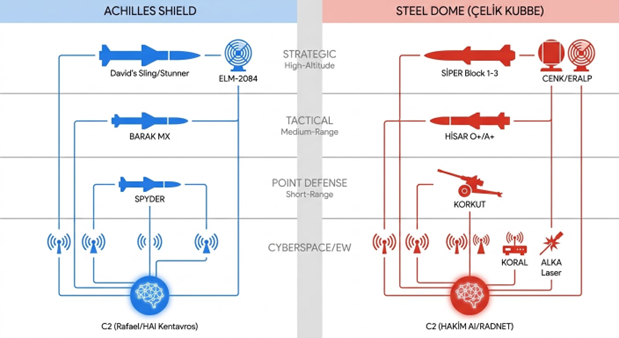
Both Greece and Turkey have adopted a military ‘system of systems’ architecture. Turkey relies on Steel Dome (Çelik Kubbe), which uses wholly indigenous technologies, with a particular emphasis on directed-energy weapons such as ALKA and advanced electronic warfare systems such as KORAL.
From this perspective, Greece’s Achilles Shield project should be understood as a move towards an integrated, multilayered air and missile defence network. Its upper layers rely on Israel’s David’s Sling system, which uses interceptors equipped with a dual electromagnetic and radar seeker to engage tactical ballistic missiles, cruise missiles and heavy unmanned aircraft at ranges of 40–300 kilometres. The middle layer relies on BARAK MX to provide air defence coverage extending to 150 kilometres. The short-range layer uses SPYDER to protect bases on the islands; the system is distinguished by its ability to deploy and become operational within just three minutes.
Alongside missile interception, electronic warfare capabilities form a core component of Achilles Shield. Hellenic Aerospace Industry has integrated the indigenous Kentavros counter-unmanned aircraft system into its command-and-control architecture. Kentavros can detect unmanned aircraft through their electromagnetic emissions at a distance of 150 kilometres and conduct radio-frequency jamming at a distance of 25 kilometres, severing command-and-control links and disrupting Global Positioning System (GPS) navigation.
This integration of electronic jamming and missile interception, supported by artificial intelligence, raises the financial and military costs of Turkish air operations. It enables Greek forces to counter unmanned aircraft electronically without depleting their stocks of costly interceptor missiles, thereby constraining Turkey’s economic advantage in air operations over the Aegean and the Eastern Mediterranean.
Hedging or Encirclement
Israel’s role is a central factor in the strategy to constrain Turkish influence in the Eastern Mediterranean. Israeli–Turkish competition has evolved from diplomatic disputes and economic rivalry over gas resources into direct strategic confrontation across several geographical theatres. Within this operational context, Israeli air strikes against military facilities in Syria, specifically Abu al-Duhur military airfield, represented a tangible shift in the rules of engagement. The operation’s objectives extended beyond weakening local armed groups to delivering a direct deterrent message against any Turkish military expansion within Syrian territory. Through the strike, Israel also sought to affirm its opposition to the establishment of forward Turkish airbases, with the aim of preserving its air superiority and preventing Turkey from establishing a direct military presence close to Eastern Mediterranean airspace.
This Israeli approach is linked to domestic political shifts: Knesset elections after 2022 produced governing coalitions that regard advances in Turkish military manufacturing as a direct threat requiring a response. Israel consequently deploys its political influence in Washington to obstruct Turkey’s acquisition of advanced weaponry. At the operational level, Israel counters Turkish capabilities by shortening the time required to complete the targeting sequence, as measured through ‘kill-chain metrics’, using artificial intelligence to direct energy weapons and electronic jamming systems. The aim is to impose technological constraints that limit the effectiveness of Turkey’s low-cost tactics.
To achieve this military containment, the Israeli security establishment pursues a policy of strategically linking theatres, with Greek–Israeli defence integration as its principal pillar. Athens has become a forward base for Israel, and cooperation has extended beyond naval exercises to the construction of early-warning systems for joint surveillance. This coordination links Israeli radars with defence systems in the Aegean and Cyprus to establish continuous radar coverage from Syrian airspace to the Greek coast, with the aim of detecting and intercepting Turkish unmanned aircraft as soon as they take off.
Figure 2. Anti-access/area-denial (A2/AD) networks and subsea infrastructure
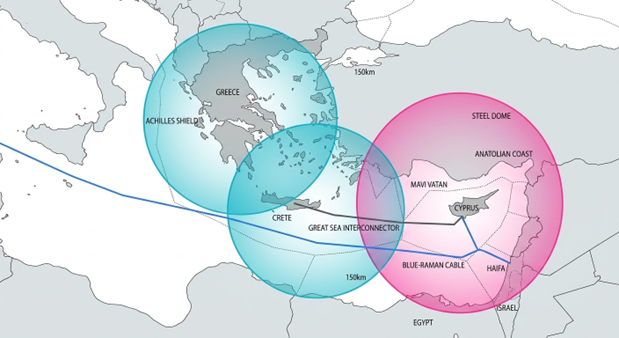
The rationale for ‘hedging’ emerges from the need to secure the economic and digital infrastructure of Europe and the wider region. The Eastern Mediterranean has become a critical geographical transit point for global connectivity and forms the western terminus of the India–Middle East–Europe Economic Corridor (IMEC). The Mediterranean contains complex networks of gas pipelines and submarine fibre-optic cables that carry flows of trade and data between Asia, Africa and Europe. This strategic landscape encompasses the implementation of major infrastructure projects costing billions of dollars that deliberately bypass Turkish territory, linking Europe to the Middle East through Greece, Cyprus and Israel. Prominent among these initiatives are the Great Sea Interconnector, the Blue–Raman cable and the East Mediterranean Gas Forum.
This approach is captured by the concept of the ‘economics of deterrence’, whereby deterrence is no longer defined solely through direct military threats, but also through the interdependence of supply chains, cross-border infrastructure and data networks. This model assumes that the cost of destabilisation rises to unacceptable levels when multiple international actors, including the European Union, the United States, India and the Gulf states, share an interest in maintaining the integrity of these corridors.
This configuration gives rise to a clear security dilemma. While European capitals, Greece and Israel regard Achilles Shield as a defensive measure intended to protect infrastructure and freedom of navigation, Ankara views the integration of Greek air defence systems with regional infrastructure projects that exclude Turkey as a coordinated form of strategic encirclement. Turkey views these initiatives not as defensive measures, but as an offensive form of ‘lawfare’ and military containment, designed to confine it geographically to its immediate coastal waters and thereby exclude it from the emerging wealth of the energy sector and the revenues generated by regional data transmission routes.
The measures taken by Greece and its allies to secure their infrastructure directly diminish Turkey’s economic and regional security. In response, Ankara is expanding its naval, electronic warfare and subsea operational capabilities. Sustained Turkish investment focuses on developing unmanned surface vessels (USVs) and autonomous swarm technologies, such as the Kapan system, alongside autonomous one-way attack submarines, such as the Kilic system. By developing these systems, Ankara seeks to demonstrate its operational capacity to challenge or disrupt critical national infrastructure (CNI) should its maritime claims continue to be disregarded.
The security and defence transformations associated with Achilles Shield, together with the corresponding Turkish responses, indicate a fundamental change in the nature of geopolitical interaction in the Eastern Mediterranean. The region has moved beyond traditional bilateral boundary disputes to become a major arena of global economic and technological competition. Regional states’ reliance on independent security alliances outside conventional institutional frameworks, such as NATO, is entrenching a clear geopolitical divide. Greece, Israel and their allies seek to secure strategic energy and data routes, while Turkey rejects its exclusion from these arrangements and seeks to demonstrate its capacity to influence regional trade flows.
At the strategic level, this dynamic establishes a new reality in which absolute political or military dominance is difficult for any party to achieve. The parity arising from both sides’ possession of advanced defensive and offensive systems prevents either from imposing its will on the other, drawing the region towards a cautious strategic equilibrium. Within this context, states continue to employ military modernisation as a political instrument to strengthen their negotiating positions and avoid direct confrontations that could result in the reciprocal destruction of economic infrastructure.
Future geopolitical stability in the Eastern Mediterranean therefore depends on the capacity to channel this security competition into a shared political and economic process. Achieving such stability requires new diplomatic frameworks that accommodate the security and economic interests of all regional actors and establish mechanisms to integrate Turkey into regional infrastructure projects rather than pursuing policies of isolation. Without this political accommodation, the Eastern Mediterranean will remain an arena of persistent tension, threatening the continuity of the economic projects and global connectivity corridors that these defensive systems are intended to protect.
A crucial strategic reality consequently emerges: the belief that ‘absolute security’ can be achieved through technological superiority alone is a geopolitical illusion. While the shield may succeed tactically in raising the cost of escalation to protect data cables and gas pipelines, it deepens mutual distrust at the strategic level and closes off opportunities for preventive diplomacy. The challenge facing both the architects of this alliance and decision-makers in Ankara thus extends beyond winning the arms race to devising effective political mechanisms for ‘managing technological escalation’. Unless this rigid defensive architecture is accompanied by flexible diplomatic processes that accommodate Turkey’s rising power and recognise the geoeconomic rights of all actors, Achilles Shield will offer no umbrella for sustainable peace. Instead, it will become a sophisticated detonator, awaiting the first algorithmic error to plunge the Eastern Mediterranean into an open-ended war of attrition with no victor.
References
ترك برس. الأدميرال غوردنيز.. مبدأ “الوطن الأزرق” و”بحرنة تركيا”. ترك برس. ٢٤ أغسطس .٢٠٢٠، متاح على الرابط التالي: https://www.turkpress.co/node/73644
Mehmet, Ayhan. “After Greece Signs Deal to Buy Achilles Shield, Israel’s Control of Source Code Sparks Controversy.” Anadolu Ajansı. Anadolu Ajansı, September 8, 2026. Available on:
Baltzoi, Ioannis. “The ‘Achilles Shield,’ the Strengthening of Deterrence and Turkey.” Hellenic Institute for Strategic Studies. Hellenic Institute for Strategic Studies, September 5, 2026. Available on:
https://elisme.gr/en/i-aspida-tou-achillea-i-enischysi-tis-apotropis-kai-i-tourkia/
Kasapoğlu, Can. “Bayraktar K2: A Strategic Answer to the New Rules of the Battlefield.” Hudson Institute. Hudson Institute, n.d. Available on:
Hellenic Republic, Ministry of National Defence. “‘Achilles Shield’ Dome Agreement Signing in Tel Aviv.” August 31, 2026.
Israel Ministry of Defense. “Israel and Greece Have Signed the Massive ‘Achilles Shield’ Agreement.” August 31, 2026.
Scheer, Steven, and Lefteris Papadimas. “Israel Signs $3.5 Billion Air Defence Deal with Greece.” Reuters, August 31, 2026.
Katsikidis, Athanasios. “Achilles Shield to Provide ‘Full Coverage’.” Kathimerini, September 7, 2026.
Nedos, Vassilis, and Stavros Ioannidis. “Israel: ‘Greek Source Code’ to Be Developed for Achilles Shield.” Kathimerini, September 8, 2026.
North Atlantic Treaty Organization. “Military De-confliction Mechanism between Greece and Turkey Established at NATO.” October 1, 2020.
International Telecommunication Union. “Submarine Cable Resilience.” Updated April 2026.
U.S. Geological Survey. “Assessment of Undiscovered Oil and Gas Resources of the Levant Basin Province, Eastern Mediterranean.” Fact Sheet 2010–3014, 2010.
Kurç, Çağlar, et al. “Balancing Aspiration and Reality: Autarky in Turkish Defence Industrial Policy.” Defence Studies 25, no. 2 (2025): 383–406.
Oral, Ferhan, and Serhat Süha Çubukçuoğlu. “Assessing Türkiye’s Blue Homeland Doctrine through Mahanian Sea Power Theory.” Gazi Akademik Bakış 19, no. 38 (June 2026): 417–440.
“Bayraktar AKINCI.” Accessed September 14, 2026. International Committee of the Red Cross. “ICRC Position on Autonomous Weapon Systems.” May 12, 2021.
European Relations. “Greece Builds Achilles Shield.” EuropeanRelations.com. European Relations, September 2, 2026. Available on:
https://europeanrelations.com/quick-brief/greece-builds-achilles-shield/


Related Articles
Achilles Shield: Between Diversification and Dependence
Geography Under Siege: How the Sea Became Israel’s Greatest Vulnerability
Are Europe’s Capability Gaps Choosing Its Defence Partners?
Contradictions Triangle: How Israel’s Recognition of the Armenian Genocide Reshaped the Geopolitics of the South Caucasus
Ankara’s Defensive Rise: A New NATO Path?
Comments