

When governments shut down the internet, the standard justification is security, and the standard assumption is that the measure is temporary. Iran has tested both of those assumptions to their breaking point. Its nationwide internet blackout is now the longest ever imposed on an entire population, and Iranian authorities have simultaneously passed legislation making possession of a satellite internet terminal a criminal offence punishable by execution. These two facts are not separate policies responding to separate pressures. They are expressions of a single, long-prepared doctrine of information sovereignty, one in which connectivity is not a public utility to be temporarily suspended but a political instrument to be permanently controlled.
What Iran has built, and what it is now operating at scale for the first time, raises a question that extends well beyond its borders: when a state decides that controlling information is worth more than the economic cost of losing it, and the international system has no answer, what happens next?
A Doctrine Built Before the War Began
Any serious examination of Iran’s blackout must begin with a basic observation, which is that this did not start on February 28. When U.S. and Israeli strikes hit Iran on that date, the infrastructure needed to impose and sustain a near-total internet shutdown was already in place. Iran has a fifteen-year documented history of building toward this moment. The existence of a parallel national intranet, a closed state-controlled domestic network separate from the global internet, was confirmed as early as 2012.
That infrastructure was not built in isolation. Over more than fifteen years, Iran received extensive technical assistance from China in constructing its filtering and surveillance architecture, including the deployment of Chinese-supplied tools for facial recognition, deep packet inspection, and network monitoring that allow authorities to identify, track, and selectively block users at scale. This Chinese technical foundation is what transformed Iran’s intranet from a basic domestic network into a functional replacement capable of sustaining basic state services, banking platforms, and state media during a near-total severance from the global internet.
President Masoud Pezeshkian visited the construction site of a new Huawei-based national network in March 2025, over a year before the current war began. That facility, estimated to cost between $700 million and $1 billion, is located under a building in Pardis IT Town northeast of Tehran and was deliberately designed to be difficult to destroy by missile strike.
The pattern of progressive capability-building is also visible in Iran’s own shutdown history. The 2019 fuel protests produced a six-day full blackout. The 2022 Mahsa Amini protests saw WhatsApp and Google Play banned for extended periods. The June 2025 twelve-day war with Israel resulted in a 97% collapse in internet usage. And the January 2026 protests triggered a twenty-day near-total shutdown. Each episode was longer, deeper, and more technically sophisticated than the last, reflecting not crisis improvisation but gradual improvement of a system being tested and improved under real conditions.
On Jan.15, 2026, more than six weeks before the February strikes, the internet monitoring organization Filterwatch published a confidential Iranian government plan for what it described as “Absolute Digital Isolation.” The plan outlined the transformation of Iran’s internet infrastructure into what it called a “Barracks Internet,” granting access only to individuals and organizations with security clearance through a strictly monitored whitelist system. State media had already signaled that “unrestricted access will not return after 2026.” This was not improvisation under pressure; it was a plan approaching its implementation phase.
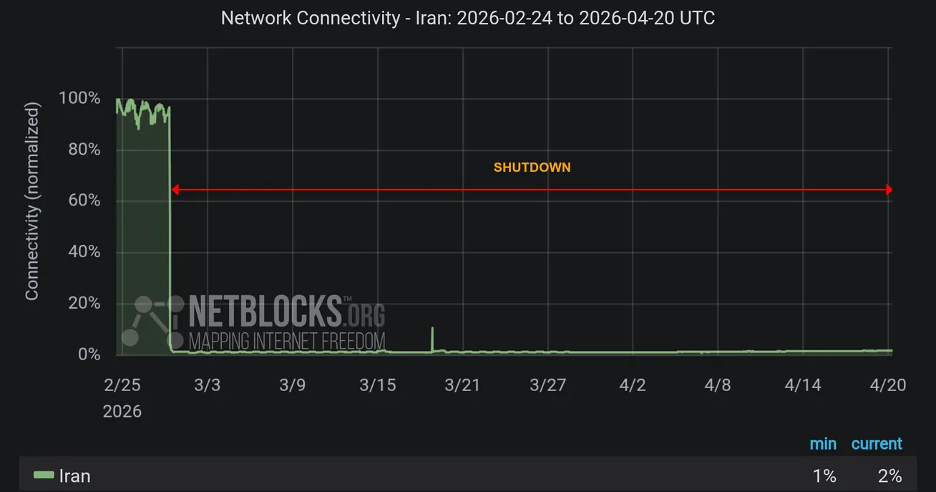
The blackout that followed confirmed it. Within hours of the February 28 strikes, internet traffic collapsed by 98% simultaneously across Tehran, Fars, Isfahan, Razavi Khorasan, and Alborz. All traffic was rerouted through a single country-scale chokepoint allowing the state to monitor, filter, and revoke access centrally. The Iranian Minister of Communications, Sattar Hashemi, acknowledged the shutdown was costing the economy $35.7 million per day, with independent estimates placing the true figure closer to $70 to $80 million when indirect costs were included. By mid-April, total losses were estimated at $1.8 billion. Online sales fell by 80%, financial transactions dropped by 185 million in January alone, and small businesses went bankrupt across the country. The state absorbed all of this and did not reverse course.
What emerged instead was a tiered access system that reveals the doctrine’s underlying logic. Officials and regime-aligned figures received white SIM cards offering relatively open connectivity. Vetted professionals, including doctors, university professors, and traders introduced through their guilds and chambers of commerce, were offered a service called Internet Pro, a metered and heavily filtered package requiring full identification and institutional referral documents. The general public, over 90 million people, received nothing. The government made no effort to conceal the political logic behind this arrangement, with official statements making clear that access under the tiered system would flow to those seen as supportive of the state’s account of events, and not to the broader public. Connectivity had been formally converted from a public utility into a political instrument, distributed as a reward and withheld as a punishment.
The human consequences of this architecture were direct and measurable. Many Iranians did not learn the scale of the January protests crackdown, in which around 12,000 people were killed, until weeks after the events, because information could not travel through a population severed from both international networks and each other. During the war, civilians had no reliable access to airstrike warnings distributed through international channels, with internet connectivity reduced to roughly 1% of normal levels nationwide. Meanwhile, the regime sent daily SMS messages to citizens declaring military victories over the U.S. and Israel, with no competing sources of information available to most of the population to challenge those claims.
Why Satellite Internet Could Not Close the Gap
Starlink, the low-earth orbit satellite internet service operated by SpaceX, became the primary workaround for Iranians seeking access to the outside world during the blackout. During the January protests, it transmitted footage of state violence and enabled human rights documentation that reached international audiences. Amnesty International and Human Rights Watch both described the blackout as an attempt to conceal what was happening on the ground. Starlink briefly succeeded in piercing that concealment, which is precisely why it became a priority target.
The Iranian state’s response followed the same escalation logic as the broader shutdown. Banning the service proved insufficient because terminals were already inside the country. GPS spoofing and radio-frequency jamming degraded connections to between 30 and 80% packet loss depending on location. Physical seizures and door-to-door operations removed devices from homes and businesses. Financial sanctions targeted users’ bank accounts, and arrests of sellers created deterrence. When all of these measures still failed to eliminate an estimated 50,000 operational terminals, the state moved to capital punishment as the ceiling of the enforcement ladder. The IRGC also warned of potential strikes on SpaceX and other American technology companies, reflecting the state’s assessment that a satellite internet service enabling the documentation of a crackdown was a genuine threat to internal stability, serious enough to place in the same category as hostile foreign infrastructure.
However, the broader significance is what the Iranian case reveals about the limits of satellite internet as a tool of political resistance. Starlink terminals depend on GPS positioning and timing signals to maintain alignment with satellites in orbit, and those signals are vulnerable to the same spoofing and jamming tactics Russia deployed against Ukraine in 2022. This is not a flaw in Starlink’s engineering but a design constraint that states with the right equipment and political will can exploit. Iran invested in that equipment deliberately, and China supplied much of the underlying surveillance and filtering architecture that made the broader shutdown sustainable.
There is a further dimension that receives insufficient attention. In 2025, SpaceX unilaterally disabled more than 2,500 Starlink terminals in Myanmar without any government request and without disclosing its reasoning publicly. That decision demonstrated that the technical ability to shut down satellite connectivity at scale exists within the company itself, and that the choice of whether to exercise it depends on SpaceX’s own political, commercial, and geopolitical calculations. In Iran, the U.S. government covertly smuggled thousands of terminals into the country and that operation is itself an admission that no open or systematic solution was available. The most powerful external actor in the conflict could not restore connectivity through any legitimate or transparent channel, because no international legal framework exists to govern how a private operator must behave when it becomes the last communications lifeline for tens of millions of people in a conflict zone.
Moreover, the International Telecommunication Union, the body that governs global spectrum management, has no mechanism to distinguish between legitimate interference prevention and deliberate political repression. Iran can classify military-grade GPS jamming as routine spectrum enforcement, and the international system accepts that framing without applying any proportionality test or human rights assessment. The governance blind spot is structural, not incidental, and Iran is exploiting it at a scale and sophistication that has not been seen before.
What Comes After the Record
Iran’s blackout is not only a record. It is a proof of concept, and the evidence suggests other states are positioned to treat it as one. China has supplied Iran with filtering infrastructure, surveillance tools, facial recognition systems, and Huawei-based network architecture over more than 15 years, creating a transferable technical package that any state with a Chinese partnership and a national intranet project can acquire without developing the capabilities independently. The infrastructure that made 52 days of near-total disconnection survivable for the Iranian state did not originate in Tehran.
The jamming playbook is equally portable. Russia deployed the same GPS spoofing and radio-frequency jamming tactics against Ukraine’s Starlink connections in 2022 that Iran refined during the current blackout. That the two cases share both a technical method and a geopolitical alignment is not coincidental. It confirms that the capability to neutralize low-earth orbit satellite internet already circulates among states with shared interests in controlling connectivity, and that Iran’s current application of it represents a refinement of an already-tested approach rather than an original invention.
Russia, which has progressively restricted its own domestic internet through its sovereign internet law passed in 2019, presents a particularly significant case to watch. That legislation gave the Russian state the technical architecture to disconnect from the global internet entirely if it chose to do so. Combined with its demonstrated willingness to deploy satellite jamming, and its deepening alignment with both Iran and China, Russia possesses both the technical foundation and the geopolitical incentive to move toward the kind of population-scale digital isolation that Iran has now demonstrated is survivable. In a world where economic deglobalization is accelerating and states are increasingly treating digital infrastructure as a sovereign asset rather than a shared global resource, the question of whether internet connectivity itself follows the same fragmenting trajectory as trade, supply chains, and financial systems is no longer hypothetical.
Additionally, foreign telecommunications providers have begun leaving Iran during the conflict, with Iranian and Chinese institutions positioned to fill that space. That exit reduces future dependence on Western companies that might resist participating in a shutdown, expose its architecture, or face legal and reputational pressure from their home governments. A system that once relied partly on foreign commercial infrastructure is being rebuilt to function without it, making future shutdowns easier to impose and harder to detect from the outside.
The governance gap ties all of this together. Any state with Chinese technical partnership, a functioning national intranet, and the political will to absorb short-term economic damage can observe Iran’s experience as a working model, knowing that the ITU will not intervene, that Starlink can be jammed, and that international condemnation carries no enforcement consequence. SpaceX operates simultaneously as a tool of U.S. foreign policy, a commercial enterprise, and a de facto humanitarian infrastructure provider for populations under blackout, with discretionary power over all three roles and formal accountability for none of them.
That combination, a doctrine refined over 15 years, a transferable technical package, a portable jamming playbook, a consolidating national infrastructure, and a governance architecture with no enforcement teeth, is what makes Iran’s blackout something more than a record. The internet was once framed as an inherently democratizing technology, too distributed and too global for any state to fully control. Iran has not only challenged that assumption; it has methodically dismantled it. And as deglobalization reshapes the political and economic order, the risk is not simply that states already invested in sovereign internet infrastructure replicate this model, but that the fragmentation of the global internet, one sovereign chokepoint at a time, becomes a structural feature of the world order rather than an exception to it.
References
AFP. 2026. “Iran Entrepreneurs Angered by Months-Long Internet Blackout.” France 24. FRANCE 24. April 19, 2026. https://www.france24.com/en/live-news/20260419-iran-entrepreneurs-angered-by-months-long-internet-blackout.
Doe, Jane. 2026. “1,224 Hours of Internet Blackout in Iran.” Iranwire.com. IranWire. April 20, 2026. https://iranwire.com/en/news/151467-1224-hours-of-internet-blackout-in-iran/.
Engelking, Niklas Jan. 2026. “Internet Shutdown in Iran Is Now the Longest in World History.” Heise Online, April. https://www.heise.de/en/news/Internet-shutdown-in-Iran-is-now-the-longest-in-world-history-11246134.html.
Hauer, Neil. 2026. “Iranians Try to See through Fog of War amid Internet Blackout.” CBC. April 13, 2026. https://www.cbc.ca/news/world/iran-war-us-internet-blackout-9.7161918.
Iran International . 2026. “Iran’s Internet Kill Switch Project in Final Stages – Sources.” Iranintl.com. Iran International. January 14, 2026. https://www.iranintl.com/en/202601145172.
James, Luke. 2026. “Iran’s Forced Nationwide Internet Blackout Becomes Second-Longest on Record as It Passes 1,000 Hours Offline — Possessing Starlink Terminals Punishable by Death, Country Using ‘Military-Grade Jamming’ against Service.” Tom’s Hardware. April 12, 2026. https://www.tomshardware.com/tech-industry/iran-passes-1000-hours-offline.
Motamedi, Maziar. 2026. “Iran Expands Limited Internet Access but Restrictions Remain for Most.” Al Jazeera. April 20, 2026. https://www.aljazeera.com/news/2026/4/20/iran-expands-limited-internet-access-but-restrictions-remain-for-most.
Reuters Staff. 2026. “Two Foreigners Arrested in Iran for Importing Starlink Technology, Tasnim Reports.” Reuters, April 19, 2026. https://www.reuters.com/world/middle-east/two-foreigners-arrested-iran-importing-starlink-technology-tasnim-reports-2026-04-19/.
Solomon, Erika, and Sanam Mahoozi. 2026. “Iran Eases Some Internet Restrictions, as Wider Blackout Passes 50th Day.” Nytimes.com. The New York Times. April 19, 2026. https://www.nytimes.com/2026/04/19/world/middleeast/iran-internet-blackout-50th-day.html?unlocked_article_code=1.cFA.SoKT.Zl1mU_bUB3LS&smid=url-share.
Van Der Geest, Dinah. 2026. “What Iran’s Internet Shutdown Reveals about Starlink.” Tech Policy Press. February 5, 2026. https://www.techpolicy.press/what-irans-internet-shutdown-reveals-about-starlink/.


Economic Outcast: The Limits of U.S. Secondary Sanctions Against a China-Insulated Iranian Economy
Diplomacy without Resolution: What Comes After the 60-Day Deadline?

Iran’s Water Signal: Measuring What a Non-Event Could Become

Bab al-Mandab at the Heart of the Crisis: Will the Houthi Blockade Push Pakistan into a Confrontation with Iran?

Tel Aviv Stock Exchange: Why did it rise during the war and fall with the truce?

Comments