


President Donald Trump announced that the United States will impose a naval blockade on the Strait of Hormuz after weekend talks to end the Iran war collapsed without a settlement. The Islamabad negotiations, which were intended to turn a tenuous ceasefire into a durable peace and reopen Hormuz to safe navigation, broke down over unresolved disputes on nuclear enrichment, sanctions relief, and control of maritime transit. In response, Trump issued an executive order directing the US Navy to interdict any vessel attempting to transit the strait, with particular focus on neutral and commercial ships that have paid Iranian transit tolls, which the White House now characterises as an illegal extortion regime rather than a lawful fee regime.
Trump’s declaration instantly elevates the conflict from a regional shooting war to a global maritime and energy crisis centred on the world’s most critical oil chokepoint, a waterway just twenty‑one nautical miles across at its narrowest. By pledging to enforce a blockade without United Nations Security Council authorisation, the president has pushed the United States into a legally and operationally contested grey zone, framing the move as necessary to dismantle the Islamic Revolutionary Guard Corps’ grip over the strait and sever a key stream of cryptocurrency and foreign-exchange revenue to Tehran. The administration’s strategy now hinges on whether US naval power, layered secondary sanctions, and sustained diplomatic pressure can actually sustain a prolonged blockade in the face of Iranian asymmetric deterrence. The following analysis, therefore, centers on Trump’s blockade order itself: its operational viability, Iran’s capacity to erode or break it through asymmetric tactics, and the resulting shockwaves for global energy markets, commercial shipping patterns, and regional economic stability.
Is It Possible?
From a strictly tactical perspective, the United States possesses the forward-deployed military architecture necessary to initiate a naval blockade in the Arabian Gulf. The operational backbone of this enforcement campaign relies upon the United States Central Command and the United States Fifth Fleet. Leveraging an extensive regional basing network, the United States Navy can project immense surface, submarine, and aerial power into the littoral combat zone.

Operations have already commenced under the banner of Operation Epic Fury, encompassing freedom of navigation manoeuvres, integrated uncrewed surveillance tracking, and complex mine-countermeasure deployments to neutralise the lethal hazards introduced by Iranian forces. The military objective is to establish an exclusionary maritime zone, hail and inspect commercial traffic, and physically divert or seize vessels suspected of funding the Iranian state through illicit toll payments.
Despite this overwhelming concentration of conventional military force, the sustained feasibility of a hermetic blockade is highly suspect due to severe operational hazards and a profound lack of international burden-sharing. Enforcing a blockade within the confined, congested waters of the Strait of Hormuz exposes United States surface combatants to constant, overlapping threats from shore-based anti-ship cruise missiles and fast-attack drone swarms. Furthermore, the diplomatic isolation of the United States significantly degrades the long-term viability of the operation. Traditional allies and regional partners are acutely aware that participating in a unilateral blockade without United Nations authorisation invites accusations of engaging in an illegal act of aggression under Article 2(4) of the United Nations Charter. Consequently, efforts to assemble a broad maritime coalition have largely failed. While the United Kingdom has offered limited defensive coordination, major naval powers, including France, Japan, and Australia, have abstained, leaving the United States to shoulder the overwhelming majority of the kinetic risk. The absence of a United Nations Security Council mandate, blocked by vetoes from the Russian Federation and the People’s Republic of China, leaves the operation on fragile legal ground, relying almost entirely on a contested self-defence rationale.
To compensate for the vulnerabilities of physical naval interdiction, the United States has weaponised its economic statecraft to construct a functional blockade through secondary sanctions. The administration swiftly invoked emergency statutory authorities and trade mechanisms to impose ad valorem tariffs on any nation purchasing Iranian goods or complying with the transit tolls, effectively forcing neutral states to choose between access to the American consumer market or the Iranian energy corridor. Following a Supreme Court ruling that restricted the use of the International Emergency Economic Powers Act for broad tariff application, the administration pivoted to Section 122 of the Trade Act of 1974 to enact import quotas and surcharges on uncooperative nations. However, this aggressive economic coercion has generated intense international friction. European allies have threatened retaliatory trade countermeasures using the bloc’s anti-coercion trade instruments, while major Asian energy importers, specifically China and India, view the blockade as an existential threat to their sovereign energy security. The reliance on blunt tariff instruments and secondary sanctions highlights the fundamental vulnerability of the blockade. Moreover,The United States cannot physically police every vessel in the Gulf indefinitely, and its attempts to enforce compliance through financial strangulation are actively eroding the very international alliances required to isolate Tehran. The intersection of these diplomatic, legal, and kinetic hurdles guarantees that the enforcement of the blockade will remain an arduous, highly contested endeavour.
Iranian Asymmetric Deterrence
While the United States Navy wields undeniable conventional supremacy, Iran possesses the geographic and asymmetric advantages necessary to effectively prevent the United States from unilaterally securing the Strait of Hormuz. Iran’s overarching strategic objective is not to defeat the Fifth Fleet in a symmetric naval engagement but rather to manipulate the risk environment to such an extreme degree that commercial shipping remains paralysed regardless of American security guarantees. By entirely overlapping the navigable transit corridors with its territorial waters, Iran claims jurisdiction under the principle of non-suspendable innocent passage, utilising this legal interpretation to justify the interdiction of non-compliant vessels. Iran has weaponised this geography by establishing a heavily guarded corridor near Larak Island, compelling tankers to pay extortionate fees to the Islamic Revolutionary Guard Corps via untraceable digital currencies or Chinese yuan before granting safe passage.
Iran’s capacity to prevent the American blockade from succeeding is rooted in its potent anti-access and area-denial capabilities. The Iranian military has seeded the shipping lanes with sophisticated naval mines and positioned mobile, concealed anti-ship missile batteries along its rugged coastline.
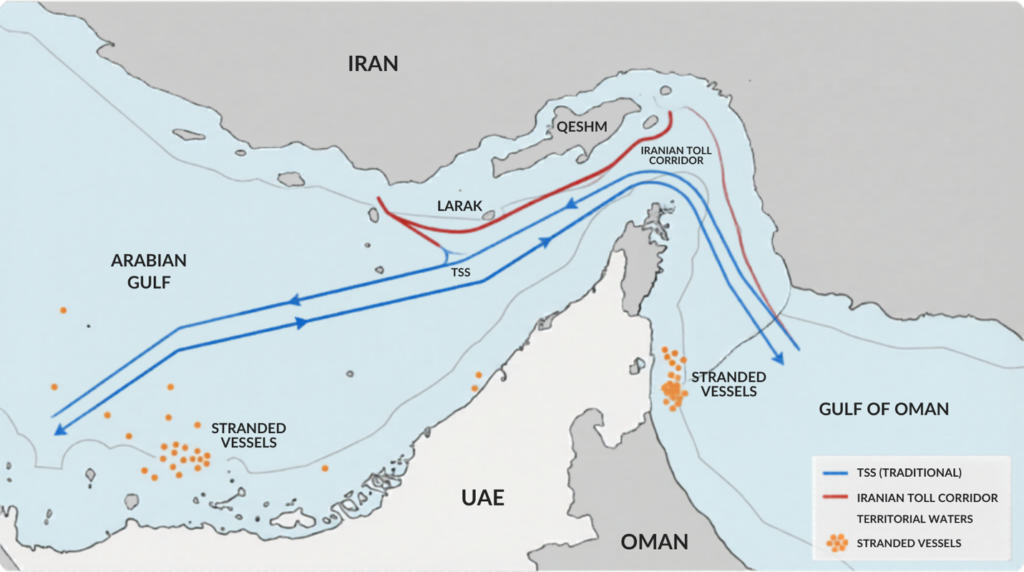
Even if United States destroyers manage to escort specific vessels or clear localised minefields, Iran only needs to execute a handful of successful strikes on merchant vessels to shatter the illusion of safe passage. The United States cannot eliminate every asymmetric threat without initiating a massive, prolonged ground and air campaign on sovereign Iranian territory, an escalation that carries catastrophic geopolitical risks. Therefore, Iran can maintain a state of permanent lethal friction, ensuring that the waterway remains a combat zone where standard commercial operations are fundamentally impossible. The Iranian strategy does not require the absolute destruction of the American naval presence; it requires only the persistent application of unpredictable violence to deter the global shipping industry. The threat of a single maritime casualty is entirely sufficient to cause commercial underwriters to abandon the market.
Furthermore, Iran has demonstrated a ruthless willingness to hold the entire region hostage through retaliatory strikes against the critical infrastructure of neighbouring states. By threatening the desalination plants, energy pipelines, and logistical hubs of states like Saudi Arabia, Qatar, and the United Arab Emirates, Tehran effectively deters regional powers from supporting the United States blockade. This coercive diplomacy forces shipping conglomerates into an impossible dilemma. They must either pay the Iranian toll and risk interdiction and secondary sanctions from the United States or comply with the American blockade and face the imminent threat of physical destruction by Iranian drones and missiles. Ultimately, Iran’s asymmetric deterrence ensures that the United States Navy can contest the Strait of Hormuz, but it cannot unilaterally guarantee the free flow of global commerce through it. The ensuing stalemate inherently favours the disruptive actor, as the prolonged closure of the strait achieves Iran’s objective of inflicting unacceptable economic pain on the international community, thereby leveraging global panic to force an end to the conflict on its own terms.
Catastrophic Implications
The intersection of the American naval blockade and Iranian asymmetric warfare will transform the Strait of Hormuz into an impassable chokepoint, triggering the most severe macroeconomic supply disruption in the modern history of global trade. The sheer volume of commodities trapped behind the blockade is staggering. Approximately twenty million barrels of crude oil and petroleum liquids, representing roughly one-fifth of global daily consumption, are structurally dependent on this maritime artery. With alternative pipeline capacities in Saudi Arabia and the United Arab Emirates capable of offsetting only a fraction of this volume, the global energy market has experienced unprecedented price shocks. Brent crude oil surged past previous historical ceilings, reaching toward $130 per barrel, with market projections indicating a trajectory toward $200 per barrel if the blockade persists indefinitely.
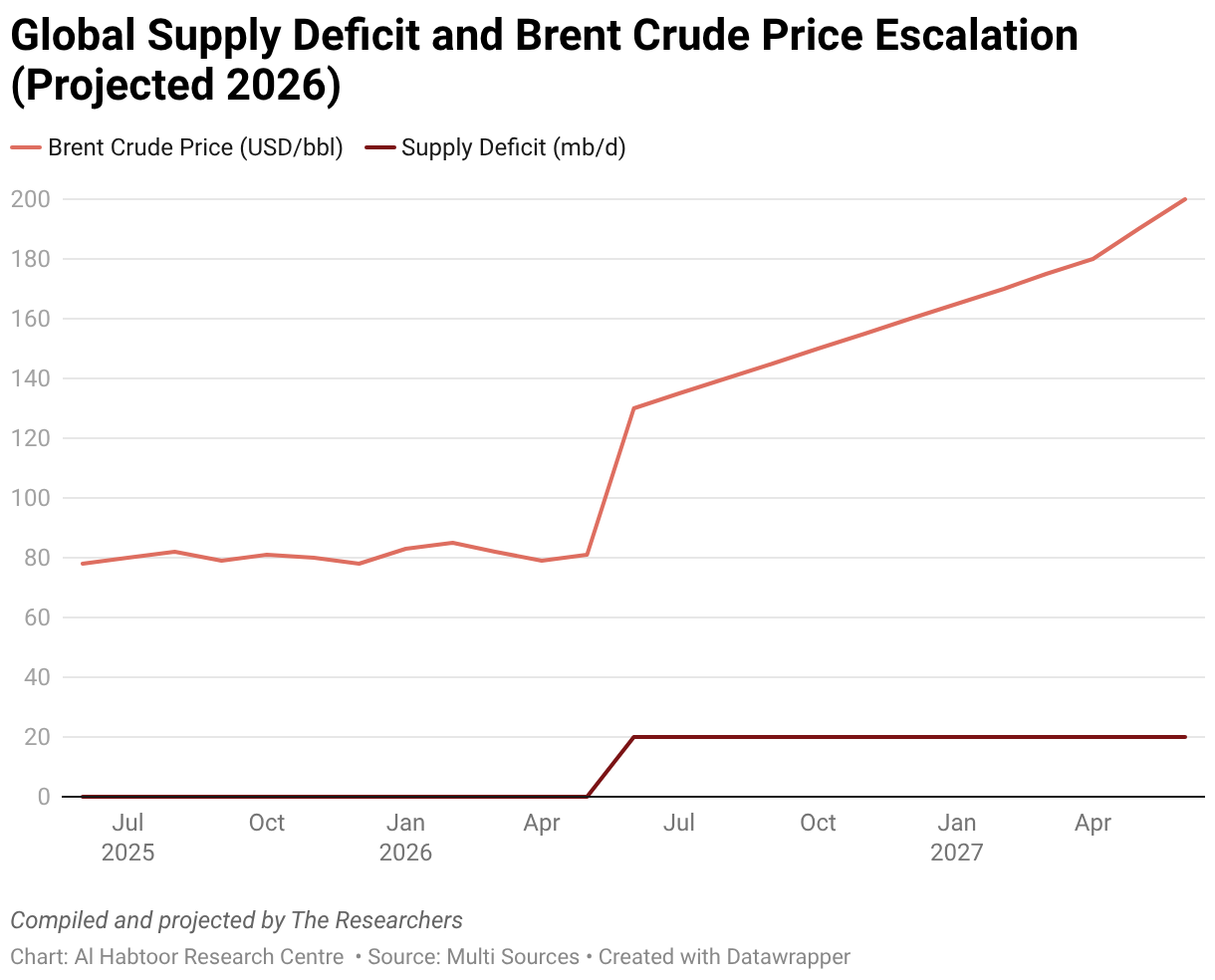
This severe energy deficit immediately cascaded into the refined product sector, crippling global supplies of diesel, petrol, and aviation fuel, and threatening to plunge major economies into a deep stagflationary recession.
The economic devastation extends far beyond hydrocarbon markets, fundamentally threatening global food security and the viability of the commercial shipping industry. The Gulf region exports 20% of the world’s liquefied natural gas and up to 30% of critical agricultural fertilisers, including urea and ammonia. With the blockade severing these supply chains on the eve of the Northern Hemisphere’s planting season, global fertiliser prices spiked by over 30% in a single week. Concurrently, the commercial maritime insurance market has collapsed under the weight of kinetic risks and legal liabilities. War-risk premiums have skyrocketed to an extortionate 1% of a vessel’s total hull value, adding millions of dollars in overhead to a single voyage. Because marine underwriters risk catastrophic secondary sanctions if they ensure a vessel that pays the illicit Iranian toll, the majority of Protection and Indemnity clubs have entirely withdrawn coverage for the region. The result is a total operational paralysis, with hundreds of commercial vessels stranded at anchorages across the Gulf of Oman and the Arabian Gulf, unable to legally or safely transit the conflict zone.
What’s Next?
The trajectory of the United States naval blockade in the Strait of Hormuz points toward a protracted and economically punishing stalemate, with highly constrained avenues for immediate diplomatic de-escalation. As the administration attempts to enforce an uncompromising interdiction regime against an entrenched and asymmetrically capable Iranian adversary, the international community faces a prolonged period of severe maritime and commercial disruption. The strategic forecast dictates that this crisis will not be resolved through a decisive, conventional naval victory. Instead, it will devolve into a gruelling war of economic attrition and diplomatic brinkmanship. The ensuing months will be defined by how the friction between American unilateral enforcement and Iranian area-denial capabilities shapes the behaviour of neutral states, necessitating an evaluation of the most probable scenarios that will dictate regional stability and the future of the global economy.
The most perilous, yet highly probable, scenario involves a kinetic escalation resulting from miscalculation or the rigid enforcement of the blockade against non-compliant, third-party shipping. Should the United States Navy utilise lethal force or execute a hostile boarding of a major commercial vessel—particularly one flagged or owned by an emerging global power such as China or India—the crisis will rapidly mutate from a regional containment operation into a broader, systemic geopolitical fracture. Under these conditions, Iran is virtually guaranteed to respond by fully activating its regional proxy networks and launching direct, overwhelming asymmetric strikes against the critical infrastructure of United States allies in the Gulf Cooperation Council. This theatre-wide conflagration would cement the absolute closure of the maritime corridor, entirely neutralise the Fifth Fleet’s localised security efforts, and push global crude prices well beyond the catastrophic threshold of $200 per barrel.
Alternatively, a scenario defined by fractured international compliance and a porous, degraded blockade could emerge if the United States determines that the economic and diplomatic costs of absolute enforcement are ultimately unsustainable. Facing the profound risk of permanently alienating essential strategic partners in Europe and driving the global economy into a severe, stagflationary depression, Washington might be forced to tacitly permit a shadow maritime economy to operate within the conflict zone. In this dynamic, certain merchant vessels operating under sovereign protection or utilising sophisticated evasion protocols could navigate the strait, clandestinely pay the Iranian transit tolls, and absorb extortionate war-risk insurance premiums. While this would allow a marginal trickle of hydrocarbons and commodities to reach international markets, the fractured compliance would only entrench the strategic uncertainty, leaving the world’s most critical maritime corridor in a state of permanent volatility. Furthermore, this scenario would fundamentally undermine the credibility of the United States sanctions architecture and demonstrate the stark limitations of American unilateral power when confronted with unified resistance from major Asian energy consumers and European allies.
Regardless of the immediate tactical resolution, the long-term structural impacts of the blockade are effectively irreversible. The aggressive weaponisation of the Strait of Hormuz by both the United States military and the Islamic Revolutionary Guard Corps will aggressively restructure to mitigate chokepoint vulnerability, accelerating massive sovereign investments in alternative energy transit corridors, redundant overland pipeline networks, and the rapid diversification away from Middle Eastern hydrocarbons. Ultimately, the blockade will be analysed not merely as a localised naval dispute but as the definitive catalyst that eroded international maritime law, accelerated the fragmentation of the United States-led global economic order, and permanently redrew the strategic geography of global trade.
References
“A $2M Fee to Pass through Hormuz, Shield from Future Strikes: Inside Iran’s Peace Plan That Got Trump’s Nod.” Economic Times, April 10, 2026. Accessed April 12, 2026. https://m.economictimes.com/news/international/world-news/middle-east-war-iran-10-point-plan-strait-of-hormuz-fee-war-guarantees-sanctions-relief-donald-trump-deadline/articleshow/130076629.cms.
“Iran Sets $1 per Barrel Crypto Toll on Tankers Transiting via Strait of Hormuz: FT.” India Today, April 8, 2026. Accessed April 10, 2026. https://www.indiatoday.in/world/story/tehran-sets-1-per-barrel-crypto-toll-on-tankers-transiting-via-strait-of-hormuz-2893417-2026-04-08.
“Russia, China Veto UN Resolution to Reopen Strait of Hormuz.” Times of India, April 10, 2026. Accessed April 12, 2026. https://timesofindia.indiatimes.com/world/middle-east/russia-china-veto-un-resolution-to-reopen-strait-of-hormuz/articleshow/130091501.cms.
“US–Iran Historic Ceasefire Talks in Pakistan Conclude before Dawn, to Resume after Break.” Economic Times, April 12, 2026. Accessed April 12, 2026. https://m.economictimes.com/news/international/world-news/us-iran-historic-ceasefire-talks-in-pakistan-conclude-before-dawn-to-resume-after-break-strait-of-hormuz-donald-trump/articleshow/130201131.cms
Borger, Julian, and Erin Cunningham. “Trump Announces Naval Blockade of Iran after Islamabad Talks Yield No Deal.” Washington Post, April 12, 2026. Accessed April 12, 2026. https://www.washingtonpost.com/world/2026/04/12/iran-us-talks-ceasefire-vance/.
Brownstein Hyatt Farber Schreck. “Supreme Court Restricts Presidential Tariff Authority under IEEPA.” Policy alert, February 2026. Accessed April 12, 2026. https://www.bhfs.com/insight/supreme-court-restricts-presidential-tariff-authority-under-ieepa/.
Covington & Burling LLP. “The Risks of Paying the Strait of Hormuz Toll: Will Passing ‘Go’ Mean Violating Sanctions?” National Law Review, April 2026. Accessed April 12, 2026. https://natlawreview.com/article/risks-paying-strait-hormuz-toll-will-passing-go-mean-violating-sanctions.
Deloitte. “The Middle East Conflict Begins to Cast a Shadow on the Global Economy.” Deloitte Insights, March 2026. Accessed April 08, 2026. https://www.deloitte.com/us/en/insights/topics/economy/iran-middle-east-conflict-impacts-global-economy.html.
H.S.F. Kramer. “Trump Administration Announces New Tariff on Imports Linked to Iranian Trade.” Kramer Sanctions Notes, February 2026. Accessed April 10, 2026. https://www.hsfkramer.com/notes/sanctions/2026-posts/trump-administration-announces-new-tariff-on-imports-linked-to-iranian-trade.
Haque, Jibran. “Trump Shares Article Discussing Possibility of Naval Blockade against Iran as Peace Talks Fail.” Indian Express, April 12, 2026. Accessed April 12, 2026. https://indianexpress.com/article/world/us-news/trump-iran-naval-blockade-vance-islamabad-talks-fail-no-agreement-10632077/.
International Crisis Group. “Strait of Hormuz.” Accessed April 10, 2026. https://www.crisisgroup.org/trigger-list/iran-usisrael-trigger-list/flashpoints/strait-hormuz.
Lazaroff, Tovah. “Donald Trump to Cancel Iran’s Ceasefire Profit with Full Hormuz Blockade.” Jerusalem Post, April 12, 2026. Accessed April 12, 2026. https://www.jpost.com/middle-east/iran-news/article-892658/.
McLaughlin, Rob. “The Law of Naval Warfare and Convoy Operations.” International Law Studies 108 (2024). Accessed April 12, 2026. https://digital-commons.usnwc.edu/ils/vol108/iss1/5/.
Middle East Council on Global Affairs. “The Costs of the Iran Conflict for the Gulf.” Blog post, March 2026. Accessed April 12, 2026. https://mecouncil.org/blog_posts/the-costs-of-the-iran-conflict-for-the-gulf/.
Rankin, Jennifer. “ ‘Food Security Timebomb’: A Visual Guide to the Gulf Fertiliser Blockade.” The Guardian, April 3, 2026. Accessed April 10, 2026. https://www.theguardian.com/world/2026/apr/03/visual-guide-gulf-fertiliser-blockade.
Saidi, Nasser. “Beyond Oil: Global Trade and Food Security Impacts of the Hormuz Disruption.” Weekly Insights, March 13, 2026. Accessed April 12, 2026. https://nassersaidi.com/2026/03/14/beyond-oil-global-trade-and-food-security-impacts-of-the-hormuz-disruption-weekly-insights-13-mar-2026/.
Schank, John F. “The Legal Question of Tolling Hormuz.” Eno Center for Transportation, April 9, 2026. Accessed April 09, 2026. https://enotrans.org/article/the-legal-question-of-tolling-hormuz/.
Stimson Center. “Global Markets and the Strait of Hormuz: The Economic Shockwaves of the Iran War.” Stimson.org, 2026. Accessed April 12, 2026. https://www.stimson.org/2026/global-markets-and-the-strait-of-hormuz-the-economic-shockwaves-of-the-iran-war/.
TRM Labs. “Iranian Crypto Tolls in Strait of Hormuz.” TRM Insights Blog, April 2026. Accessed April 10, 2026. https://www.trmlabs.com/resources/blog/iranian-crypto-tolls-in-strait-of-hormuz.


Related Articles
Diplomacy without Resolution: What Comes After the 60-Day Deadline?
Closure Upon Closure: The Potential Impact of Houthi Threats to Saudi Shipping at Bab al-Mandeb

How Wartime Purges Are Reshaping U.S. Military Doctrine?

The Implications of the April 2026 U.S.–Iran Ceasefire on Oil Prices
Defence Economies at War: National Budget Stress

Comments