

The prolonged Russia-Ukraine War has been met with futile efforts to end it by several peace plans throughout nearly four years of war. Currently, U.S. President Donald Trump appears determined to end the war by pushing a peace plan in the last few months of 2025 and negotiating with both Russian President Vladimir Putin and Ukrainian President Volodymyr Zelenskyy.
Many scenarios unfold for the aftermath of the Russia-Ukraine War. Amid the ongoing peace negotiations, driven mainly by the U.S. and Russia’s push for Trump’s 28‑point plan and Ukraine’s counterproposal through the amended 19‑point plan, a settlement favouring Russia is increasingly possible, raising the question: if such a plan is adopted, how will the Eurasian scene change?
Revisiting the ‘Peace Plan’
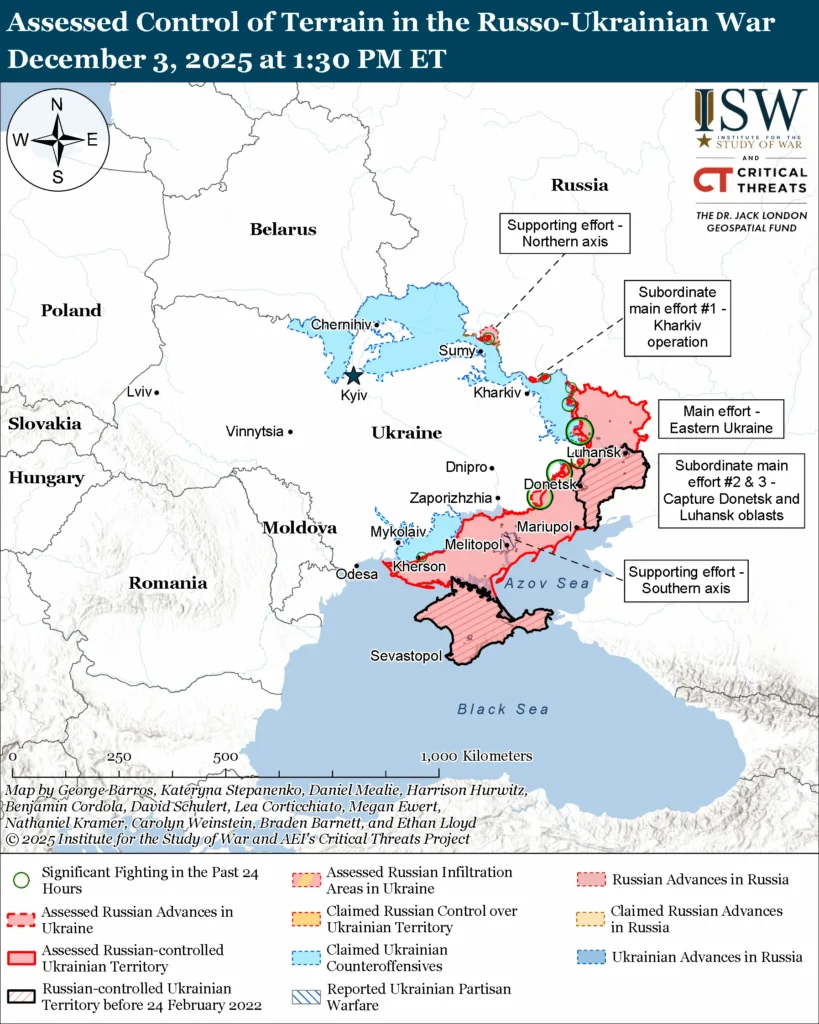
A U.S. peace plan consisting of 28 points aiming to end the Russia-Ukraine War came to light earlier in November. The plan has been heavily criticised by the Ukrainian and EU sides as being favourable to Russian interests. The key points of contention in the peace plan include reducing the size of the Ukrainian Armed Forces to 600,000 personnel; Ukraine refraining from joining NATO and ruling out the stationing of NATO troops on its territory; and the most pressing issue, recognising Crimea and the Donbas region, notably Luhansk and Donetsk, as part of Russia.
Many points in this plan align with Russia’s terms, including the recognition of Crimea and the Donbas as part of Russia territory, Ukrainian neutrality with no affiliation to NATO, limits on the size of Ukraine’s armed forces, and gradual easing of sanctions. As a response, the Ukrainian side presented an amended 19-point plan, which is more acceptable to them but less appealing to Russia. This raises the question of the type of peace plan that will be adopted, as the most conflicting issue between the two sides is the territorial concession, including border demarcation. Moscow insists on seizing the entire Donbas region in eastern Ukraine, while agreeing on such a condition is strategically and politically damaging to Kyiv.
For the U.S., Trump seems determined to reach a final peace deal by negotiating with both sides to reach a consensus settlement. First, U.S. Army Secretary Daniel Driscoll held talks with Kyrylo Budanov, the chief of the Ukrainian defence ministry’s Main Intelligence Directorate (GUR), and a Russian delegation in Abu Dhabi. Then, special envoy Steve Witkoff and Trump’s son-in-law Jared Kushner met with Putin in Moscow, before that, both of them, along with Secretary of State Marco Rubio, met with Ukrainian officials in efforts to make both sides agree on common points.
Whereas ‘more discussions’ are required as the current standpoint, it seems that both parties are initially prepared to reach a tangible agreement. The scenario appears to be repeating itself; nevertheless, forecasts indicate that any final peace plan will lean more toward Russia for several reasons. First, Russia has been progressing on the battlefield as it has captured significant lands in the Donbas region. Second, Trump appears more willing to push for territorial concessions in exchange for Putin’s agreement to a peace deal.
Moreover, the Ukrainian government is under pressure following the resignation of Ukraine’s Chief of Staff Andriy Yermak amid corruption allegations that reached many high-level politicians. Yermak was a key figure in the Russia-Ukraine peace negotiations throughout the war, and he helped persuade the U.S. to remove certain clauses unfavourable to Ukraine from the latest peace plan proposal. Furthermore, Ukrainian troops are facing a shortage in both weapons and funding, while at the same time, Trump is pressuring Zelenskyy to make concessions to Russia to bring the war to an end.
The situation involves complex dynamics over disputed territories, NATO support, and sanctions on oil exports. Since the beginning of the war, multiple peace proposals have emerged, yet none have manifested. However, it seems that if a peace plan is agreed upon in the current situation, it would most likely favour Russia rather than Ukraine. Hence, this outlines a potential scenario for how the geopolitical landscape of Eurasia and relations between regional states would look if the war ended on Russia’s terms.
How Do Things Stand for Russia and Ukraine?
A settlement favourable to Moscow would involve territorial concessions by Ukraine, most notably formalising Russian control over the Donbas region, and the gradual lifting of Western sanctions targeting Moscow, along with security guarantees preventing Ukraine from joining NATO. If this is the situation, the Eurasian scene envisions a stronger Russian influence within the neighbouring countries and, at the same time, a stronger Kremlin government. Russia will frame the peace agreement as a victory to strengthen its domestic legitimacy with further centralisation of power. Along with that, the Kremlin will direct its efforts on reconstituting two central interlinked sectors: military and economy.
For the military, Russia’s State Armament Programme for 2027–2036 will most likely focus on modernising and expanding its armed forces through updating its warfare system to replace refurbished equipment used in the war. In addition to building new facilities to increase its production capacity and deploy additional military personnel and equipment on its borders with Finland, a new NATO member state. So, Moscow’s emphasis on the quality and quantity of weapons is in correlation to meeting the need to counterbalance NATO expansion and Western equipment. Nevertheless, Russia’s military advancement plan is expected to face challenges in enlisting new personnel amid a long, tiring war experience, as well as labour shortages across many industries.
As for the Russian economy, it has been facing sanctions that affected oil revenues and restricted access to critical technologies, along with a shortage of labour and large lumps of money directed toward the military industry. So, once a favourable Russian peace agreement takes place, the government might start rebalancing the budget between civilian and military spending while working on lifting Western sanctions. The main aim is to decrease the gap between national demand and supply through launching potential 2026 state projects in many areas, including industry and high technology. Meanwhile, fixing the labour shortage in non-military sectors and acquiring advanced technology might be the most pressing challenge.
On the other hand, such a peace deal will likely erode public trust in both the Ukrainian government and the West, triggering snap elections and paving the way for a weaker pro-Russia government and anti-Western/American sentiment. Ukraine will also face internal resistance movements and disturbances, particularly in territories newly brought under Russian control. Meanwhile, EU member states will receive a new flow of Ukrainian refugees and migrants, while others may grow increasingly sceptical of the EU’s and NATO’s credibility in safeguarding their country. Moreover, the envisioned security guarantees for Ukraine would be fragile, as the EU and NATO support would remain limited and cautious to avoid provoking Moscow. The U.S. is also expected to withdraw its military assistance, raising serious doubts about the effectiveness of any security guarantees offered to Ukraine.
Implications on Eurasia Dynamics
A favourable peace plan will boost Russia’s regional position but will be met with China’s growing influence in Central Asia and security concerns from Eastern Europe. The peace agreement would leverage Russia’s regional position toward the Central Asian states—Kazakhstan, Kyrgyzstan, Tajikistan, and Uzbekistan—after it was strained due to the war. Moscow might refocus on the Eurasia military alliance, Collective Security Treaty Organization (CSTO), strengthening the alliance by leveraging its troops’ battlefield experience while also relying on the Eurasian Economic Union (EAEU) to strengthen its strained economy through increased investments.
After the territorial concessions by Russia, it’s plausible that there will be increasing pressure for Central Asian states to align with Moscow for security guarantees and military initiatives, limiting Western influence in the region. For instance, Kazakhstan might be more prompted to coordinate security matters with Russia, as the war raised the country’s fear of a similar approach with ethnic Russian populations concentrated in the northern part of the country bordering Russian territory.
A plausible future scenario features a stronger Chinese presence in the region through its increased arms trade, investments, infrastructure projects, and diplomatic engagement. However, contrary to assumptions that this may strain Moscow–Beijing relations, their mutual interests and long-standing partnership across different sectors may instead encourage Russia to deepen its coordination with China, using Beijing’s influence to help restore its own regional engagement as before the war. At all levels, Central Asian states would face countervailing pressures: fear of a similar Russian aggression on one side, and appeal to Chinese economic opportunities on the other. So, they are likely to continue balancing between the two countries, maintaining security ties with Russia while capitalising on economic opportunities with China.

Regarding the European countries, the Russian territorial gains will change the calculations of direct neighbouring countries regarding the security of their borders as they will increase their deterrence and accelerate procurement of long-range missiles, such as HIMARS. Most specifically, Eastern European NATO members will likely increase their defence spending and coordination between the troops as a precaution for a similar Ukrainian scenario. Non-NATO countries will change their risk assessment while engaging with Russia and the West out of fear of escalation. In general, front-line states will push for more deterrence measures, while cautious allies that don’t share direct borders with Russia will favour avoiding any sort of escalation with Moscow. Also, the EU will direct more of its budget toward rearmament of the Baltics and Nordic arctic states and increase humanitarian support for Ukrainian refugees in EU countries.

Furthermore, the fear of nuclear proliferation will accelerate within the states, which will place greater emphasis on mechanisms to ensure tighter oversight of Russia’s nuclear arsenal. These concerns will be heavily influenced by the implications of Russia’s control over Donbas and by the uncertainty surrounding whether the peace agreement will effectively safeguard the Zaporizhzhia Nuclear Power Plant as intended.
Finally, Türkiye is expected to play a pivotal role in upholding an agreement regulating grain shipments across the Black Sea, benefiting both Russia and Ukraine. Ankara’s involvement stems from its strategic maritime position, as well as its effective role in the Black Sea Grain Initiative in 2022 and in facilitating prisoner exchange deals. As for the demand on the Russian energy sector, Europe’s direction envisions an ongoing strategy to cut back Russian oil and gas imports while shifting toward clean-energy technologies.
In sum, a favourable Russia peace plan will enhance the country’s regional dominance. Eurasia geopolitical dynamics will remarkably transform; security concerns will intensify within the countries over Russia’s territorial ambitions, particularly within post-Soviet states and direct neighbouring countries. Moreover, the question of the effectiveness of a state using military force to compel compliance with its demands will further intensify security concerns across the region. On the other hand, Ukraine will likely hold Trump’s administration responsible for the devastating implications that occurred in the country.
References
Ash, Timothy Garton. “What if Russia wins in Ukraine? We can already see the shadows of a dark 2025.” European Council on Foreign Relations. January 2, 2025, Accessed December 1, 2025. https://ecfr.eu/article/what-if-russia-wins-in-ukraine-we-can-already-see-the-shadows-of-a-dark-2025/
Baker, Sinéad. “A NATO ally staring down Russia is doubling down on HIMARS after Ukraine showed what they can do.” Business Insider. November 25, 2025, Accessed December 1, 2025. https://www.businessinsider.com/nato-member-estonia-doubling-down-us-made-himars-ukraine-success-2025-11
Chávez, Steff and Christopher Miller. “US holds Russia-Ukraine peace talks in Abu Dhabi.” Financial Times. November 25, 2025, Accessed December 1, 2025. https://www.ft.com/content/55a9f8cb-52fd-40f2-97ff-e0a13a17e5eb
Coşkun, Alper. “Turkey Stakes its Claim in the Ukraine Peace Process.” Carnegie Europe. November 27, 2025, Accessed December 3, 2025. https://carnegieendowment.org/europe/strategic-europe/2025/11/turkey-stakes-its-claim-in-the-ukraine-peace-process?lang=en
Dyner, Anna Maria. “Russia’s Economy Feeling the Effects of Prolonged War.” PISM. NO. 52 (2553), May 8, 2025. https://pism.pl/publications/russias-economy-feeling-the-effects-of-prolonged-war
Gfoeller, Tatiana. “What Russia’s war on Ukraine means for Central Asia.” Atlantic Council. August 15, 2025, Accessed December 1, 2025. https://www.atlanticcouncil.org/blogs/new-atlanticist/what-russias-war-on-ukraine-means-for-central-asia/
Gomart, Thomas (ed.). “Europe-Russia: Balance of Power Review.” Ifri Studies. November 4, 2025. https://www.ifri.org/en/studies/europe-russia-balance-power-review
Massicot, Dara. “Russian Military Reconstitution: 2030 Pathways and Prospects.” Carnegie Endowment for International Peace. September 12, 2024, Accessed December 2, 2025. https://carnegieendowment.org/research/2024/09/russian-military-reconstitution-2030-pathways-and-prospects?lang=en
Miller, Christopher. “US and Ukraine draft new 19-point peace plan but defer biggest decisions.” Financial Times. November 25, 2025, Accessed December 1, 2025. https://www.ft.com/content/883e5a47-430c-4fc2-85ee-cd6af9bb599d
Pekar, Valerii and Andrii Dligach. “What the End of Russia’s War in Ukraine Could Look Like: Six Scenarios.” United24 Media. November 21, 2025, December 4, 2025. https://united24media.com/opinion/what-the-end-of-russias-war-in-ukraine-could-look-like-six-scenarios-13158
Peleschuk, Dan. “Zelenskiy’s ‘man for all seasons’ resigns amid Ukraine corruption probe.” Reuters. November 28, 2025, Accessed December 3, 2025. https://www.reuters.com/world/europe/zelenskiys-man-all-seasons-ensnared-corruption-probe-2025-11-28/
President of Russia. “Meeting on key parameters of draft State Armament Programme for 2027–2036.” June 12, 2025, Accessed December 2, 2025. http://en.kremlin.ru/events/president/news/77180
Prokopenko, Alexandra. “The Cracks in Russia’s War Economy.” Foreign Affairs. October 20, 2025, Accessed December 2, 2025. https://www.foreignaffairs.com/russia/cracks-russias-war-economy
Rainsford, Sarah. “Updated peace plan could be a deal Ukraine will take – eventually.” BBC. Accessed December 1, 2025. https://www.bbc.com/news/articles/cn4d27dx80no
Ravid, Barak and Dave Lawler. “Trump’s full 28-point Ukraine-Russia peace plan.” Axios. November 20, 2025, Accessed December 3, 2025. https://www.axios.com/2025/11/20/trump-ukraine-peace-plan-28-points-russia
Ravid, Barak. “Witkoff and Kushner met Putin for five hours on Ukraine plan.” Axios. December 2, 2025, Accessed December 3, 2025. https://www.axios.com/2025/12/02/putin-witkoff-kushner-meeting-ukraine-plan
Reynolds, James C. “Trump ‘to hand occupied Ukrainian land to Putin in return for peace deal’.” The Independent. November 29, 2025, Accessed November 30, 2025. https://www.independent.co.uk/news/world/europe/trump-crimea-ukraine-putin-russia-peace-deal-b2874740.html
“Russia makes another real peace proposal to Kiev — Putin.” Tass. June 14, 2024, Accessed December 9, 2025. https://tass.com/politics/1803657
Shamim, Sarah. “Trump’s 28-point Ukraine plan in full: What it means, could it work?.” AlJazeera. November 24, 2025, Accessed November 30, 2025. https://www.aljazeera.com/news/2025/11/21/trumps-28-point-ukraine-plan-in-full-what-it-means-could-it-work
Wright, Helen. “Ukrainian victory cheaper than Russian win for Europe, study finds.” TVP World. November 29, 2025, Accessed December 3, 2025. https://tvpworld.com/90290018/russian-victory-would-cost-europe-16-billion-euro
Vinjamuri, Leslie. “Competing visions of international order.” Chatham House. March 8, 2025, Accessed December 2, 2025. https://www.chathamhouse.org/2025/03/competing-visions-international-order/03-russia-stakes-global-ambitions-regional-dominance


Related Articles
What If: AI Erases the Books It Learns From?
Silent Elite Fragmentation: Trajectory of Putin’s Regime in Russia
What If: The United States Launched a Ground Invasion of Iran?
What If: The Houthis Close Bab el-Mandeb?

What If: Global AI Systems Collapsed Overnight?
Comments