


The United States–Israel–Iran war, which began with a set of vaguely defined objectives including regime change in Iran and the dismantling of its missile and nuclear capabilities, now appears to be shifting toward a different set of priorities. Iran has managed to internationalise the conflict in a way that has redirected attention toward containing the scale of global economic disruption. Put simply, the focus is increasingly on securing the flow of oil amid what is being described as one of the most severe energy crises in modern history. Much of the world’s attention has centred on the Strait of Hormuz, and rightly so. This vital shipping lane accounts for roughly 20% of global liquid petroleum consumption, as well as a significant share of global liquefied natural gas trade (LNG). However, with the Iran-backed Yemeni Houthis now entering the conflict, the risks facing regional oil exports and maritime routes have intensified further. As the de facto controllers of the Bab al-Mandeb Strait, the Houthis are in a position to disrupt shipping through the Red Sea and the Gulf of Aden.
This raises several critical questions. Why have the Houthis chosen this moment to enter the war? Under what conditions might they escalate their involvement? And what would be the consequences of a closure of the strait?
Houthis, Why Now?
Yemen’s Houthis have entered the Iran war by launching strikes on Israel, a move that could open a new front in the conflict. Analysts warn that their involvement raises the prospect of a blockade of the Bab al-Mandeb Strait, a critical chokepoint in global commodities trade.
Brigadier-General Yahya Saree, the Houthis’ military spokesperson, announced on Saturday the Iranian-backed group’s first attack on Israel. A day later, he confirmed a second operation involving cruise missiles and drones, and stated that such actions would continue until Israel “ceases its attacks and aggression”. This signals a willingness to sustain pressure, even if the scale of engagement remains limited for now. Notably, the Houthis have yet to formally declare that they have joined the war. This distinguishes them from Lebanon’s Hezbollah and various Iraqi armed groups, both of which have more clearly aligned themselves with Iran’s regional posture. Although Iran presents the Houthis as part of its so-called “axis of resistance”, the relationship is not identical. Unlike Hezbollah or Iraqi factions, Houthi religious doctrine does not place the same degree of authority in Iran’s supreme leader, suggesting a looser and more pragmatic alignment.
Even so, their involvement is far from unexpected. Iran’s actions have broadly followed its stated positions, and the Houthis’ entry reflects this wider strategic pattern. At present, however, their participation appears calibrated rather than comprehensive. The limited strikes can be understood as a signal rather than a full commitment, a warning in response to mounting tensions and the possibility of escalation, particularly with United States forces reportedly preparing for a potential ground intervention in the coming days. In this sense, the “Houthi card” is already being deployed as a form of deterrence. By demonstrating their ability to threaten a vital maritime chokepoint, Iran and its allies are signalling that any further escalation, especially a ground invasion, would carry severe regional and global consequences. The implicit message is that the conflict would not remain contained, but would expand to disrupt critical trade routes and energy flows.
For now, the Houthis are signalling readiness without fully engaging. Should the conflict escalate further, their most consequential move would likely be an attempt to disrupt or block the Bab al-Mandeb Strait, whether through small vessels, naval mines or missile attacks, an action that would have immediate and far-reaching implications for global trade.
Geopolitical Leverage
Bab al-Mandeb lies at the southern entrance of the Red Sea between Yemen and the Horn of Africa. It connects the Red Sea to the Gulf of Aden and onward to the Indian Ocean, forming a vital link between Europe and Asia. Its strategic importance is amplified by its connection to the Suez Canal and the SUMED pipeline, making it a central artery in global energy and trade flows. An estimated 10 to 12% of global oil and natural gas shipments pass through this narrow corridor. At its narrowest point, it is only 29 km wide, forcing maritime traffic into two tightly controlled channels for inbound and outbound vessels. Control over Yemen’s Red Sea coastline, particularly around Hodeidah, has effectively placed the Houthis in a position of de facto influence over this passage.
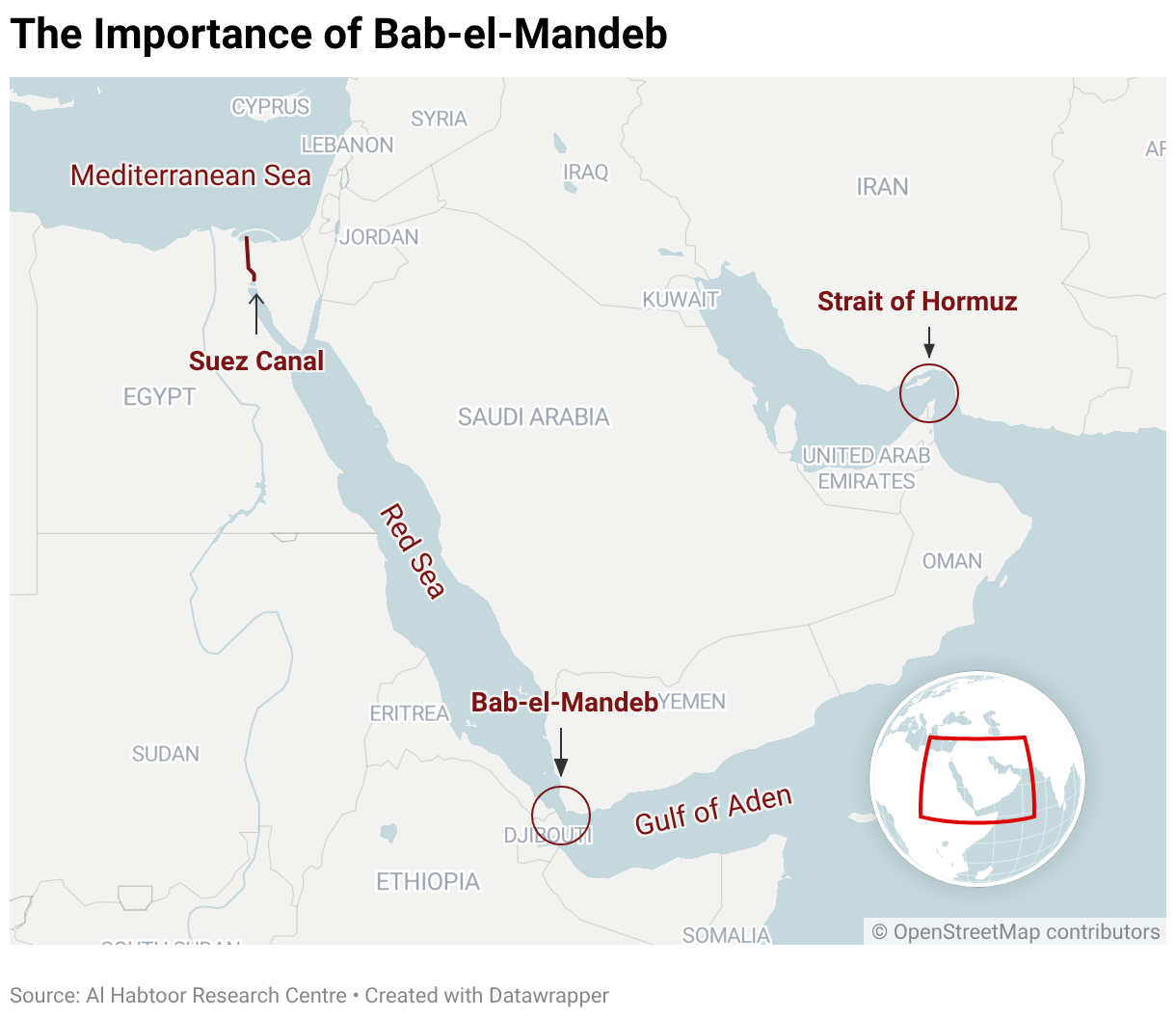
This geographical reality translates directly into strategic leverage. Bab al-Mandeb is one of the world’s most critical routes for seaborne commodities, especially Gulf oil destined for Europe, as well as goods heading toward Asian markets. In the current conflict, it represents perhaps the most significant remaining pressure point available to both the Houthis and, by extension, Iran. At present, the strait remains open. Shipping continues to pass through, including vessels linked to the U.S. and Israel, indicating that the Houthis have not yet moved to impose a full blockade. However, this restraint appears deliberate. The threat of closure is itself a strategic tool, one that can be activated in response to further escalation.
The Houthis have already demonstrated their ability to disrupt maritime traffic. Following the outbreak of Israel-Hamas war in October 2023, they launched a sustained campaign against commercial shipping in the Red Sea, targeting vessels they identified as linked to or bound for Israel. Between November 2023 and early 2025, more than 100 ships were attacked and two were sunk, forcing many shipping companies to reroute. Even without a formal blockade, these operations significantly disrupted global trade flows. Their operational approach relies on asymmetric tactics, including drones, anti-ship missiles and the potential use of naval mines. Combined with their strategic positioning along Yemen’s coastline and reported Iranian technical and military support, this gives the Houthis a credible capacity to threaten, and potentially halt, navigation through the strait.
Importantly, their involvement remains calibrated. During periods of de-escalation, such as the ceasefires between Israel and Hamas in 2025, Houthi attacks subsided, suggesting that their engagement is closely tied to broader regional dynamics and Iranian strategic signalling. This reinforces the view that the group functions as a flexible instrument within a wider deterrence framework. Should the situation escalate further, particularly in the event of a wider confrontation involving Iran, the closure of Bab al-Mandeb becomes a plausible scenario. If combined with disruptions in the Strait of Hormuz, the consequences would be severe. Global shipping would be forced to reroute around the Cape of Good Hope, adding between 4,000 and 6,000 nautical miles to journeys and delaying shipments by up to 20 days. The result would be a sharp increase in freight costs, significant supply chain disruptions and heightened volatility in global energy markets.
In this sense, Bab al-Mandeb is not only a geographic chokepoint, but a strategic lever. The Houthis’ ability to threaten it, even without fully closing it, already exerts pressure on global trade and serves as a powerful deterrent against further military escalation.
Energy Markets and Oil Prices
The most immediate consequence of a Bab al-Mandeb closure would be felt in global energy markets. Gulf oil destined for Europe via the Suez Canal and the SUMED pipeline relies heavily on this corridor. A blockade would sever this already strained route entirely, forcing tankers to reroute around the Cape of Good Hope, the economic cost of these diversions is already measurable: even without a formal closure, major carriers including Maersk, MSC, and CMA CGM have maintained Cape of Good Hope diversions since late 2023, generating an estimated $7–9 billion in excess annual shipping costs across the global container fleet.
A full closure would multiply these figures dramatically. Crucially, unlike the Strait of Hormuz — for which Saudi Arabia’s East-West Pipeline offers partial relief at 5 million barrels per day — there is no viable land bypass for cargo forced out of the Red Sea. Oil prices would be expected to spike sharply, amplifying the inflationary pressures already generated by the closure of the Strait of Hormuz and deepening what already will likely be one of the most severe energy crises in modern history.
Freight Rates, Supply Chains, and Trade Volumes
The ramifications do not simply end at the global supply of oil, but cascade into all areas, immediately the ramifications on global freight rates and supply chains would be severe and widespread. Global container spot rates, which surged 400–600% during the 2021 supply chain crisis and 200–300% during the Red Sea disruptions of early 2024, would face an equivalent or greater shock.
These costs are ultimately borne by consumers through higher prices on imported goods, from electronics and automobiles to clothing and food. For economies heavily dependent on Red Sea trade — particularly those in Europe, East Africa, and South and Southeast Asia — the inflationary impact would be immediate and severe. India, for example, which relies on this corridor for a substantial share of its energy imports and manufactured goods exports to Europe, would face acute pressure on both its trade balance and domestic inflation.
Food Security and Agricultural Commodities
Beyond energy, the strait is a critical artery for global food security. Agricultural commodities including wheat, fertilisers, and edible oils transit through Bab al-Mandeb in significant volumes, particularly from Black Sea and South Asian producers bound for African and Middle Eastern markets.
A closure would disrupt these flows at a moment when global food prices are already elevated due to energy-driven production costs and logistical strain. Military analyst Cedric Leighton, speaking to CNN, warned explicitly that further disruptions could jeopardise the supply of essential goods including food and medicine, particularly in regions already facing constraints.
The Gulf states themselves are acutely exposed: as high-volume importers of food, consumer goods, and industrial inputs, they face inflationary pressure from higher shipping costs even if elevated oil prices could benefit their export revenues.
European Energy Vulnerability
Europe stands among the most exposed regions to a Bab al-Mandeb closure. The continent relies on this corridor for Gulf oil and LNG imports, most notably from Qatar — Europe’s second-largest LNG supplier. Qatar has previously suspended LNG tanker transits through Bab al-Mandeb in response to escalating threats, raising acute concerns about winter energy supply in European markets. As energy security analyst Dr. Elisabeth Kendall has warned, simultaneous restrictions on both the Strait of Hormuz and Bab al-Mandeb would “disrupt, if not cripple, trade toward Europe.”
Although Saudi Arabia maintains an alternative oil export route through the Yanbu terminal on the Red Sea, a closure of Bab al-Mandeb or attacks from the Houthis would sever this outlet as well, effectively eliminating one of Riyadh’s key contingency options and placing enormous pressure on European energy markets heading into any seasonal demand cycle. European economies would be forced to draw down strategic reserves, accelerate emergency LNG procurement from alternative suppliers, and absorb significant consumer price inflation as a result.
Insurance, Shipping Costs, and the Broader Economic Cascade
War-risk insurance premiums have already risen significantly; a full blockade would likely render standard commercial insurance unavailable for the corridor entirely. Shipping companies would be forced to self-insure, raise rates sharply, or withdraw from the route. The cascade extends into financial markets: commodity-price volatility would heighten inflation expectations and complicate monetary policy for central banks already navigating elevated interest-rate environments. The Center of Economics and Law Studies (Celios) has assessed that a Bab al-Mandeb closure poses a greater systemic threat to global trade than a Hormuz blockade alone, precisely because the Red Sea route has no equivalent replacement.
Conclusion
The United States-Israel-Iran War has evolved from a conflict with defined military objectives into a crisis with systemic economic implications, and Bab al-Mandeb sits at the centre of that evolution. The Houthis’ entry has already proven sufficient to reshape global shipping patterns without a formal blockade. Control over Yemen’s Red Sea coastline has transformed a non-state actor into the gatekeeper of a passage through which approximately 12% of world trade flows daily, a position of strategic leverage that vastly exceeds their conventional military capacity. Their restraint is deliberate: the threat of closure is the instrument, its value derived precisely from remaining in reserve.
Should that restraint end the economic consequences would be immediate and multi-dimensional: energy supply shocks compounding an already severe crisis, freight rate surges rippling through consumer prices globally, food commodity disruptions threatening import-dependent populations, and insurance markets withdrawing from the corridor entirely. With no viable bypass and no precedent for a simultaneous restriction of both Hormuz and Bab al-Mandeb, the international community faces an urgent imperative to factor this vulnerability into diplomatic and contingency planning. Bab al-Mandeb is no longer merely a geographic chokepoint. It is the fulcrum on which much of the world’s economic stability now rests.
References
“Houthis Open New Front in Iran War: Will Yemeni Group Block Bab al-Mandeb?” Al Jazeera, March 29, 2026. https://www.aljazeera.com/news/2026/3/29/houthis-open-new-front-in-iran-war-will-yemeni-group-block-bab-al-mandeb
“Houthis Threaten to Join Mideast War, Raising Specter of Renewed Red Sea Attacks.” The Times of Israel, March 2026. https://www.timesofisrael.com/houthis-threaten-to-join-mideast-war-raising-specter-of-renewed-red-sea-attacks/
“Houthis Attack Israel: Why Bab el-Mandeb Strait Matters.” The Indian Express, March 2026. https://indianexpress.com/article/world/houthis-attack-israel-bab-el-mandab-10607537/
“Bab el-Mandeb Strait: Has Iran Found Second Global Choke Point after Hormuz?” The Economic Times, March 2026. https://economictimes.indiatimes.com/news/international/global-trends/bab-el-mandeb-strait-has-iran-found-second-global-choke-point-after-hormuz/articleshow/129806526.cms
“Houthis Expand Role in Regional Conflict.” Iran International, March 25, 2026. https://www.iranintl.com/en/202603253635
“Bab al-Mandeb: The Second Chokepoint That Could Shut Down Global Trade.” The Middle East Insider, March 29, 2026. https://themiddleeastinsider.com/2026/03/29/bab-al-mandeb-strait-houthi-global-trade-2026/
“Bab el-Mandeb: The Alternate Trade Lifeline Under Threat.” Outlook Business, March 2026. https://www.outlookbusiness.com/economy-and-policy/bab-el-mandeb-the-alternate-trade-lifeline-under-threat-explained
“Bab el-Mandeb Closure: A Strategic Card Yet to Be Played.” WANA News Agency, March 30, 2026. https://wanaen.com/bab-el-mandeb-closure-a-strategic-card-yet-to-be-played/
“Houthi Red Sea Attacks: One Year On, the Impact on Global Shipping.” BBC News, November 19, 2024. https://www.bbc.com/news/articles/c9dl13zezdlo
“Red Sea Crisis: What Is Happening and What Is the Impact on Trade?” World Economic Forum, January 2024. https://www.weforum.org/stories/2024/01/red-sea-attacks-shipping-houthi-what-you-need-to-know/
“Strait of Bab el-Mandeb.” U.S. Energy Information Administration, August 2024. https://www.eia.gov/international/analysis/special-topics/World_Oil_Transit_Chokepoints
“Houthis and the Red Sea: Iran’s Axis of Resistance Strategy Explained.” Reuters, December 2023. https://www.reuters.com/world/middle-east/houthis-red-sea-irans-axis-resistance-strategy-explained-2023-12-19/
Gady, Franz-Stefan. “The Houthi Maritime Campaign: Lessons for Naval Deterrence.” International Institute for Strategic Studies (IISS), 2024. https://www.iiss.org/online-analysis/military-balance-blog/2024/02/the-houthi-maritime-campaign/


Related Articles

The Implications of the April 2026 U.S.–Iran Ceasefire on Oil Prices
Defence Economies at War: National Budget Stress

Blank Rounds: Can Trump Blockade the Strait of Hormuz?

Breaking the Tether: How Iridium Unleashes Shahed Drones
Pulse: The United States-Israel-Iran War
Comments