

The geopolitical and security complexities of land borders in the Middle East have created a strategic reality in which Israel effectively functions as an "island economy", despite its physical connection to the continental landmass. This overland isolation has left the Israeli economy with little choice but to rely almost entirely on maritime routes to sustain its trade arteries, secure vital imports and maintain the flow of exports. The sea, therefore, is no longer merely an additional geopolitical and military domain, but has become the lung through which the Israeli economy breathes.
In this context, geography has shifted from a potential defensive shield to a structural vulnerability, with any disruption to freedom of navigation or coastal security posing an existential threat to capital flows and market stability.
This strategic vulnerability is further compounded by the country's demographic and economic geography. The coastal strip constitutes Israel's true centre of gravity, concentrating much of its population, financial centres, logistics infrastructure and principal ports.
This concentration leaves the coastline particularly exposed. Any security disruption in the maritime domain would affect not only shipping, but also the very fabric of everyday life and the core of commercial activity. Non-state armed actors have recognised this dynamic and identified the maritime domain as an opportunity to inflict economic paralysis at extremely low cost, circumventing the need to penetrate Israel's sophisticated air and land defence systems.
The concept of maritime infrastructure is no longer confined to ships and ports, but has expanded to encompass sovereign assets that constitute pillars of contemporary national security. Natural gas fields beneath the Eastern Mediterranean have become a cornerstone of energy independence, with any threat to production platforms or pipelines having immediate repercussions for industrial production costs and electricity grid stability.
In parallel, subsea telecommunications cables have emerged as a lifeline for the digital knowledge economy. The high-tech and financial services sectors depend entirely on these cables' integrity to ensure the global flow of data. Protecting these subsea assets has therefore moved beyond the technical realm to become a core element of the security doctrine aimed at protecting the economy from collapse in times of crisis.
This maritime exposure confronts the military establishment with a dual strategic dilemma: a widening protection gap between the immediate coastline and distant international sea lanes.
At the near-shore tactical level, the challenges associated with protecting coastal installations from unconventional threats, such as explosive-laden boats and drones, are intensifying. Countering these threats entails enormous financial costs, requiring the operation of expensive interception systems and warships against low-cost offensive capabilities available to adversaries.
At the more distant strategic level, the challenge lies in protecting the vital trade routes running through the Red Sea and the Bab el-Mandeb Strait. Any disruption there could choke off the Port of Eilat, disrupt supply chains from Asia, and drive up insurance and shipping costs, dealing a severe blow to investor confidence and the broader business environment.
When the Sea Becomes a Lifeline
This exposure is evident in the structure of Israel’s foreign trade, around 98% of which, by both volume and value, moves by sea through the Eastern Mediterranean. In 2024, the country’s total trade reached $153.2 billion, comprising $91.5 billion in imports and $61.7 billion in exports.
While exports of integrated circuits and medical devices give Israel a position within high-value supply chains, its imports reveal a critical dependence on essential goods and energy from China, the United States and Europe. The economy is therefore sensitive not only to port closures, but also to disruptions at the chokepoints vessels must pass through before reaching Israeli ports.
The closure of Bab el-Mandeb to Israel-linked shipping exposed the extent of this vulnerability. Vessels were forced to reroute around the Cape of Good Hope, adding between 3,000 and 3,500 nautical miles to their journeys and between 8 and 15 days to transit times.
The longer route increased fuel consumption, adding an estimated $200,000 to $300,000 to the cost of a typical container ship voyage. Meanwhile, war-risk insurance premiums surged from around $10,000 to more than $500,000, potentially accounting for as much as 1% of the cargo’s value. Geographic distance thus became a direct tax on producers, importers and consumers.
The most visible consequence was the collapse of the Port of Eilat’s role as Israel’s southern gateway for vehicle imports and phosphate exports. Cargo traffic through the port fell by 85%, and no vessel called at Eilat for eight months in 2024, while revenues plunged from NIS 212 million to just NIS 42 million, a decline of around 80%. In July 2025, the port was declared bankrupt and ceased operations after its bank accounts were frozen over accumulated tax liabilities.
The significance of this case lies not merely in the loss of a single port, but in demonstrating that an actor without a conventional fleet can disrupt a distant economic node by undermining confidence in the route leading to it.
The vulnerability extends beyond trade to life-support systems through what can be described as a gas-water interdependence trap. Five coastal desalination plants supply around 80% of Israel’s drinking water and produce approximately 600 million cubic metres annually, with the Sorek complex foremost among them.
Yet these plants depend on an electricity grid in which natural gas accounts for around 70% of power generation, while the Tamar, Leviathan and Karish fields hold approximately 900 billion cubic metres of reserves. Given the dependence on continuous flows from offshore platforms, an attack on a gas field would not remain a sector-specific incident. Its effects could quickly spread to electricity and then to water supplies in major population centres, foremost among them Gush Dan.

A parallel chokepoint lies beneath the sea, where fibre-optic cables extending up to 200 nautical miles offshore connect Israel to the outside world. Israel has sought to diversify these routes through the Google-led “Blue-Raman” cable system, costing $400 million and offering 218 terabits per second of capacity, as well as the $900 million transcontinental “TEAS” project.
However, threats in the Red Sea and rising insurance costs disrupted the Raman route, while geopolitical hesitation among some partners stalled progress on “TEAS”. The digital economy thus remains, despite its sophistication, dependent on physical routes that can be affected by conflict and alliances just as trade and energy routes can.
The maritime shock is transmitted to the economy not only through shipping losses, but also through slower and more far-reaching channels. Longer transit times force companies to hold larger inventories and maintain higher levels of working capital, while delaying the arrival of components required by advanced industries. Higher insurance premiums and fuel costs, meanwhile, feed through into goods prices and profit margins. Export disruptions can also undermine the reliability of companies within international value chains, even when the factories themselves remain capable of production.
When the threat shifts from a temporary incident to a persistent expectation, the more consequential cost becomes the risk premium demanded by investors, financiers and shipping companies. At that point, maritime pressure can disrupt the economic cycle without a full blockade. It only needs to make every transaction slower, more expensive, and less predictable.
A Fleet Smaller Than Its Mission
Historically, the Israeli Navy has received less funding and wielded less institutional influence than the air force and intelligence services, while its doctrine long remained focused on coastal defence. Yet the discovery of offshore gas, the expansion of Israel’s exclusive economic zone and the growth of more distant threats have imposed responsibilities on the navy that exceed the numerical scale for which it was designed.
In 2024, the backbone of the surface fleet comprised seven missile corvettes: three Sa’ar 5-class and four Sa’ar 6-class vessels, supported by eight Sa’ar 4.5-class missile boats and six Dolphin-class diesel-electric submarines. Once maintenance requirements, crew rest, and transit times are factored in, the number actually available for deployment falls, creating temporal and geographic gaps that are difficult to bridge across two separate theatres.
The events of 7 October 2023 exposed the coastal dimension of this gap. While attention focused on the collapse of Israel’s land defences, small boats with low radar signatures succeeded in breaching the maritime border, exposing shortcomings in near-shore maritime domain awareness. The breach showed that Sa’ar 6-class corvettes, while able to counter conventional threats and protect offshore installations, cannot maintain continuous surveillance along every mile of coastline. Superior platform capabilities cannot compensate for the absence of a dense, distributed network of sensors and patrols that can detect low-cost, commercially available threats.
In the Red Sea, the challenge becomes more complex. The Houthi strategy is not aimed at waging a conventional naval battle, but at imposing a functional blockade that raises risks and alters shipping companies’ calculations. By concealing launch platforms within Yemen’s terrain and using missiles and drones, the group has been able to wage a form of maritime insurgency without possessing a fleet. This forces Israel and its allies into a prolonged and costly defensive deployment, while making the security of the maritime corridor dependent on the continued political and operational commitment of the international powers involved in its protection.
The attrition equation is most acute in the cost exchange. Iranian-designed drones and cruise missiles may cost between $2,000 and $20,000, while an SM-2 or SM-6 interceptor missile costs between $2.2 million and $4.3 million. The disparity can reach 100:1 and, in some cases, exceed 1,000:1. Even the naval “C-Dome” system, which reduces interception costs to around $50,000, does not eliminate the risk of saturation.
The adversary need not strike a major vessel. It needs only to force the defender to deplete its stocks, increase spending and normalise the perception that maritime routes linked to Israel are unsafe.
The protection dilemma therefore extends beyond direct military calculations. The fleet must simultaneously escort commercial shipping, secure thousands of square miles of the exclusive economic zone, protect gas fields, subsea cables and ports, and conduct intelligence and deterrence missions.
Every vessel assigned to escort duty or static defence reduces flexibility for other missions. Low-cost threats thus become a means of forcing a redistribution of Israeli military power, compelling Israel to protect almost everything. At the same time, the adversary retains the freedom to choose the time, place and means.
This picture reveals two distinct gaps that cannot be addressed with the same tools. The near-shore domain requires continuous surveillance and the ability to distinguish small targets amid dense civilian traffic, while distant sea lanes require sustained presence, escort, interception and logistical support.
Using advanced corvettes for static guard duties squanders their advantages and increases their operating hours, while leaving installations to lighter assets alone exposes them to more complex threats. In the Red Sea, distance itself becomes a source of pressure, lengthening supply and maintenance lines and increasing dependence on bases and partners.
The problem, therefore, is not simply a numerical shortfall, but a mismatch between force structure and the range of functions it must perform. This explains the shift toward a distributed system rather than relying solely on acquiring a limited number of larger vessels.
The Hybrid Fleet: Israel's Bet on Smart Deterrence
Israel is seeking to break this equation through a hybrid fleet that combines crewed vessels, serving as command, control and deterrence platforms, with swarms of unmanned systems operating on and beneath the surface.
The aim is to distribute risk, expand surveillance and keep crews away from hazardous coastal and underwater environments, while reserving heavier vessels for missions that smaller platforms cannot perform. This shift also has an industrial dimension: operational experience can be translated into exports to countries facing similar challenges in the Strait of Hormuz or the Red Sea, turning maritime technology into an instrument that combines national security, economic returns and defence influence.
The ELI-3325 “BlueWhale” submarine, developed by Israel Aerospace Industries in collaboration with Atlas Elektronik, embodies this approach. On the surface, the “Seagull” unmanned vessel performs surveillance, mine countermeasure and anti-submarine warfare missions, and can transition from detection to launching a lightweight torpedo. This enables denser patrols around Leviathan and port approaches at a lower operating cost than crewed patrols.
Protection is not confined to mobile platforms. Distributed Acoustic Sensing (DAS) technology transforms commercial fibre-optic cables into arrays comprising thousands of virtual sensors. By analysing the backscatter of laser pulses, it can detect vibrations caused by ship anchors, unmanned vehicles, or divers before they reach sensitive cables such as “Blue-Raman”. This technology’s value lies in its ability to repurpose existing civilian infrastructure as an early-warning network, increasing surveillance density without deploying a comparable number of standalone seabed sensors.
Operationally, distributed deployment allows naval forces to keep higher-cost platforms outside the threat area while pushing replaceable sensors and vehicles forward. It also lets forces adjust protection density to the threat level, increasing patrols around a gas platform or port entrance without diverting an entire corvette from another mission.
Yet this flexibility depends on secure communications, standardised data-exchange protocols, and the ability to maintain and replace systems rapidly. It also requires clear human oversight of decisions on the use of force, particularly in an environment crowded with commercial vessels and fishing boats. The value of the hybrid fleet, therefore, lies not in the number of unmanned systems alone, but in the system’s ability to translate numerical dispersion into reliable situational awareness and disciplined engagement decisions.
Figure 1: Structure of Israel’s Hybrid Naval Fleet and C4I Network
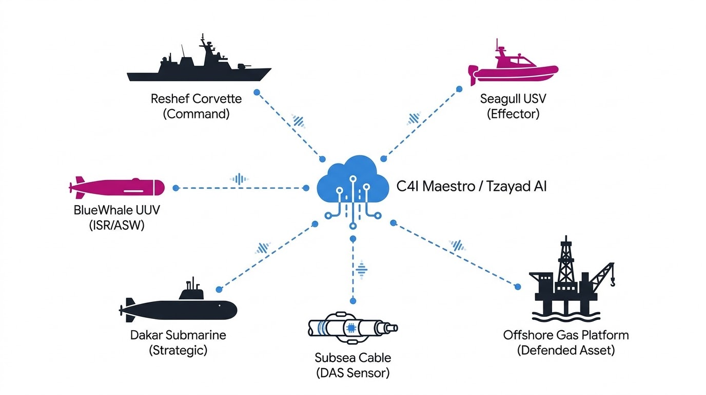
Yet sensors and unmanned systems cannot operate effectively without a neural network that integrates their data. The C4I system has therefore moved towards a unified digital environment, with the establishment of the “BINA” artificial intelligence division and the deployment of command systems such as “Tzayad” and “Maestro”.
In recent conflicts, these systems have processed more than 850,000 detections, integrating data from satellites, radars, “BlueWhale” and “Seagull” into a common operational picture. This integration shortens the sensor-to-engagement cycle: an alert generated by a cable using Distributed Acoustic Sensing (DAS) can rapidly direct an unmanned vehicle or missile battery towards the threat, with less human intervention.
AI Cannot Override Geography
Yet autonomous platforms are not a definitive substitute for a conventional fleet. They remain constrained by battery capacity and seaworthiness, vulnerable to electronic jamming and loss of navigation when GPS is disrupted, and the data they generate can become a liability if communications fail or algorithms make classification errors.
Their effectiveness still depends on a broader system encompassing intelligence, aerial surveillance, heavier naval assets, electronic warfare, and human decision-making. Autonomy expands surveillance and reduces human exposure. Still, it does not eliminate the need for a force capable of maintaining a presence, interception and deterrence in environments where digital networks themselves come under attack.
More importantly, technology addresses gaps in coverage more readily than it addresses the lack of alternatives. It can detect a threat to a gas platform or cable. Still, it cannot create an alternative port to Eilat, reduce electricity dependence on gas or desalination on electricity, or move demographic and economic concentrations away from the coast.
The success of the maritime strategy will therefore be measured by its ability to combine deterrence with resilience: distributing sensors and platforms, building reserves and alternative routes, reducing interception costs, and preserving freedom of navigation in cooperation with allies. Until then, the sea will remain the lung through which the “island economy” breathes, while at the same time remaining the vulnerable flank that adversaries can pressure without waging a conventional naval war. In this sense, an adversary’s success is not measured by the number of ships it sinks, just as Israel’s success is not measured by the number of projectiles it intercepts. The deeper measure is which side can withstand the pressures of time and cost while preserving its freedom of action.
If interception remains far more expensive than attack, and ports, platforms and cables remain concentrated in a limited number of nodes, then each round, even without major losses, will accumulate pressure on budgets, stocks, insurance and investor confidence. If, however, Israel succeeds in distributing protection functions, providing operational alternatives and reducing the cost of countering smaller threats, the returns from attrition will diminish. The contest at sea thus becomes as much a competition over economic resilience and network architecture as it is over firepower. Geography, in turn, becomes a manageable source of risk rather than a constraint technology can erase.
This conclusion requires a shift in the planning criterion from protecting individual assets to ensuring the continuity of the functions they perform. What matters is not keeping a port, cable or gas field beyond the reach of threats at all times, an unrealistic objective, but the state’s ability to absorb disruption, redirect flows to alternatives and restore service before the shock develops into a national crisis.
At this point, maritime defence converges with economic planning, emergency management and foreign policy, making resilience a responsibility of the entire state system rather than of the navy alone.
In conclusion, the experience since late 2023 has shown that Israel’s core vulnerability lies not in the prospect of a major vessel being sunk, but in a low-cost adversary’s ability to disrupt the functions sustained by the sea: trade, energy, water and connectivity. The Eilat crisis demonstrated that pressure on a shipping route can paralyse a port without directly attacking it. At the same time, the interdependence of gas, electricity and desalination shows that disruption at a single node can trigger cascading effects. Maritime security should therefore be measured not by fleet size or interception rates alone, but by the state’s ability to maintain services under pressure and restore them rapidly.
This conclusion points to the required shift from protecting individual platforms to engineering resilience: distributing sensors and bases, providing alternative ports, routes and reserves, reducing interception costs, protecting cables and civilian infrastructure within a common operational picture, and deepening cooperation with partners to ensure freedom of navigation.
Autonomous platforms and artificial intelligence expand surveillance and reduce human exposure, but they cannot create a geographical alternative or compensate for shortages in reserves and options. The maritime contest will therefore be decided by each side’s ability to withstand time and cost pressures while preserving its freedom of action. Israel can manage the geographic trap, but it cannot eliminate it through technology alone.
References
Bikash, Koley. Google Cloud. “Announcing the Blue and Raman Subsea Cable Systems.” . July 29, 2021. Available on: https://cloud.google.com/blog/products/infrastructure/announcing-the-blue-and-raman-subsea-cable-systems
Bueger, Christian, and Timothy Edmunds. Understanding Maritime Security. Oxford: Oxford University Press, 2024. Available on: https://global.oup.com/academic/product/understanding-maritime-security-9780197767146?cc=ae&lang=en&
Center for Strategic and International Studies, Missile Defense Project. “Iron Dome (Israel).” Missile Threat, July 13, 2021. Available on: https://missilethreat.csis.org/defsys/iron-dome/
Cinturion Group. The Network: TEAS—Trans Europe Asia System. Herndon, VA: Cinturion Group, n.d. Available on: https://www.cinturiongroup.com/the-network
Elbit Systems. Seagull USV: Multi-Mission Unmanned Surface Vessel. Haifa: Elbit Systems, n.d. Available on: https://www.elbitsystems.com/unmanned/maritime/unmanned-surface-vessel/seagull-usv
Fabian, Emanuel. “Navy’s Sixth Dolphin 2-Class Submarine, Drakon, on Its Way to Israel.” Times of Israel, September 1, 2026. Available on: https://www.timesofisrael.com/liveblog_entry/navys-sixth-dolphin-2-class-submarine-drakon-on-its-way-to-israel/
Germond, Basil. The Maritime Dimension of European Security: Seapower and Securing Sea Lanes. London: Palgrave Macmillan, 2015. Available on: https://link.springer.com/book/10.1057/9781137017819
Helfont, Samuel. “Victory at Sea? The Israeli Navy’s Gains and Gaps Since October 7.” Hoover Institution, June 10, 2025. Available on: https://www.hoover.org/research/victory-sea-israeli-navys-gains-and-gaps-october-7
Jewish Institute for National Security of America. U.S. Must Defeat Houthis’ Asymmetric Warfare Strategy. Washington, DC: JINSA, 2024. Available on: https://jinsa.org/jinsa_report/u-s-must-defeat-houthis-asymmetric-warfare-strategy/
Mimran, Tal, Magda Pacholska, Gal Dahan, and Lena Trabucco. “Beyond the Headlines: Combat Deployment of Military AI-Based Systems by the IDF.” Articles of War, February 2, 2024. Available on: https://lieber.westpoint.edu/beyond-headlines-combat-deployment-military-ai-based-systems-idf/
Monaghan, Sean, Michael Darrah, Eskil Jakobsen, and Otto Svendsen. “Red Sea Cable Damage Reveals Soft Underbelly of Global Economy.” Center for Strategic and International Studies, March 7, 2024. Available on: https://www.csis.org/analysis/red-sea-cable-damage-reveals-soft-underbelly-global-economy
Nuclear Threat Initiative. “Israel Submarine Capabilities.” August 15, 2024. Available on: https://www.nti.org/analysis/articles/israel-submarine-capabilities/
Reuters. “Israel’s Eilat Port Sees 85% Drop in Activity amid Red Sea Houthi Attacks.” December 21, 2023. Available on: https://www.reuters.com/world/middle-east/israels-eilat-port-sees-85-drop-activity-amid-red-sea-houthi-attacks-2023-12-21/
Reuters. “Red Sea War Insurance Rises with More Ships in Firing Line.” January 16, 2024. Available on: https://www.reuters.com/business/finance/red-sea-war-insurance-rises-with-more-ships-firing-line-2024-01-16/
Sabbagh, Dan. “Israeli Command System Identified 850,000 Targets in Gaza and Lebanon Wars, Says Supplier.” Guardian, July 6, 2026. Available on: https://www.theguardian.com/world/2026/jul/06/israel-command-system-identified-850000-targets-gaza-lebanon-war-supplier-elbit-systems
Till, Geoffrey. Seapower: A Guide for the Twenty-First Century. 4th ed. Abingdon: Routledge, 2018. Available on: https://www.routledge.com/Seapower-A-Guide-for-the-Twenty-First-Century/Till/p/book/9781032877341
United Nations Conference on Trade and Development. Navigating Troubled Waters: Impact to Global Trade of Disruption of Shipping Routes in the Red Sea, Black Sea and Panama Canal. Geneva: United Nations, 2024. Available on: https://unctad.org/publication/navigating-troubled-waters-impact-global-trade-disruption-shipping-routes-red-sea-black
United Nations Statistics Division. UN Comtrade Database: Israel, Merchandise Trade, 2024. New York: United Nations, 2025. Available on: comtrade.un.org
Weisbrod, Noam. “Israel Water Resources and Desalination.” Interview by Todd Votteler. Talk+Water Podcast, September 7, 2023. Available on: https://podcasts.apple.com/us/podcast/talk-water/id1450729314
Zagrizak, Assaf. “Debt of NIS 10 Million: Behind the Threat to Close Eilat Port.” Globes, July 16, 2025. Available on: https://en.globes.co.il/en/article-debt-ridden-eilat-port-to-close-sunday-1001516171


Related Articles

Contradictions Triangle: How Israel’s Recognition of the Armenian Genocide Reshaped the Geopolitics of the South Caucasus

Tel Aviv Stock Exchange: Why did it rise during the war and fall with the truce?

War, Pressure and Policy: Europe’s Gradual Turn on Israel

Defence Economies at War: National Budget Stress
The Samson Option: Implications for the Nuclear Taboo and Fatalism

Comments