

Recent developments point to a discernible shift in U.S. foreign policy, as Washington moves away from traditional international principles towards a more pragmatic, interest-driven approach. Within this evolving framework, islands and narrow maritime chokepoints have gained renewed strategic prominence as critical instruments of influence. No longer viewed as remote geographic outposts, islands are increasingly regarded as pivotal assets for securing energy flows, safeguarding supply lines, and controlling maritime navigation. This shift reflects a broader strategic intent to assert effective control over key geographic positions in order to sustain military presence, expand economic influence, and command the vital corridors through which global trade flows.
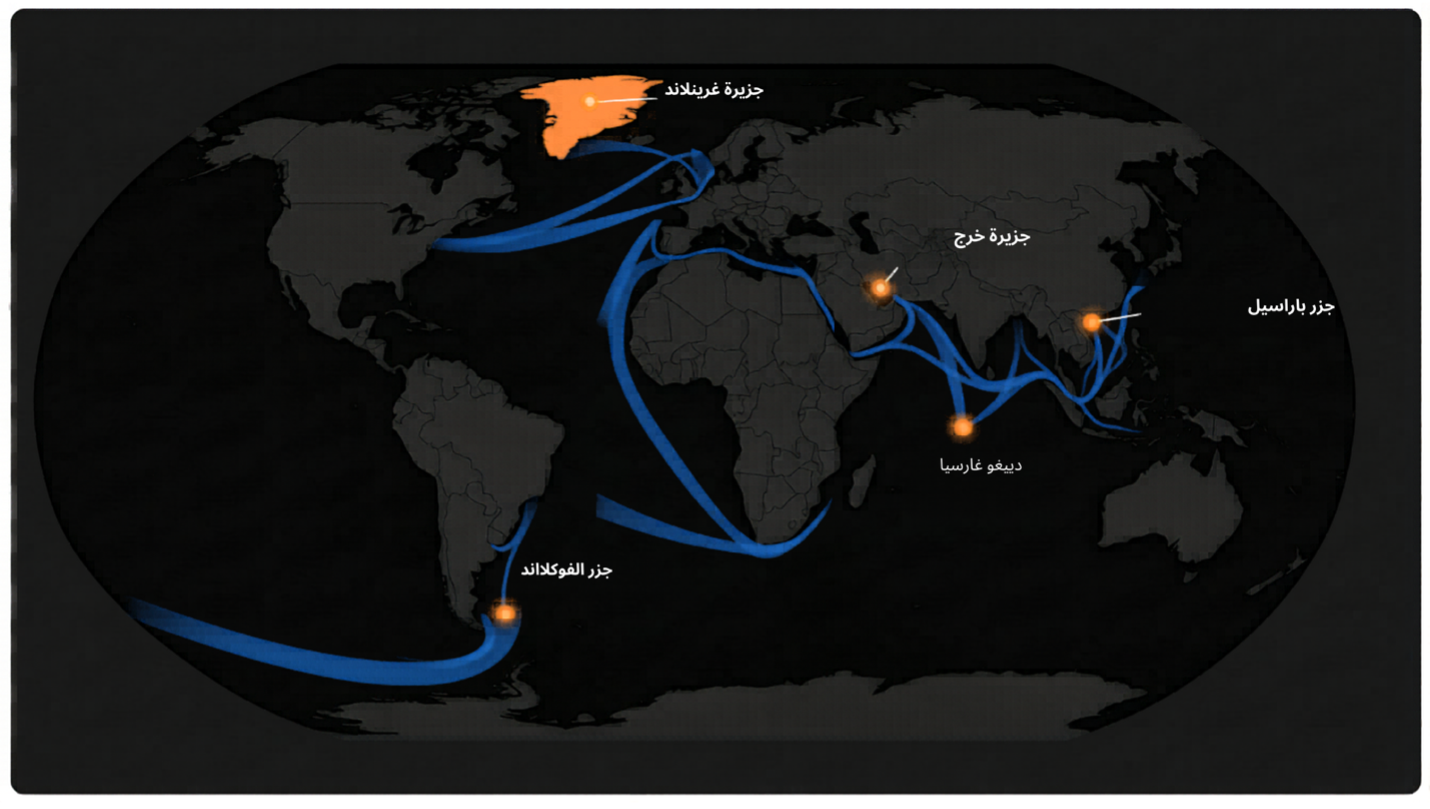
This heightened focus on islands in current U.S. policy reflects a strategic mindset that tightly links geography, military presence, and sovereignty. Within this framework, geographic locations are treated as assets that can be leveraged through acquisition or utilised as instruments of pressure and bargaining. In this context, islands are seen as discrete, manageable nodes that can be secured or defended to project influence across wider regions. This approach is evident in the handling of territories such as Greenland, Kharg Island, the Chagos Archipelago, and the Falkland Islands during Donald Trump's presidency. Against this backdrop, the present analysis seeks to unpack the geopolitical foundations and strategic drivers shaping the Trump administration’s approach to islands, positioning them as central instruments in the reconfiguration of American influence.
Islands in Trump’s Political Mindset
The U.S. administration’s interest in islands and archipelagos stems from a strategic vision that views these locations as pivotal footholds for redefining American dominance beyond multilateral constraints and long-term institutional commitments. Within this political mindset, islands are conceived as instruments for achieving major strategic objectives through a distinctly personalised and transactional approach, whereby geographic locations are assessed according to their capacity to deliver concentrated financial and security leverage that can be readily marketed domestically as tangible achievements. This orientation towards controlling islands reflects a broader ambition to transform foreign policy from the complex management of international relations into the management of clearly defined physical assets, where sovereignty and on-the-ground control become the primary benchmarks of power and success.
- Controlling Critical Maritime Hubs and Global Chokepoints
Trump’s interest in islands is closely tied to their proximity to some of the world’s most critical maritime chokepoints. Classical geopolitical theory, particularly the principles advanced by Alfred Thayer Mahan, establishes a direct link between global dominance and the possession of naval power alongside firm control over sea lines of communication. The Trump administration has effectively updated this doctrine, recognising that the ability to control, disrupt, or exploit maritime corridors confers unprecedented strategic leverage in an era of accelerated globalisation. Within this framework, U.S. policy has increasingly focused on securing control points across these geographic nodes in order to redirect trade and energy flows away from strategic competitors. This approach marks a clear departure from the traditional emphasis on preserving freedom of navigation in international waters.
For instance, Kharg Island serves as a strategic hub in the Middle East and is a cornerstone of the Iranian economy. The island’s deep-water ports, uniquely equipped along Iran’s coastline, handle approximately 90% of the country’s total crude oil exports. These facilities generated net oil export revenues of around $53 billion in 2025, equivalent to roughly 11% of Iran’s annual GDP. In addition, the island’s energy infrastructure is estimated to generate annual returns of approximately $78 billion. From the perspective of the Trump administration, establishing effective control over Kharg Island, or exerting direct pressure upon it, would translate into tangible leverage over a significant share of global energy supplies. This strategic value is further reinforced by the island’s location within the Strait of Hormuz, one of the world’s most critical maritime corridors.
Similarly, Donald Trump’s declaration of imposing full American control over Greenland, alongside his assertion that no vessel should enter or exit without U.S. naval approval, reflects a strategic orientation centred on using adjacent islands as forward bases for projecting comprehensive maritime power. Greenland offers a critical strategic position in the Northern Hemisphere, lying along the Greenland–Iceland–United Kingdom (GIUK) gap, a key corridor employed in anti-submarine operations to monitor and constrain Russian naval movements in the North Atlantic. At the same time, Greenland’s geostrategic significance is evolving as polar ice continues to melt due to climate change, at an estimated rate of 30 million tonnes per hour. This transformation is repositioning the island as a central transit point along emerging maritime routes, including the trans-Arctic sea route and the Northwest Passage. These new corridors are gradually reducing reliance on traditional routes under U.S. protection, such as the Panama and Suez Canals.
The Trump administration’s geopolitical strategy, through the potential acquisition or effective control of Greenland, is aimed at anticipating shifts in global trade structures and ensuring the continued U.S. command over transcontinental maritime flows throughout the twenty-first century.
The South China Sea stands out as a central arena within this strategic orientation across the Indo-Pacific. In 2025, the Trump administration moved to establish spheres of influence and prioritise bilateral commercial interests over strict adherence to international legal frameworks governing territorial waters, marking a departure from earlier administrations that relied on alliance networks to safeguard freedom of navigation near both natural and artificial islands. At the same time, Washington recognises the importance of maintaining forward-operating bases, designating locations such as the Philippines as key hubs for military logistics and munitions to assert control over critical transit routes in the South China Sea. In parallel, China continues to pursue dominance over these corridors through military expansion and the construction of artificial islands atop coral reefs, as seen at Antelope Reef in the Paracel Islands.
This U.S. approach maintains clear strategic coherence, as forward island positions serve as indispensable footholds for projecting power and controlling the maritime corridors that underpin the global economy.
- From Indirect Influence to Direct Control
The foreign policy of Donald Trump is characterised by a rejection of traditional alliances and a preference for unilateral dominance. Within this framework, the U.S. administration regards indirect influence, achieved through treaties, collective defence arrangements, or soft power, as an insufficient and potentially detrimental instrument to American interests. This political mindset has driven the administration towards policies aimed at converting abstract influence into tangible sovereignty or direct, on-the-ground control.
The pursuit of acquiring or annexing Greenland clearly reflects this orientation. The Trump administration assumes that European states benefit from U.S. security guarantees without providing adequate returns, despite Denmark being a founding member of NATO. It further views the continued operation of Pituffik Space Base, formerly known as Thule Air Base, under bilateral agreements with Copenhagen as insufficient to meet U.S. national security requirements. Trump has stated that outright ownership would confer exclusive authority. Full sovereign control, in this view, would enable the direct transfer of Greenland’s mineral wealth into the U.S. budget, bypassing oversight by a foreign parliament. These resources include 31 of the 34 critical minerals required for future technologies, as well as substantial reserves of iron ore, graphite, tungsten, palladium, vanadium, zinc, gold, uranium, and copper.
This drive towards direct resource control is further reflected in the focus on the Kvanefjeld and Tanbreez mining projects, aimed at bypassing China’s near-total dominance of rare-earth processing. In December 2025, the U.S. administration appointed Jeff Landry as a special envoy to Greenland. This move circumvented conventional diplomatic channels and the Danish government, underscoring a clear intent to assert direct American control over the territory. The administration also appeared to assume that Greenland’s future, as a self-governing territory with a population of approximately 56,000, could be negotiated through direct economic and diplomatic pressure, effectively treating it as an independent entity open to acquisition.
This model of material control extends to active military theatres. The Trump administration’s approach to Kharg Island moves beyond traditional strategies of military containment towards direct occupation and resource exploitation. In early 2026, during the course of military operations against Iran, Donald Trump stated that securing the island would require the deployment of ground forces and a sustained U.S. military presence. He further reiterated his preference for seizing oil resources, echoing his administration’s earlier stance on Venezuelan oil. This approach marks a fundamental departure from the U.S. military doctrine that has prevailed since the end of World War II, which prioritised denying adversaries access to resources or maintaining global market stability rather than directly appropriating sovereign wealth. Through signalling an intent to control Iranian oil via Kharg Island, Trump seeks to convert military victories into tangible assets capable of generating financial returns.
The crisis surrounding the Chagos Archipelago further underscores this strategic orientation. The Trump administration intervened to obstruct the British government, led by Keir Starmer, from ratifying the 2025 agreement transferring sovereignty over the archipelago to Mauritius, despite the United Kingdom retaining a 99-year lease on the joint UK–U.S. military base on Diego Garcia. Washington rejected the introduction of a third-party sovereign authority, viewing it as an unacceptable concession of control, while disregarding assurances that operational access to the base would remain intact and that the United Kingdom would continue to pay approximately £100 million in annual lease fees.
The U.S. administration classifies Mauritius as a state increasingly aligned with the Chinese Communist Party, citing statements by Prime Minister Navin Ramgoolam regarding his intention to strengthen diplomatic ties with Beijing. This assessment prompted senior U.S. officials, including Secretary of State Marco Rubio and Secretary of Defense Pete Hegseth, to oppose the agreement decisively. Their position was grounded in the imperative for the United States to retain uninterrupted legal access to the base, free from constraints arising from foreign sovereignty, to safeguard core national interests.
- Maximising Bargaining Power in Major Conflicts
The “islands issue” is closely intertwined with the U.S. administration’s practice of transactional diplomacy. At its core, this approach is grounded in a logic of exchange, whereby every cooperative step, security guarantee, or regional arrangement is treated as a tradable asset. Given their high strategic value and often contested political status, islands are leveraged as high-yield bargaining chips, enabling the United States to maximise its negotiating power across multiple and diverse diplomatic fronts.
The most extreme application of this tactic emerged during the U.S.–Iran war of 2026. Donald Trump employed the existential threat to Kharg Island as a maximal pressure instrument to compel Tehran’s capitulation. Under a strategy reportedly termed “deal or destruction”, he ordered intensive bombing raids that dismantled the island’s military defences, including air defence systems, naval bases, and mine depots, while deliberately sparing the deep-water oil infrastructure. He made clear that this restraint was temporary, warning: “Just one simple word and the pipes will be gone too.”
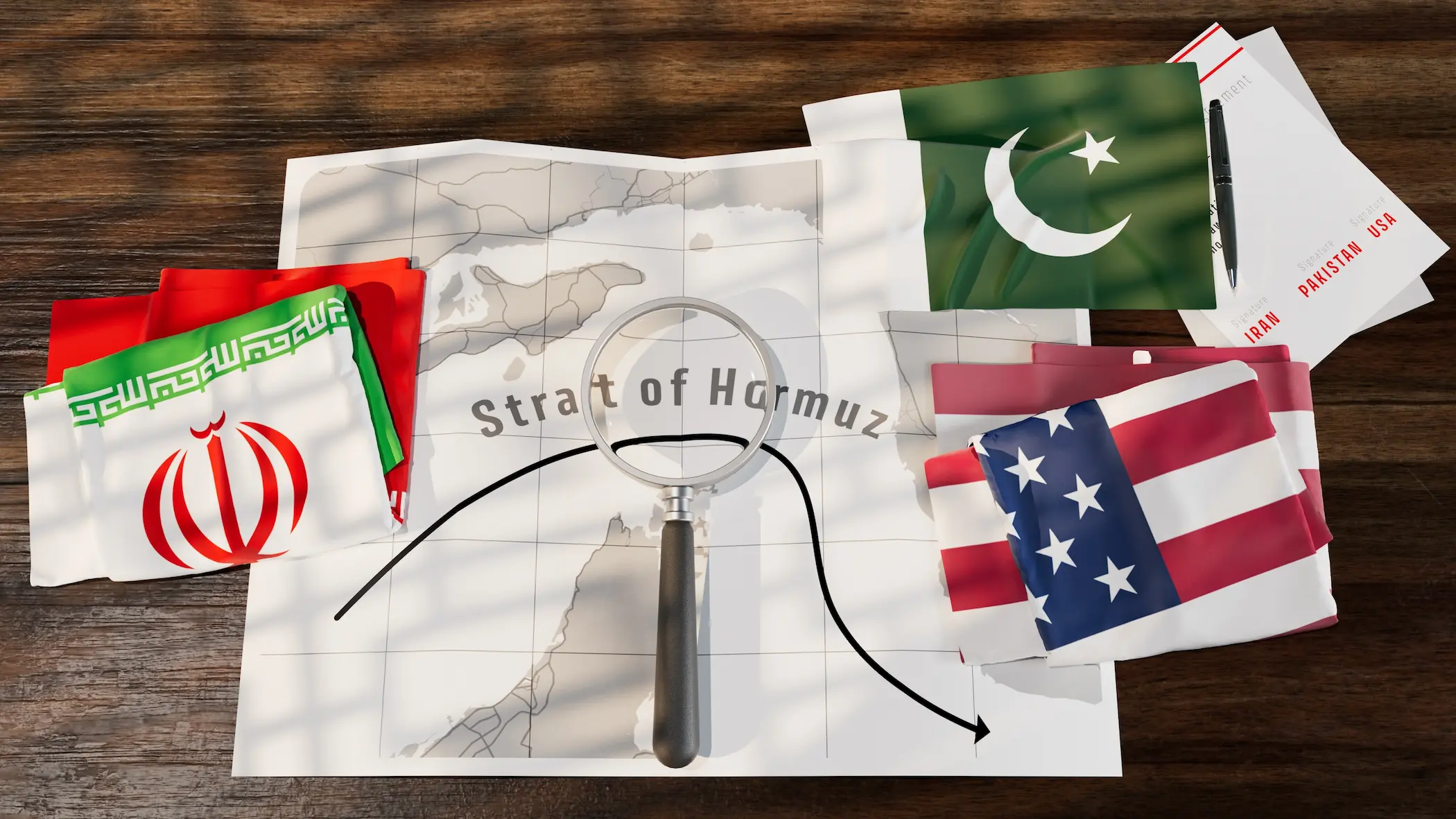
The U.S. administration sought to hold Iran’s entire economy hostage within a single geographic node, using this leverage to compel Tehran to accept a comprehensive 15-point plan delivered through Pakistani intermediaries. The plan required Iran to dismantle its three nuclear sites, halt uranium enrichment, end support for proxy forces, and immediately reopen the Strait of Hormuz in exchange for sanctions relief. In this context, Kharg Island was not merely a military target but a mechanism of intense coercion within an ongoing negotiation process. The survival of the island’s infrastructure became the principal instrument through which the United States exerted pressure on what remained of the Iranian state.
The U.S. administration also demonstrated a willingness to weaponise the territorial sovereignty of its closest allies in order to extract concessions. A leaked 2026 memorandum from the U.S. Department of Defense revealed that the Trump administration had considered reassessing its longstanding diplomatic support for United Kingdom sovereignty over the Falkland Islands, a British Overseas Territory that is strongly contested by Argentina. Historically, the United States has maintained a neutral position on the sovereignty dispute while recognising the United Kingdom’s de facto administration, a stance that has helped shield London from sustained United Nations decolonisation efforts concerning what is classified as a “non-self-governing territory.”
The memorandum further indicated that withdrawing this diplomatic cover had been actively considered as a punitive measure against the United Kingdom for its failure to provide sufficient military support to the U.S. bombing campaign in Iran. In this context, Donald Trump leveraged a distant territory, the Falkland Islands, as a coercive instrument to compel European alignment with his Middle East war objectives by threatening to leave Britain diplomatically isolated on the global stage over the sovereignty dispute.
Taiwan has likewise been repeatedly subjected to this transactional perspective. Donald Trump has often treated the island’s security as a variable closely tied to trade economics, whereas China regards Taiwan as a core territorial issue. Within this framework, the U.S. administration has signalled to Beijing that geopolitical boundaries may be negotiable under the right economic conditions, linking the defence of Taiwan to tariff schedules, investment quotas, and the island’s dominance in semiconductor manufacturing. Some of Trump’s advisers have explicitly characterised the concentration of chip production in Taiwan as a “single point of failure” for the global economy, proposing a strategy to rapidly reduce dependence on the island in order to limit U.S. exposure to potential disruptions in the Taiwan Strait.
This shift in rhetoric effectively recasts Taiwan from an ideological outpost of democracy into a strategic asset that can be leveraged or sidelined, depending on the immediate transactional priorities shaping U.S.–China relations. A notable incident in early 2026, when Taiwan reported a Chinese unmanned reconnaissance aircraft entering its airspace over the Paracel Islands, highlighted how grey-zone tactics are testing the limits of a U.S. security umbrella that has now become explicitly conditional on commercial compliance.
- Projecting an Image of Entrenched Power
Beyond their strategic and economic significance, the U.S. administration’s pursuit of control over islands serves defined domestic political objectives, foremost among them demonstrating a firm American capacity to impose dominance. The administration’s rhetoric centres on themes of national strength and the restoration of influence, seeking to counter narratives that point to a decline in the U.S. global role. Islands, as clearly delineated geographic entities, provide a tangible spatial arena through which such power can be visibly and materially asserted.
The U.S. administration first proposed purchasing Greenland in 2019, then intensified its efforts in 2025, framing it as a strategic move shaping the future of the United States. Donald Trump has characterised the acquisition as akin to a major real estate transaction, drawing a historical parallel with William H. Seward’s 1867 purchase of Alaska from Russia, a decision that helped transform the United States into a global power. This approach is intended to underscore America’s capacity for territorial expansion and the projection of influence, as a counterpoint to international trends favouring the emergence of a multipolar global order.
This proposal was firmly rejected by the Danish government, which declared that Greenland was not subject to financial negotiation. In response, Donald Trump, in early 2026, signalled the potential use of military force or the imposition of tariffs of up to 25% on European imports to compel Denmark to cede the territory. These measures were intended to communicate, both domestically and internationally, that the United States was departing from traditional European diplomatic norms. The resulting diplomatic crisis, spanning late 2025 to early 2026, underscored the administration’s willingness to alter the existing political order to secure absolute American dominance.
This pattern of imposed influence is particularly evident in the handling of Kharg Island and the broader Middle East. Donald Trump openly criticised opponents of his plan to seize Iranian oil, accusing them of weak judgment, and issued direct orders to the U.S. Navy to target and destroy any vessel attempting to lay mines in the Strait of Hormuz. He also delivered public statements containing explicit threats, portraying Iran as militarily weak and internally divided, and characterising divisions among its political factions as irrational conflict. Trump further warned of the potential elimination of the Iranian state altogether should the stipulated negotiation deadlines be exceeded.
The U.S. administration has utilised island positions as an operational arena to assert its dominance, portraying adversaries as weak and declaring unilateral U.S. naval control over global trade routes. These principles are echoed in the 2026 National Defense Strategy, which criticised previous policies as ineffective for outsourcing manufacturing and managing military conflicts without decisive direction, while presenting the current approach as an imperative path towards restoring comprehensive American power.
Personal Obsession or Strategic Vision?
Assessing Donald Trump’s foreign policy raises a central question about the extent to which personal motivations, rather than strategic vision, shape his decision-making. The administration’s conduct on the “islands issue” reflects a fusion of both elements. Trump appears to implement an explicit geopolitical strategy through a highly personalised, deal-driven approach, closely aligned with his professional background in real estate development, the imprint of which is clearly visible in this policy orientation.
This was explicitly reflected in Trump’s own remarks in a prior interview on Greenland, where he stated that he evaluates locations through the lens of a real estate developer seeking to acquire land for projects, adding that he studies maps and views Greenland’s vast size as justification for its incorporation into the United States. This orientation drives the U.S. administration to assess global geography as a portfolio of tangible assets open to acquisition or exploitation, while overlooking the fact that these entities are sovereign and governed by international law. In doing so, it effectively sidesteps the foundational principles of the Peace of Westphalia, including Denmark’s sovereignty and the Inuit people’s right to self-determination, in pursuit of material gain in the United States’ interest.
Framing this approach as purely personal obscures the strategic logic that underpins it. The U.S. administration’s focus on islands addresses genuine structural vulnerabilities confronting the United States in the twenty-first century. At a broader level, this strategy seeks to secure dominance in the energy sector while constraining Chinese influence.
First, the U.S. pursuit of control over Greenland is driven in part by the fragility of existing supply chains. China exercises near-total control over the processing of rare-earth elements, which are essential for advanced military equipment, space technologies, and clean-energy projects. The European Commission has identified 25 of the 34 critical raw materials required by the European economy as being located within Greenland. In addition, control over global data connectivity nodes has emerged as a national security priority, particularly following acts of sabotage targeting the “Greenland Connect” cable and other subsea networks. Within this context, the “America First” doctrine frames reliance on foreign supply chains and external data infrastructure as a strategic vulnerability that undermines U.S. national interests.
Second, achieving energy supremacy requires securing strategic maritime corridors. The U.S. administration has targeted the geographic vulnerabilities of Iran and China by signalling potential action against Kharg Island and seeking control over the Strait of Hormuz. China relies on this chokepoint for more than half of its oil imports, a structural vulnerability often described as the “Malacca Dilemma”. In response, Beijing has attempted to reduce this dependence by constructing artificial islands in the South China Sea and developing overland routes through the Belt and Road Initiative. Within this context, Donald Trump has sought to generate strategic leverage over Xi Jinping ahead of an anticipated bilateral summit, signalling Washington’s capacity to disrupt global energy supplies at their source and to leverage tensions in the Middle East to constrain China’s economic growth trajectory.
Trump’s focus on islands thus represents an application of pragmatic realism, rather than merely a personal inclination or a conventional strategic posture. This doctrine articulates clear strategic requirements, including securing resources, achieving energy dominance, ensuring military presence, and safeguarding supply chains. The U.S. administration has sought to meet these objectives through direct mechanisms based on control, material acquisition, and the instrumentalisation of assets as tools of leverage, while deliberately avoiding reliance on the multilateral institutions that have long characterised American foreign policy.
In conclusion, Donald Trump’s approach to the “islands file” in 2025 and 2026 represents a fundamental shift in U.S. foreign policy, elevating insular geography from peripheral locations to a central currency of global diplomacy. By fusing a real estate developer’s pursuit of tangible assets with an uncompromising geopolitical doctrine, Washington has deployed islands as powerful levers to secure supply chains, threaten adversarial economies, and exert unprecedented pressure on allies.
While this strategy has delivered short-term tactical advantages, it has also injected profound uncertainty into the architecture of international alliances. Transforming islands and maritime chokepoints into arenas of diplomatic coercion and economic bargaining risks undermining the stability of the global trading system, which depends on freedom of navigation and cooperative frameworks. In an increasingly interconnected world reliant on fragile maritime routes and infrastructure, this emerging U.S. doctrine ensures that geopolitical dynamics remain in a state of sustained volatility, with physical geography serving as both the ultimate prize and the primary instrument of dominance in an era defined by transactional realism.
References
—–. “Arctic Security in Flux: Why Greenland Has Become a Geopolitical Flashpoint.” India’s World, January 16, 2026. Accessed April 28, 2026. https://indiasworld.in/arctic-security-in-flux-why-greenland-has-become-a-geopolitical-flashpoint/.
Boffey, Daniel. “Could Trump Withdraw US Support for UK Sovereignty of Falklands?” The Guardian, April 24, 2026. Accessed April 28, 2026. https://www.theguardian.com/us-news/2026/apr/24/could-donald-trump-withdraw-us-support-uk-sovereignty-falklands.
Brookings Institution. “Breaking Down Trump’s 2025 National Security Strategy.” Brookings, February 22, 2026. Accessed April 28, 2026. https://www.brookings.edu/articles/breaking-down-trumps-2025-national-security-strategy/.
Chul-min, Lee . “Trump Reverses Stance on Diego Garcia Sovereignty Transfer.” The Chosun Ilbo, January 30, 2026. Accessed April 28, 2026. https://www.chosun.com/english/world-en/2026/01/30/Y6CHNKPT6NH5XC5AJ4EJLS6JOI/.
CLINE, SARAH and JACK BROOK. “Trump’s Envoy Gov. Jeff Landry Headed to DC to Discuss Greenland.” AP News, January 15, 2026. Accessed April 28, 2026. https://apnews.com/article/greenland-trump-landry-denmark-louisiana-9f120dade00849082a42556074ddf35a.
Dan Sabbagh, Peter Walker and Sam Jones.“UK Position on Falklands Will Not Change, No 10 Says after Leaked Pentagon Memo.” The Guardian, April 25, 2026. Accessed April 27, 2026. https://www.theguardian.com/uk-news/2026/apr/24/uk-position-falklands-unchanged-leaked-pentagon-memo.
Dodds, Klaus. “President Trump, Hemispheric Security and the Greenland Connection.” Groupe d’études géopolitiques, February 20, 2025. Accessed April 27, 2026. https://geopolitique.eu/en/2025/02/21/president-trump-hemispheric-security-and-the-greenland-connection/.
Ferragamo, Mariel. “Trump, Iran, and Diego Garcia: Inside the Fight over a Remote Military Base.” Council on Foreign Relations, March 23, 2026. Accessed April 27, 2026. https://www.cfr.org/articles/trump-iran-and-diego-garcia-inside-the-fight-over-a-remote-military-base.
Goldstein, Lyle. “Trump Takes Step Back from Philippines in South China Sea.” Defense Priorities, August 2, 2025. Accessed April 27, 2026. https://www.defensepriorities.org/opinion/trump-takes-step-back-from-philippines-in-south-china-sea/.
Hankyoreh. “Trump’s Bid for Energy Supremacy by Taking Maritime Choke Points Could Fuel US Decline.” The Hankyoreh English Edition, April 24, 2026. Accessed April 25, 2026. https://english.hani.co.kr/arti/english_edition/e_international/1255789.html.
Hass, Ryan. “America’s Narrative on Taiwan Needs an Update.” Brookings, February 18, 2026. Accessed April 24, 2026. https://www.brookings.edu/articles/americas-narrative-on-taiwan-needs-an-update/
Messingschlager, Stefan. “Trump’s Taiwan Gamble: How U.S. Transactionalism Reshapes Beijing’s Risk Calculus.” Columbia Journal of International Affairs, School of International and Public Affairs, Columbia University, February 13 , 2026. Accessed April 25, 2026. https://jia.sipa.columbia.edu/news/trumps-taiwan-gamble-how-us-transactionalism-reshapes-beijings-risk-calculus.
Miller, Saige. “Why Trump’s Attacks and Threats to Iran’s Kharg Island Are a Big Deal.” WBUR/NPR, 07, April 2026. Accessed April 25, 2026. https://www.wbur.org/npr/nx-s1-5750514/trump-iran-war-kharg-island-oil.
Rajghatta, Chidanand. “Deal or Die: Trump’s Iran Playbook Takes a Dark Turn.” The Times of India, 23, April 2026. Accessed April 26, 2026. https://timesofindia.indiatimes.com/world/middle-east/deal-or-die-trumps-iran-playbook-takes-a-dark-turn/articleshow/130475002.cms.
Schwartz, Meredith and Gracelin Baskaran.“Greenland, Rare Earths, and Arctic Security.” Center for Strategic and International Studies (CSIS), January 8, 2026. Accessed April 26, 2026. https://www.csis.org/analysis/greenland-rare-earths-and-arctic-security.
Sir Robin, Niblett. “Trump’s Greenland Ambition Is About U.S. Power, Not Alliances.” Center for Strategic and International Studies (CSIS), January 14, 2026. Accessed April 27, 2026. https://www.csis.org/analysis/trumps-greenland-ambition-about-us-power-not-alliances.
Sutherland, Callum. “What Trump Has Said About Seizing Iran’s Oil Hub Kharg Island.” Time, April 1, 2026. Accessed April 25, 2026. https://time.com/article/2026/03/30/trump-comments-about-seizing-iran-kharg-island-oil-hub/.
Sutherland, Callum. “Why Trump Is Threatening to Impose a ‘Big Tariff’ on the U.K.” Time, April 24, 2026. Accessed April 28, 2026. https://time.com/article/2026/04/24/trump-threatens-uk-with-big-tariff-iran-war-relationship-fractured/.
UK Parliament. “Diego Garcia Military Base.” Hansard, House of Lords debate, June 3, 2025. Accessed April 28, 2026. https://hansard.parliament.uk/Lords/2025-06-03/debates/43D3F1CD-9A56-4666-AE94-D08893CAC7BF/DiegoGarciaMilitaryBase.
Wachtel, Ileana. “Expert on Arctic Politics Explains Greenland’s Strategic Appeal.” USC Dornsife College of Letters, Arts and Sciences, April 11, 2025. Accessed April 25, 2026. https://dornsife.usc.edu/news/stories/why-trump-finds-greenland-strategically-appealing/.



From Dependency to Influence: How the Global South Changed the United Nations’ Map?
Diplomacy without Resolution: What Comes After the 60-Day Deadline?

Trump, Tariffs, and the Revolt of the American Farmer

Engines of War: Why the Automotive Sector Is the Fastest to Pivot to Military Production
From Wartime Partners to Political Rivals… Could Iran Ignite a Rift Between Trump and Netanyahu?
Comments