

The geopolitical landscape has entered a critical and highly volatile inflection point, defined by deepening transatlantic divisions and an unprecedented destabilisation of the global security architecture. The outbreak of intense military confrontation in the Middle East has accelerated this fragmentation, as the United States initiated pre-emptive operations against Iran, prompting Tehran to retaliate by closing the Strait of Hormuz. Given the Strait’s pivotal role as a strategic artery for global energy supplies, the administration of President Donald Trump called on European members of the North Atlantic Treaty Organization (NATO) to deploy naval units and provide military support to secure the passage. European capitals, however, rejected the request in a unified stance.
This refusal triggered a marked escalation in diplomatic tensions with the US administration. The European position rested on the absence of prior consultation and on a strategic assessment that classified the conflict as a discretionary war, falling outside the Alliance’s geographic remit and exceeding its defined defensive mandate. In response, the United States administration intensified its rhetoric, openly threatening withdrawal from NATO, describing the Alliance as a "paper tiger", and casting doubt on its military and political effectiveness.
This confrontation has transformed the prospect of a retrenchment in US security commitments from a theoretical possibility into a scenario under active strategic evaluation. Consequently, transatlantic relations have shifted from a framework of fixed commitments to one increasingly governed by transactional, interest-driven engagement. Assessing the likelihood of a US withdrawal, therefore, necessitates a comprehensive review of the governing international frameworks, the domestic constitutional constraints limiting executive authority, the military ramifications of withdrawal, and the potential future trajectories of Europe’s defence architecture.
Legal Mechanisms for Accession to and Withdrawal from NATO
The Washington Treaty of 1949, as the founding instrument of NATO, establishes distinct legal frameworks governing both accession and withdrawal. Article 10 regulates enlargement under the “open door” policy, defining geographic parameters that restrict invitations to European states in order to preserve the Alliance’s regional defence focus. The issuance of a membership invitation requires unanimous consent among all member states, thereby granting each state an effective veto. Upon receiving an invitation, a prospective member must demonstrate adherence to democratic principles, the rule of law, and civilian oversight of the military, and must also possess the capacity to contribute meaningfully to collective defence. These criteria are implemented through structured evaluation mechanisms, most notably the Membership Action Plan. The accession process is formally concluded through the deposit of the instrument of accession with the Government of the US, acting as the Treaty’s official depository.
By contrast, the withdrawal mechanism, governed by Article 13 of the Treaty, permits unilateral action and imposes no substantive constraints. The original text established an initial commitment period of twenty years during which withdrawal was prohibited; this period expired in 1969, thereby granting all member states the formal right to withdraw. Under international law, withdrawal requires only the submission of a formal written notification to the Government of the US, acting as the Treaty’s depository. A mandatory one-year waiting period begins upon official receipt of this notification. Throughout this critical transitional phase, the withdrawing state remains fully and legally bound by all Treaty obligations, including the strict requirement to respond to the invocation of Article 5 on collective defence.
Upon the expiry of the one-year period, membership is legally terminated. The withdrawal process does not require the provision of strategic justification, the assumption of financial obligations, or approval from the North Atlantic Council. In the event of a US withdrawal, the legal framework requires the executive branch to submit a formal notification to the US Department of State, given Washington’s role as the Treaty’s official depository. In practical terms, this amounts to the U.S. notifying itself before formally communicating the decision to the remaining allied states.
Executive Authority versus Congressional Power
The domestic implementation of the withdrawal clause in the U.S. is marked by constitutional and legal complexity, despite the mechanism’s clarity under international law. At the core of this debate lies the question of whether the president holds unilateral authority to terminate treaties or whether such action requires formal authorisation from Congress. The US Constitution mandates a two-thirds majority in the Senate for treaty ratification, yet it remains silent on the procedures governing the termination of treaties. This constitutional ambiguity has historically produced a pattern of shared institutional practice between the executive and legislative branches. In recent decades, however, the balance has shifted decisively towards executive primacy, with the presidency increasingly asserting unilateral authority in decisions related to treaty withdrawal.
This executive-leaning interpretation draws support from the 1979 Supreme Court decision in Goldwater v. Carter, in which Congress’s challenge to President Jimmy Carter’s unilateral termination of the mutual defence treaty with Taiwan was dismissed. On the basis of this judicial stance, the doctrine of the ‘political question’, and an expansive reading of the president’s powers as Commander-in-Chief in foreign policy, the executive branch maintains that the president holds exclusive authority to terminate treaties without requiring congressional approval. Accordingly, the US administration regards any legislative intervention in this domain as an unconstitutional encroachment on presidential authority as the state’s sole representative in diplomatic affairs.
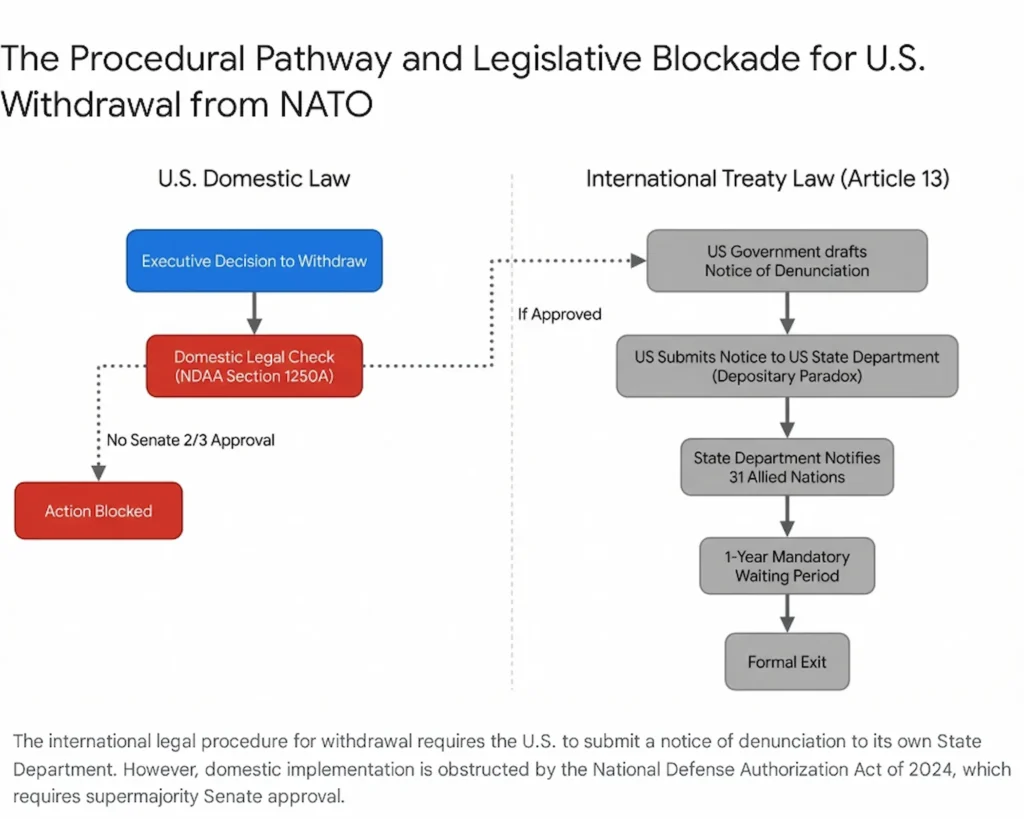
Congress under President Joe Biden, enacted Section 1250A of the National Defense Authorization Act for Fiscal Year 2024 (Public Law 118–31) to reaffirm its constitutional authority and constrain unilateral executive action in relation to US international commitments. This landmark measure establishes an unprecedented legal barrier, marking the first instance in US history in which a sitting president is explicitly prohibited from unilaterally withdrawing from a specified international treaty. The statute provides unequivocally that the president may not suspend, terminate, denounce, or withdraw the U.S. from the North Atlantic Treaty without securing the advice and consent of a two-thirds majority in the Senate or through separate legislation enacted by Congress. It further imposes a strict prohibition on the use of any authorised or appropriated federal funds to support, whether directly or indirectly, any bureaucratic effort to facilitate withdrawal, thereby entrenching this constraint in both legal and operational terms.
Any unilateral executive decision to withdraw, in contravention of this legislation, would weaken the president’s constitutional position under the principle of separation of powers. However, legal experts highlight a critical procedural gap in enforcement mechanisms, as it remains uncertain which party would possess the legal standing to initiate judicial action with sufficient speed to suspend the one-year notification period, should the president elect to circumvent the statute and proceed with withdrawal on the basis of executive authority in foreign policy.
Federal courts have consistently tended to dismiss lawsuits brought by individual legislators in cases concerning foreign policy. Accordingly, effective enforcement of the law would require a unified and rapid institutional response from Congress, a requirement that presents a substantial challenge in the context of prevailing political polarisation.
Moreover, the executive branch may circumvent the complex constitutional pathway of formal treaty termination by implementing withdrawal as a de facto reality. The Constitution grants the president, in his capacity as Commander-in-Chief, authority over the global deployment of US forces, thereby enabling unilateral decisions to withdraw troops from European bases, suspend intelligence-sharing protocols, and signal non-compliance with collective defence commitments.
Strategic Implications of a U.S. Withdrawal
European armed forces, despite substantial economic resources and sizeable personnel, remain structurally dependent on the US for critical specialised strategic support capabilities. Strategic assessments and defence reviews indicate that constructing an autonomous European defence architecture would expose significant capability gaps, requiring investment estimated at one trillion US dollars over a twenty-five-year period.
In the absence of direct US support, European forces would lose access to space-based intelligence and reconnaissance assets, operational command-and-control networks, strategic airlift essential for rapid deployment, and long-range precision munitions. Converting Europe’s economic capacity into advanced military capability would require sustained industrial mobilisation and targeted procurement programmes over several decades. This immediate erosion of capability would render the eastern flank of Europe increasingly vulnerable to conventional Russian military pressure.

The termination of extended nuclear deterrence would represent the most consequential challenge to security stability in the event of a US withdrawal, surpassing the impact of anticipated shortfalls in conventional military capabilities. The forward deployment of US tactical nuclear weapons, reinforced by the guarantees of its strategic arsenal, has historically played a decisive role in constraining regional nuclear proliferation and deterring large-scale conventional aggression. In the absence of Washington, full responsibility for nuclear deterrence would shift to the arsenals of the United Kingdom and France, both of which remain comparatively limited. Current assessments indicate that these forces, in terms of scale, diversity of destructive capabilities, and flexibility of delivery systems, would be insufficient to sustain credible deterrence across Eastern and Central Europe in the face of Russia’s modern nuclear arsenal. This strategic exposure would heighten security uncertainty across the continent, potentially incentivising adversarial escalation while also triggering internal debates among allied states over the necessity of developing sovereign nuclear capabilities.
From an economic perspective, the termination of the US military presence would adversely affect local European economies, lead to the dissolution of Status of Forces Agreements, and erode the transatlantic defence industrial base. Such a move would necessitate the closure of critical military infrastructure, including Ramstein Air Base, thereby disrupting the core logistical supply networks underpinning US operations in the Middle East and Africa. At the geopolitical level, a US retrenchment from its security commitments would signal a broader decline in the credibility of the Washington-led global security architecture. This, in turn, would likely generate heightened volatility across global financial markets, while simultaneously incentivising rival powers in the Indo-Pacific to accelerate their strategic manoeuvres.
Future Pathways for the European Security Architecture
Should Trump proceed with a decision to withdraw from NATO, the Euro-Atlantic security architecture would likely evolve along divergent trajectories, shaped by shifting geopolitical dynamics, ideological divergences, and entrenched diplomatic frictions.
The first pathway envisages transforming the Alliance into a reduced-function structure characterised by a fundamental recalibration of burden-sharing arrangements. Under this scenario, the U.S. would retain formal membership in the Treaty while substantially restructuring its operational role. Washington would progressively withdraw its conventional ground forces and tactical air units from the European continent, reallocating its capabilities towards the Indo-Pacific and reinforcing domestic defence priorities, thereby limiting its role to that of an external strategic balancer.
As a result, full responsibility for conventional regional defence would shift to European states, necessitating a rapid and significant increase in defence spending to meet evolving security requirements. US military contributions would be limited to nuclear deterrence and advanced intelligence capabilities, effectively ending the direct operational integration of conventional forces across the Atlantic.
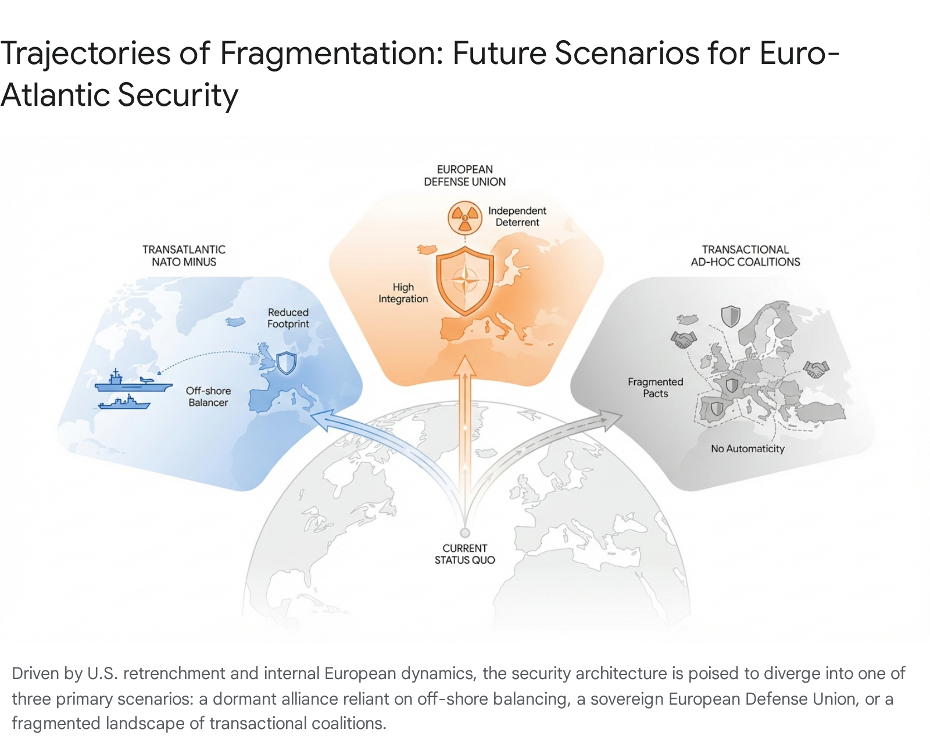
The second pathway envisages a scenario of comprehensive fragmentation of alliances, with NATO supplanted by a network of bilateral arrangements grounded in reciprocal interests. Under this trajectory, multilateral mechanisms would steadily erode as the US executive increasingly deploys the threat of withdrawal as a tool of economic and diplomatic leverage. As a result, strategic ambiguity would replace the principle of pre-committed collective defence, with US security guarantees becoming conditional on political alignment and the fulfilment of immediate national interests.
In this context, Washington would extend bilateral security commitments while maintaining troop deployments in states that align with its conditions on trade policy, defence procurement, and participation in military operations beyond the Alliance’s geographic remit, such as the Strait of Hormuz. By contrast, states pursuing more independent foreign policies or imposing domestic constraints on arms acquisitions would face reduced security support, alongside the imposition of countervailing economic measures. Such a trajectory would erode Europe’s political cohesion, effectively reverting the continent to a competitive balance-of-power system historically associated with instability and recurrent conflict.
The third pathway, and the most consequential for the overall security architecture, entails an accelerated transition towards genuine European strategic autonomy. This trajectory is driven by growing recognition that US security guarantees are increasingly contingent on domestic political dynamics in Washington, thereby prompting European capitals to advance the establishment of a sovereign and independent security framework.
This pathway necessitates comprehensive financial and industrial restructuring, centred on allocating substantial resources through continental defence funds to expand domestic military manufacturing capabilities and develop credible alternatives to US strategic support. Within this framework, the establishment of a “European Security Council”, composed of the continent’s principal powers, is likely to emerge as a mechanism to circumvent the procedural constraints imposed by unanimity requirements within existing European institutions. Such an arrangement would facilitate rapid decision-making on force deployment, coordinated border security, and the autonomous management of intelligence operations, independent of US direction.
In conclusion, the prospect of a U.S. withdrawal from NATO is shaped by a complex interplay of factors encompassing the legal framework governing international treaties, domestic constitutional constraints, and evolving geopolitical dynamics. From a legal standpoint, the formal pathway for withdrawal under Article 13 is now subject to legislative restrictions following the enactment of Section 1250A of the National Defense Authorization Act for 2024. This provision constrains the executive branch from undertaking unilateral withdrawal, potentially precipitating a constitutional confrontation over the separation of powers should the administration seek to circumvent these limits.
However, this domestic legislative framework does not guarantee the Alliance’s continued existence in its current form. The executive branch retains the capacity to curtail effective participation by reducing core operational contributions, diluting formal commitments to the implementation of Article 5, and deploying economic pressure instruments. Recent developments, including the Greenland tariff dispute of 2026 and widening transatlantic divergences following the US–Iran confrontation, underscore the extent to which economic and diplomatic measures can erode the political cohesion underpinning collective defence mechanisms, irrespective of the Treaty’s formal legal provisions.
Accordingly, any reduction in US security commitments, whether through formal legal withdrawal, legislative recalibration such as a “NATO Act”, or operational retrenchment reflected in the 2026 National Defense Strategy, would precipitate a structural transformation in the global security order. In the absence of US military capabilities, particularly in command-and-control systems and nuclear deterrence, European states would be compelled to pursue one of two paths: either the establishment of a fully integrated sovereign defence architecture capable of sustaining independent deterrence, or the acceptance of fragmentation accompanied by the expansion of rival powers’ influence. Ultimately, the trajectory of political decision-making in Washington and across European capitals will determine the Alliance’s future and the stability of the Western security system.
References
Aerospace Global News. “NATO without the US: What the Alliance Really Loses in Military Power.” Aerospaceglobalnews.com, 2026. Accessed April 14, 2026. https://aerospaceglobalnews.com/news/nato-without-us-alliance-military-power/.
Al Jazeera. “Closer to a Break than Ever’: Can NATO Survive if Trump Pulls the US Out?” AlJazeera.com, April 10, 2026. Accessed April 14, 2026. https://www.aljazeera.com/news/2026/4/10/closer-to-a-break-than-ever-can-nato-survive-if-trump-pulls-the-us-out.
Atlantic Council. “For NATO in 2027, European Leadership Will Be Key to Deterrence against Russia.” Issue brief, 2026. Accessed April 10, 2026. https://www.atlanticcouncil.org/in-depth-research-reports/issue-brief/for-nato-in-2027-european-leadership-will-be-key-to-deterrence-against-russia/.
CBS News. “Trump Says He Might Withdraw the U.S. from NATO, Even Though the Law Says He Can’t without Congress’ Approval.” CBSNews.com, 2024. Accessed April 12, 2026. https://www.cbsnews.com/news/trump-withdraw-nato-require-congress-approval/.
Congressional Research Service. “The North Atlantic Treaty: U.S. Legal Obligations and Congressional Authorities.” LSB11256, January 2024. Accessed April 13, 2026. https://www.everycrsreport.com/reports/LSB11256.html.
Cordesman, Anthony H. “The NSS That Could Destroy the NATO Alliance.” Center for Strategic and International Studies, 2025. Accessed April 12, 2026. https://www.csis.org/analysis/nss-could-destroy-nato-alliance.
Fiott, Daniel. “EU–NATO Cooperation Reloaded: The Impact of European Strategic Autonomy.” European Security 34, no. 1 (2025): 1–24. Accessed April 11, 2026. https://www.tandfonline.com/doi/full/10.1080/14702436.2025.2562975.
French, David. “Trump’s Animus against NATO Could Lead to a Geopolitical Disaster.” The Dispatch, 2024. Accessed April 14, 2026. https://thedispatch.com/article/trump-threats-abandon-nato/.
French, David. “Trump’s NATO Threats Highlight Deeper Structural Tension.” The Dispatch, 2026. Accessed April 12, 2026. https://thedispatch.com/article/trumps-nato-threats-highlight-deeper-structural-tension/.
Gabelli Funds. “NATO Spending Overview: A Structural Change to the Defense Industry.” Research note, 2024. Accessed April 13, 2026. https://gabelli.com/research/nato-spending-overview-a-structural-change-to-the-defense-industry/.
Global Times. “NATO Is Finding It Increasingly Difficult to Act in Unison.” Globaltimes.cn, April 2026. Accessed April 11, 2026. https://www.globaltimes.cn/page/202604/1358483.shtml.
Haas, Michael. “Can Europe Deliver NATO’s Five Percent?” Intereconomics 61, no. 2 (2026): 89–95. Accessed April 14, 2026. https://www.intereconomics.eu/contents/year/2026/number/2/article/can-europe-deliver-nato-s-five-percent.html.
Hindustan Times. “Is the US Leaving NATO? Can a President Withdraw? Trump–Rutte Meeting Sparks Buzz.” Hindustantimes.com, April 2026. Accessed April 09, 2026. https://www.hindustantimes.com/world-news/us-news/is-the-us-leaving-nato-can-a-president-withdraw-trump-rutte-meeting-sparks-buzz-101775674693542.html.
Körber-Stiftung. “What to Expect if the US Withdraws from NATO.” Policy Game Report, 2025. PDF. Accessed April 09, 2026. https://koerber-stiftung.de/site/assets/files/19387/koerber-policy-game_what-to-expect-if-the-us-withdraws-from-nato.pdf.
North Atlantic Treaty Organization. “Agreement between the Parties to the North Atlantic Treaty regarding the Status of their Forces (SOFA).” June 19, 1951. Official text. Accessed April 10, 2026. https://www.nato.int/cps/en/natohq/official_texts_17265.htm.
North Atlantic Treaty Organization. “The North Atlantic Treaty.” April 4, 1949. Official text. Accessed April 11, 2026. https://www.nato.int/en/about-us/official-texts-and-resources/official-texts/1949/04/04/the-north-atlantic-treaty .
North Atlantic Treaty Organization. Secretary General’s Annual Report 2025. Brussels: NATO, 2026. PDF. Accessed April 12, 2026. https://www.nato.int/content/dam/nato/webready/documents/publications-and-reports/annual-reports/sgar25-en.pdf.
O’Hanlon, Michael E. “Could NATO Survive a Second Trump Administration?” Brookings Institution, 2026. Accessed April 14, 2026. https://www.brookings.edu/articles/could-nato-survive-a-second-trump-administration/.
Primus, Richard. “What Congress Has Done—and What It Still Needs to Do—to Protect NATO.” Lawfare, 2024. Accessed April 09, 2026. https://www.lawfaremedia.org/article/what-congress-has-done-and-what-it-still-needs-to-do-to-protect-nato.
Rankin, Jennifer. “Why the NATO Alliance Is Not as Likely to Dissolve as Trump Makes It Seem.” The Guardian, April 11, 2026. Accessed April 13, 2026. https://www.theguardian.com/world/2026/apr/11/nato-alliance-trump-threats.
The White House. “Withdrawing the United States from International Organizations, Conventions, and Treaties That Are Contrary to the Interests of the United States.” Presidential Action, January 2026. Accessed April 12, 2026. https://www.whitehouse.gov/presidential-actions/2026/01/withdrawing-the-united-states-from-international-organizations-conventions-and-treaties-that-are-contrary-to-the-interests-of-the-united-states/.
Yılmaz, Harun. “NATO: With or without the United States.” Daily Sabah, opinion column, 2024. Accessed April 10, 2026. https://www.dailysabah.com/opinion/columns/nato-with-or-without-the-united-states.


Related Articles

Clean Commitments, Clean Data Centres?

Achilles Shield: Between Diversification and Dependence

Orbital Data Centres and the Limits of National Jurisdiction over Technology Firms

Europe’s Next Battle: The Coming Food Crisis

From Dependency to Influence: How the Global South Changed the United Nations’ Map?

Comments