

The long-standing efforts to end the Russia-Ukraine War were disturbed by the sudden outbreak of the U.S.-Israel-Iran War. The strikes carried out by the United States and Israel against Iran, and their broader spill-overs across the Middle East, have hindered the already difficult peace negotiations between Moscow and Kyiv. This escalation raises concerns about the extent to which the U.S.-Israel-Iran War could have on the broader geopolitical dynamics. This war risks diverting global attention away from efforts to resolve the Russia-Ukraine War and, at the same time, raises concerns about the extent to which it could reshape power dynamics and influence the trajectory of this war.
War Machine Financing
Iran’s war could fund Russia’s war efforts as countries shift their attention to buying Russian oil due to the closure of the Strait of Hormuz and the disruption of oil supply from the Middle East. Before the war, Russian crude oil and refined product revenues were facing a decline, notably after India reduced its oil exports from Russia at Washington’s discouragement. Russia is the world’s second largest oil exporter and holds the largest natural gas reserves. Moscow could now sell its oil at a high price, utilising the increase in energy prices and being the prominent option for affected countries.

Moreover, Russia could benefit from the direction of partial lifting or easing of sanctions by its American and European counterparts. Evidence suggests that the Trump administration is already taking its first steps as it waived the sanctions for 30-days for India to get its needs from Russian oil. All these developments would make Russia gain new resources to finance its war, hence, risking prolonging the war. On a side note, the United States is most likely to utilise the Venezuelan oil it has gained control over and use it as a leverage if the war is protracted.
Usually, the pace of Russia-Ukraine War slows down during the winter and resumes in spring. The U.S.-Israel-Iran War serves Russia’s interests to carry out an intense spring offensive operation. Russia will still face the crisis of shortage of troops as it is estimated that its total number of casualties is more than 1.2 million; nevertheless, the resources and funding problem could be resolved through the benefits it gains from the surge in oil prices and the closure of the Strait of Hormuz.

The question remains how long the U.S. sanctions relief will last. There are two possible scenarios, depending on the duration of the U.S.-Israel-Iran War. The first one is linked to ending the war in the short run, which would largely maintain existing sanctions, with the Trump administration relying on extending 30-days waivers for Russian oil deliveries. This would less likely make a significant boost to the Russian economy, but would still help finance its military operation. The second scenario is the continuation of war for a long period, further straining energy markets; in this case, the U.S. may be compelled to make significant changes to the sanctions package, notably lifting restrictions on Russia’s two biggest oil companies, Lukoil and Rosneft.
Such developments will shift the whole calculation for all parties. Russia’s economy would experience a substantial boost, while support for Ukraine could be weakened as its European counterparts gradually scale back their sanctions. In this case, Moscow’s position, both militarily and politically, would be strengthened. Its operational needs would be fully covered, and its stance in the peace negotiations would become significantly more favourable, relying on other parties softening their previously established positions.
Strategic and Diplomatic Shifts
The military assistance to Ukraine will most likely be affected, as the U.S. may redirect its defence systems, missile stock, and surveillance equipment to support its war in Iran. Additionally, the strikes are rapidly depleting American munitions, prompting Trump to prioritise replenishing stockpiles to compensate for these losses. Although Ukraine will continue to depend on military aid from its European allies, the drop in U.S. assistance would significantly affect the country.
In 2025, the Trump administration stopped the American military aid for Ukraine; however, a NATO-led initiative was launched under the Prioritized Ukraine Requirements List (PURL) to buy U.S. weapons and ammunition and then supply them to Ukraine. With the United States ‘ being involved in Iran, the availability of ammunition and weapons available for European purchase may be redirected for Washington’s own military needs.
This, coupled with the diversion of global attention from the Russia-Ukraine War, Russia can intensify its operations to advance on the front lines, increase its strikes, and strengthen its position in negotiations. Most notably, Russia would seek to gain full control over the Donbas region. The Kremlin likely calculates that if its concession of the region becomes a de facto reality, it may become easier to negotiate on it.
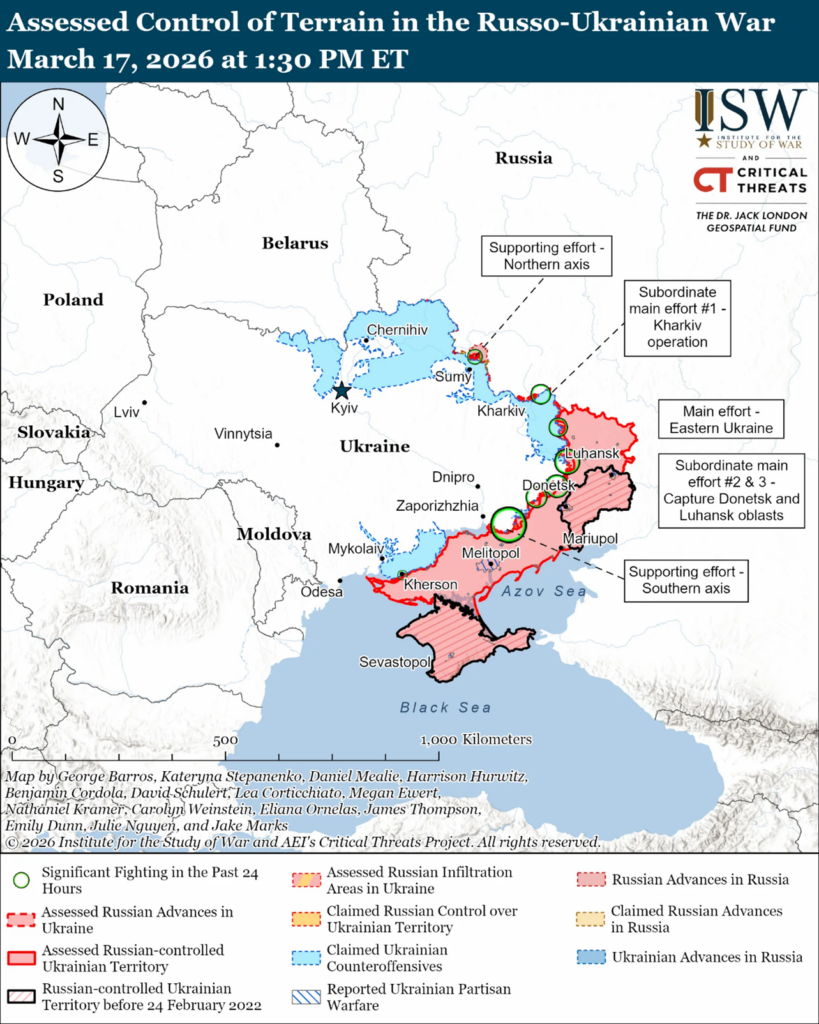
Hence, as most of the Western attention is being shifted from Ukraine to the Middle East, the political and diplomatic pressure on Russia would be weakened, and media attention would be re-centred on the developments in the Middle East, weakening international mobilisation around Ukraine. Russia, in this case, is in no rush to resume peace talks, as it has the opportunity to intensify its operations in Ukraine and advance on the ground in order to maintain the upper hand when negotiations are resumed.
Ukraine Changing the Game in Drone Warfare
Ukraine could provide tech assistance to its allies in the Middle East in exchange for U.S. defence systems supply to leverage its position in its war with Russia. The Iran war has exposed an issue with the American air defence system; the U.S. uses extremely expensive Patriot missiles, Terminal High Altitude Area Defence (THAAD) batteries, and Airborne Warning and Control System (AWACS) aircraft to shoot down relatively cheap Shahed drones. This disproportionate cost risks the U.S. running out of weapons faster than the other side.
Washington is now seeking a cheaper alternative, and Kyiv can offer its expertise, especially its experience with Shahed drones during its prolonged war. Ukraine has successfully become able to mass-produce low-cost countermeasures, such as interceptor drones, while constantly modifying and improving them. By playing a key part in developing a needed alternative, Ukraine can negotiate long-wanted U.S. air defence munition deals, notably Patriot missiles and Tomahawk long-range missiles. The country has already been taking serious steps regarding this matter; President Volodymyr Zelenskyy announced sending dispatched drone interceptors and military personnel to Jordan to assist the U.S. military at Muwaffaq Salti Air Base in response to a request from the United States.
In the scenario of a prolonged war, the U.S. may request that Ukraine reassess its previous offer of deploying “drone combat hubs” in the Middle East to address future threats from Iran. Evidence suggests that Zelenskyy previously proposed this idea to Trump as a way to share Ukraine’s low-cost interceptor drone expertise with the United States; however, the Trump administration dismissed the offer at that time. Under these circumstances, Ukraine could negotiate an arm deal with the U.S. and seek substantial financial assistance packages from Middle Eastern countries to meet its war needs.
What about Moscow and Tehran?
Evidence shows that Iran has supplied Russia with Shahed drones in its military operation in Ukraine. Now, Moscow is reportedly producing similar drones domestically and providing Iran with surveillance and drone technology, including components of modified Shahed drone, hence, increasing the potential of a tighter Russian–Iranian military partnership. Additionally, this raises Ukrainian fears of a probable intensified usage of such drones targeting more critical infrastructure and pushing for more concessions in favour of Moscow.
Furthermore, President Vladimir Putin is less likely to pressure President Donald Trump to end the war, prioritising ending the Russia-Ukraine War on the Kremlin’s terms. Additionally, Moscow benefits from the reduced U.S. military support for Ukraine due to its engagement in the Iran war. Nevertheless, Russia will face another threat in the form of Ukraine’s low-cost drone expertise, as it risks more countries deepening their reliance on such technology, and the possible missile and arsenal assistance that Kyiv could leverage in return.
Peace Deal and Washington Nexus
The U.S.-Israel-Iran War could likely affect peace prospects in Ukraine as it could delay the diplomatic initiatives, create bargaining leverage for Russia, and change Western negotiation priorities. The United States is currently focusing on managing its war with Iran, which consumes a huge amount of arsenal and surveillance. Its focus has already been shifted from continuing to mediate the peace negotiations, and as a result, the round of talks has been postponed, stalling the reaching of a settlement for the nearly five-year-old conflict. President Volodymyr Zelenskyy expressed his concern regarding the postponement of a much-needed settlement for his country. The consequences also reach the European countries, which are deeply affected by energy insecurity.
On the other side, the Iran war is likely to affect the White House’s credibility as a mediator and peace negotiator. Because the strikes were initiated by the United States and Israel, while nuclear negotiations between Washington and Tehran had shown initial positive progress. This action is likely to reinforce perceptions of U.S. untrustworthiness and raise doubts about its ability to deliver an effective peace deal.
In sum, the Iran war will undoubtedly affect the Russia-Ukraine war, from shifts in war financing to changing power dynamics in peace negotiations. However, it will not significantly impact the outcome of the war as there are many other factors that shape the dynamics of this conflict. Moreover, the Iran war influencing a Russian ultimate victory is far from certain. Ukraine’s wartime expertise is coming in handy and proving to be highly valuable, as drone warfare could become the decisive factor that strengthens the country’s position and enables it to powerfully bargain on its terms.
References
——. “Russia is supplying Iran with Shahed drones, Zelenskiy says.” Reuters. March 15, 2026, Accessed March 16, 2026. https://www.reuters.com/world/middle-east/russia-is-supplying-iran-with-shahed-drones-zelenskiy-says-2026-03-15/
——. “Zelenskiy says US sought postponement of talks on war settlement, Ukrainian media reports.” Reuters. March 14, 2026, Accessed March 16, 2026. https://www.reuters.com/world/zelenskiy-tells-ukrainian-media-us-sought-postponement-latest-talks-war-2026-03-13/
Al Jazeera Staff and Reuters. “Russia the only ‘winner’ of US-Israel war on Iran: EU Council president.” Al Jazeera. March 10, 2026, Accessed March 16, 2026. https://www.aljazeera.com/news/2026/3/10/russia-the-only-winner-of-us-israel-war-on-iran-eu-council-president
Caputo, Marc, et al. “Exclusive: U.S. dismissed Ukraine deal for anti-Iran drone tech last year.” Axios. March 10, 2026, Accessed March 17, 2026. https://www.axios.com/2026/03/10/us-ukraine-anti-drone-offer
Gabuev, Alexander. “How Is the Iran War Affecting Russia? With Nicole Grajewski and Sergey Vakulenko.” Podcast audio. Carnegie Politika. March 12, 2026, Accessed March 17, 2026. https://carnegieendowment.org/podcasts/carnegie-politika-podcast/iran-war-russia-influence
Gramegna, Adam. “America’s ongoing quest to stop firing $4 million missiles at $30,000 drones.” We are The Mighty. March 2, 2026, Accessed March 17, 2026. https://www.wearethemighty.com/tactical/us-iran-counter-drone-tech/
Grove, Thomas, et al. “Russia Is Sharing Satellite Imagery and Drone Technology With Iran.” The Wall Street Journal. March 17, 2026, Accessed March 18, 2026. https://www.wsj.com/world/russia-is-sharing-satellite-imagery-and-drone-technology-with-iran-0dd95e49
Horncastle, James. “Iran war is already bolstering Russia in Ukraine.” Asia Times. March 10, 2026, Accessed March 17, 2026. https://asiatimes.com/2026/03/iran-war-is-already-bolstering-russia-in-ukraine/
Katz, Mark N. “Russia gains from Iran war but risks more if it drags on.” Iran International. March 13, 2026, Accessed March 17, 2026. https://www.iranintl.com/en/202603126816
Lawal, Shola. “What are the Ukrainian drone interceptors sent to counter Iranian attacks?.” Al Jazeera. March 10, 2026, Accessed March 17, 2026. https://www.aljazeera.com/news/2026/3/10/what-are-the-ukrainian-drone-interceptors-sent-to-counter-iranian-attacks
McHugh, David. “U.S. lifts sanctions on Russian oil already loaded onto tankers, equal to 5-6 days’ worth of normal shipments through the Strait of Hormuz.” Fortune. March 14, 2026, Accessed March 17, 2026. https://fortune.com/2026/03/14/us-sanctions-russian-oil-tankers-crude-prices-shipments-strait-of-hormuz/
McLeary, Paul, et al. “Ukraine’s US air defenses are at risk in Iran war.” Politico. March 11, 2026, Accessed March 17, 2026. https://www.politico.com/news/2026/03/11/iran-war-ukraine-air-defenses-00823935
 1
1

Related Articles
Diplomacy without Resolution: What Comes After the 60-Day Deadline?
Closure Upon Closure: The Potential Impact of Houthi Threats to Saudi Shipping at Bab al-Mandeb
How Wartime Purges Are Reshaping U.S. Military Doctrine?

The Implications of the April 2026 U.S.–Iran Ceasefire on Oil Prices
Defence Economies at War: National Budget Stress
Comments